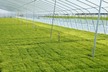


In greenhouse construction, some choices come disguised as line items, and sidewall height is one of them. On paper, it's just a number—7'6″, 10′, 13′. However, that number has a ripple effect. It dictates what can be grown, how well the environment performs, and how adaptable the facility is five, ten, even twenty years from now. Once it's set in concrete and framed in steel, it's not easy—or cheap—to change.
This scenario played out during a major design-build project at Michigan State University. What they decided to do—and how they did it—provides a blueprint for how commercial growers should be thinking today: not just in terms of crop cycles or current layouts, but in terms of long-term adaptability.
From low ceilings to high expectations
For decades, MSU ran research greenhouses with 7'6" sidewalls. That made sense in the 1950s. It doesn't anymore.
In their new build, they went with 13-foot walls across multiple zones. That one decision opened the door to full-height nursery crops, tall-stemmed research varieties, advanced HVAC strategies, and LED arrays mounted where they can actually do their job. As Mike Dougherty of Winandy Greenhouse put it, "They can grow corn, they can grow tall nursery crops—anything they want to do inside there."
It's a future-facing decision. Not a what-do-we-need-now question, but a what-will-we-wish-we-had conversation.
What's the real impact of taller walls?
Tall greenhouses breathe better. Simple physics. Heat rises, and with more vertical room, hot air can stratify above the canopy instead of hovering over it. That buffer zone gives you more stable temps, fewer microclimates, and better propagation or flowering performance. It also means more thermal inertia—your environment doesn't swing as wildly with outside conditions.
Today's LED systems are precise tools. But without height, your mounting and distribution options get cramped—literally. Taller walls allow you to fine-tune your angles, spacing, and uniformity, especially for crops that grow vertically. That means fewer hot spots, better canopy penetration, and less reliance on shading systems to keep your spectrum in check.
Low ceilings limit your playbook. Vine crops, trellised ornamentals, corn, even basic vertical racking—none of it works in a short structure. Go higher, and you open the door to mechanized booms, mobile benches, multi-level lighting arrays, and future upgrades you haven't thought of yet. That kind of flexibility isn't a luxury. It's insurance.
Retrofitting height is brutal. It means shutting down production, cutting concrete, possibly rerunning utilities. You don't want to do it. You want to build once—and build smart. Most greenhouses have a 30–40 year design life. Sidewall height is the kind of decision you feel the entire time.
What about the engineering?
Yes—going taller changes the math. You've got to recalculate snow load, wind load, curtain drops, HVAC sizing, the works. That's where our team at LLK steps in. We collaborate with structural engineers, glazing partners, and MEP consultants early—before the slab is poured—so everything downstream stays aligned.
That includes snow/wind loads matched to site conditions, glazing compatibility (poly, insulated panels, etc.), recalibrated curtain systems (blackout, shade, energy) HVAC design for taller zones and vertical air management.
Raising the roof means touching every system. If you plan it right, that's an opportunity.
For more information:
LLK Greenhouse Solutions
Tel: 440-236-8332
[email protected]
www.llklink.com