

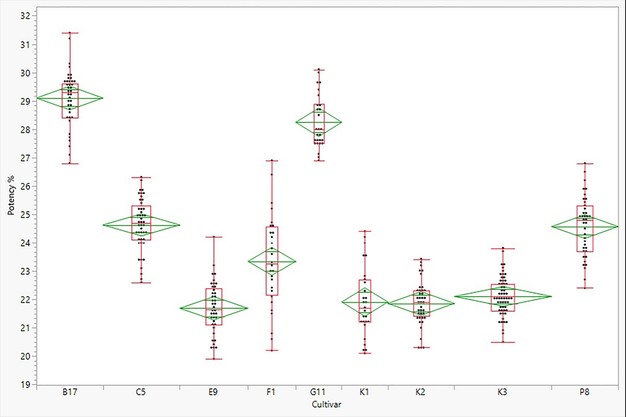
The cannabis industry's long-running hunch that THC levels aren't uniform has now been confirmed by science. In new peer-reviewed research by Pure Sunfarms, a Village Farms International subsidiary, published in Scientific Reports (part of the Nature Portfolio), the Canadian company has quantified what growers have known for years: potency is variable not only within a batch, but even within a single plant.
Data from the paper demonstrates that approximately one in three total THC measures tested is actually representative of the batch's average total THC, with current labelling practices showing just one possible total THC value. The findings add weight to calls for THC labelling reform in Canada and could influence export markets where accuracy is tightly regulated. "A single number is no longer defensible," says Orville Bovenschen, President, Village Farms Canadian Cannabis. "THC levels naturally vary, even within a single plant. Flower variability is measurable and entirely expected in every agricultural product, and our labelling standards should reflect that."
 © Pure Sunfarms
Regulatory pressure and opportunity
Orville says the company is now advocating for THC ranges based on real batch data, which is the standard in many agricultural and natural health products, but rare in cannabis. The company has already started discussions with Health Canada and industry partners, pointing to growing receptiveness as science builds the case. "Our focus now is to sit down with industry partners and regulators to determine how best to apply these insights in a meaningful way. We want to ensure any shift brings clarity for consumers and practicality for producers. This research gives us a strong foundation to guide those discussions."
"Cannabis is an organic matrix, and variability is inherent," he adds. "But unlike other consumables, it contains a psychoactive compound, which makes accurately reporting that variation not just important, but essential for consumer understanding and responsible use."
Sorting won't solve it
The study hasn't pushed Pure Sunfarms to overhaul cultivation or post-harvest sorting, partly because, as Orville puts it, "there's no way to sort your way out of agricultural variability." Instead, the company is focusing on how to translate these insights into labelling standards that serve both consumers and producers.
 © Pure Sunfarms
Global relevance
The research may have its roots in Canadian greenhouses, but its implications stretch into markets governed by EU-GMP rules, where full-plant sampling and batch-level reporting are mandatory. "One should not rely on a top-cola snapshot to represent an entire batch," Orville remarks.
Dialing in the greenhouse
Pure Sunfarms continues to trial pruning, feeding, and microclimate strategies to reduce THC swings between top, middle, and bottom buds. Some are already embedded in SOPs, while others remain under evaluation. "That's the benefit of a high-tech environment," Orville says. "It allows us to apply large-scale agricultural discipline to a crop that still has so much to teach us."
For more information:
Pure Sunfarms
[email protected]
puresunfarms.com