

The Federal University of Lavras (UFLA) will be one of the development centers for an innovative project approved by the Academic Cooperation Program (Procad), an initiative of the Coordination for the Improvement of Higher Education Personnel (Capes) in partnership with the National Secretariat for Drug Policies (Senad).
The work, titled "Innovation in the Selection of Cannabis sativa Genetic Materials for Medicinal Use: Near-Infrared Spectroscopy," brings together UFLA, the Federal University of Goiás (UFG), and the University of São Paulo (USP), under the coordination of Professor Patrícia Guimarães Santos Melo (UFG). At UFLA, the coordination is under the responsibility of Professor Vanessa Cristina Stein, head of the Biotechnology Center for Psychoactive Plants (CBPP), affiliated with the Department of Biology and the Institute of Natural Sciences.
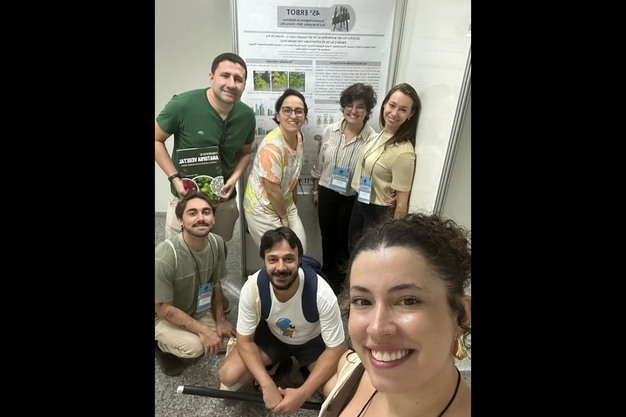 © The Federal University of LavrasThiago Alves Magalhães (Director of ICN), Marinês Pires Lira (Coordinator of PPGBA), Thais Caetano (PhD student), Vanessa Crisitna Stein (Coordinator of CBPP), João Gabriel Reis Martins (IC), Igor Andrade Correio Rohlfs (PhD student), Lilian dos Reis Ronzani (Master's student).
The proposal was one of those selected under joint Capes/Senad call for proposals No. 02/2024, which supports strategic research in the areas of drug policy, human resources training, and scientific development. The central objective is to use Near-Infrared Spectroscopy (NIRS) to develop rapid, accurate, and non-destructive protocols for selecting Cannabis sativa genotypes for medicinal use.
The technology will enable the creation of a detailed database on the phytochemical composition of genetic materials, including in vitro cell cultures . This database will be essential for the standardization of cannabinoid extracts and products, contributing to the safety, quality, and efficacy of the plant's medicinal uses.
At UFLA, the initiatives will involve the work of postdoctoral fellow Diogo Pedrosa Corrêa da Silva and the development of master's theses in the Graduate Program in Applied Botany. According to Professor Vanessa Stein, participation in the project solidifies UFLA's position as a national reference in psychoactive plant research and expands integration with other fields of knowledge. "We have a unique opportunity to unite science, technological innovation, and social commitment to transform the medical cannabis landscape in Brazil," says Vanessa.
The cooperation between UFG, UFLA, and USP ensures the integration of expertise in agronomy, biotechnology, and analytical chemistry. In addition to strengthening Brazil's scientific base, the project has the potential to influence public policy and drive the development of a regulated and safe market for medicinal cannabis products in the country.
Source: The Federal University of Lavras