
When cannabis growers talk about dialing in their lighting strategy, the conversation usually turns to PPFD, spectrum, and efficacy. But under the hood, the interaction between red, blue, and far-red light is doing more than just driving photosynthesis; it's reshaping the way we interact with the plant itself. This process, photomorphogenesis, is where the nuances of spectrum become a crop steering tool for morphology, flower density, and ultimately product quality.
Brian Gandy from Sustainable Terrains, who has spent over a decade working at the intersection of horticultural lighting and crop production, frames it this way: "In agronomy, NPK are your macronutrients, these are the most important and key limiting factors with a reduction in yield or quality. When it comes to light, red, blue, and far-red play a similar role." .
Red, blue, and diminishing returns
The two primary reaction centers, photosystems II and I, respond most strongly in the red and blue ranges. Decades of research, including work by Bruce Bugbee, have quantified their some of their roles. According to Brian, "Bugbee determined that 70% red is the maximum before photobleaching sets in. That's a solid benchmark to work back from. In my experience, for general production, a 2:1 red-to-blue ratio is optimal."
That balance isn't static, however. Too much red without enough blue elongates plants and stretches structure. More blue improves compaction, tighter internodes, and denser canopies. For cannabis, this can translate into meaningful shifts in flower morphology. These are a few of the "known knowns".
Far-red: independent or built-in?
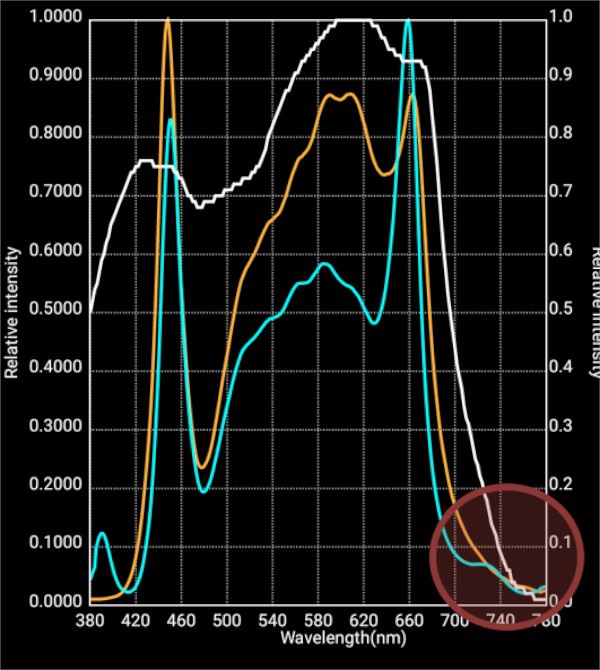
Far-red light complicates the equation. It works synergistically with red through the Emerson effect, but its impact is nonlinear. "As a standard, I prescribe 3–5% far-red in a fixed spectrum," Brian says. "If you have an independent channel, 1–10% is the working range. Go beyond that and you'll see excessive stretch, leaf expansion or reduced quality."
 © Sustainable Terrains
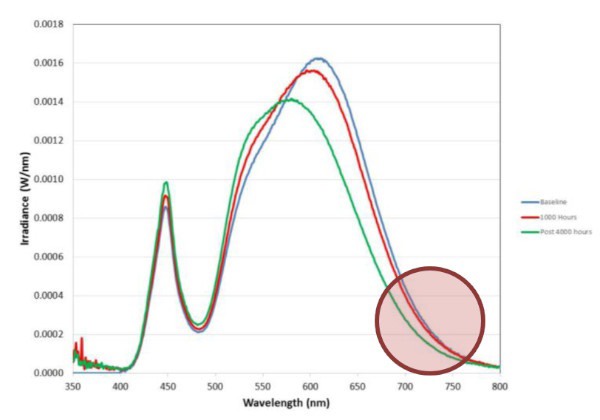
Indoor growers face another layer of complexity: diode design. Many fixtures pull far-red from lower color temperature white chips, which lose efficiency over time as their spectrum drifts back towards their blue foundation. "By year three or four, that far-red component has shifted, and you've lost the balance you thought you had," Brian explains. Dedicated far-red diodes avoid this drift, but come with efficiency trade-offs. In greenhouses, the question is often moot, sunlight supplies plenty of far-red, though some manufacturers still build it in.
 © Sustainable Terrains
Blue for trichome accessibility, not density
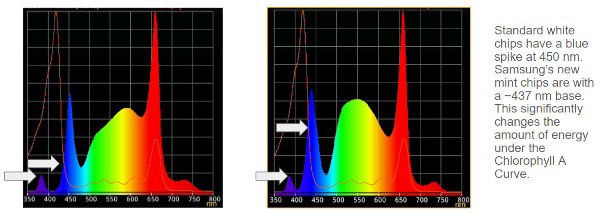
If there's one contentious point, it's trichome density. Hunter Christensen, Founder of Subculture TC and recently graduated with a Masters degree in horticulture, has overseen trials with some of the Midwests' best rosin cultivators, argues that higher blue ratios directly impact trichome quality and accessibility. "With more blue, the canopy is denser and the flower blockier. The flowers are more compressed, and the A-grade fraction for rosin is higher. With a more traditionally balanced spectrum, you get more separation between A and B grade."
 © Sustainable Terrains
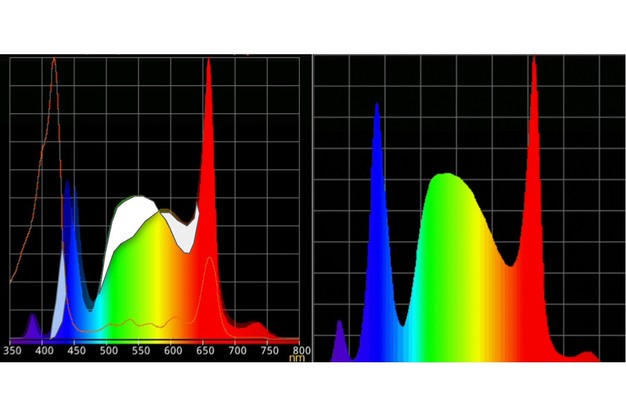
Hunter cites trials with Samsung's mint spectrum chips, which lean blue, as producing consistently compact flowers with improved yields per square foot of usable rosin-grade material. Brian, however, is more cautious: "In my opinion, trichome density is genetic. You're not going to make a flower put out more trichomes per area with light. What you can do is influence morphology, optimize how flowers stack, how dense they are, and let existing trichomes express their full potential.." In practice, both points converge: spectrum won't override genetics, but it can push morphology in ways that favor trichome harvestability.
 © Sustainable Terrains
Under-canopy lighting: more nuance than mmol/J
Another frontier is under-canopy lighting. Here, spectrum balance becomes even more critical. "Red and far-red penetrate deeper, so the temptation is to just blast those wavelengths from below," Brian notes. "Hot take here, but there's already red and far-red transferred deeper into the canopy. A more blue dominant spectrum may give better results."
Sustainable Terrains is preparing trials where under-canopy fixtures emphasize blue light to rebalance what lower leaves actually receive. "The under-canopy market feels rushed, like LED did in its early years," Brian adds. "The ROI and agronomy need more work before we can say what's truly optimal."
Vertical and spectrum as system design
In vertical setups, spectrum interacts directly with architecture. Blue-leaning spectrums help maintain compact plants, creating denser canopies in short spaces, while far-red can be used sparingly to stretch when needed. Both Brian and Hunter emphasized that spectrum strategy isn't just about diode selection, it's about integrating crop steering into the cultivation system as a whole.
As Hunter puts it: "For rosin, you're not chasing total trichome count, you're chasing the best trichomes, harvested in the right window, and in a morphology that makes them accessible. That's spectrum's role."
Light is one of the 10 Cardinal inputs for hitting goals: yield, quality or harvest window. We now have some tools coming to market that can let us optimize plant response further and we are seeing some solid results for solventless extract applications.
For more information:
Sustainable Terrains
Brian Gandy
[email protected]
www.sustainableterrains.com