
Carrying out an LED retrofit of an entire cannabis cultivation facility is certainly a particularly daunting task, albeit necessary at times. There's always the looming risk that planning and execution mistakes lead to higher operational costs, lost efficiency, or even damage to the crop. "The decision-making process needs to happen at the system level, not just at the fixture level," says Matteo del Ninno, co-founder and CTO of JumpLights.
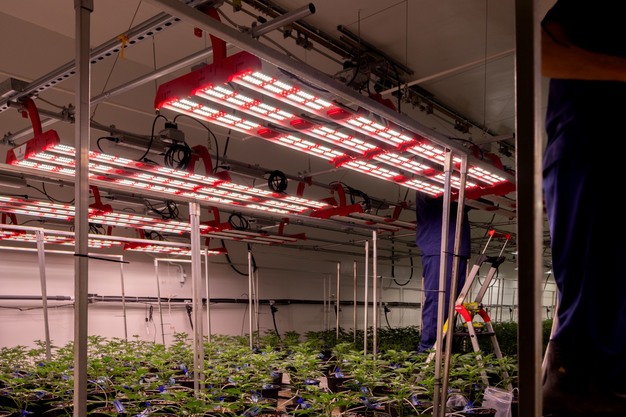
According to Matteo, one of the most frequent errors in retrofits is choosing fixtures without considering efficiency, spectrum, and layout as part of a bigger picture. "You don't just select a fixture, you select an intensity target, you look at DLI, you think about the risks of photo bleaching, and only then do you choose the right spectrum," Matteo explains. High uniformity and avoiding hotspots are critical, especially as growers consider pushing crops under higher PPFD.
 © JumpLights
The heat load trap
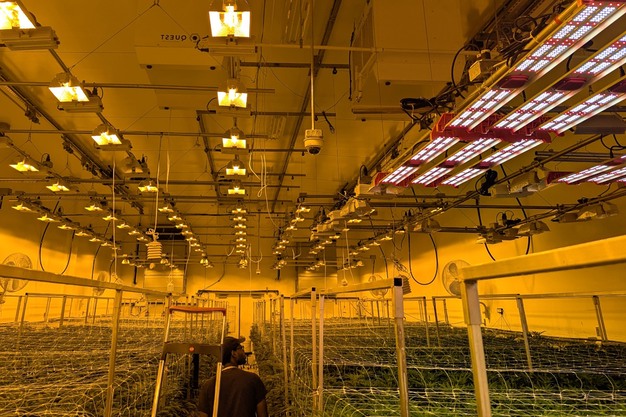
Growers switching from HPS to LED may underestimate how much the system around the light changes. "We've seen people move from 100 kW of HPS to 60 kW of LED to match the same intensity. The room's heat load changes, so suddenly the HVAC isn't kicking in as often, and people find themselves running strip heaters or dehumidifiers more aggressively. That means extra energy costs," Matteo says. Matching light power and heat load across the system is essential to prevent hidden inefficiencies.
Leaf surface temperature is another detail that can catch cultivators by surprise, Matteo points out. HPS fixtures emit infrared radiation that, while not photosynthetically active, keeps leaf tissue warmer, whereas LEDs don't. "It's a small but important factor," he remarks. "You may need to adjust room temperature settings to compensate."
 © JumpLights
Designing with the plant in mind
Retrofits are not only about replacing lights, but also about rethinking crop strategy. Under canopy lighting, for instance, can deliver strong returns. "It's one of the best bangs for your buck," Matteo says. The spectrum under the canopy is especially important: more blue light can help tighten flowers and improve density, morphing so called C buds into As and Bs .
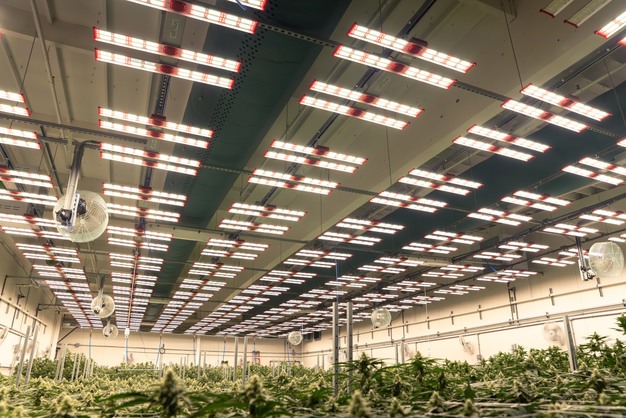
System design also extends to fixture placement. Matteo believes that more distance from the canopy allows fixtures to spread light evenly, reducing hotspots. "Photons are photons, and they don't lose energy with distance." Be careful of too much distance, though, because it can allow photons to be lost to the walls or other unproductive surfaces. That's why Matteo says that reflective surfaces can minimize photon loss. "The more reflective and uniform your environment, the more of those photons reach the plant."
Balanced spectrum vs. dynamic spectrum
Spectrum is another common pitfall in retrofit decisions. While dynamic spectrum fixtures, those with multiple diode types that can be dimmed or switched, can provide flexibility, they often come at higher cost. "The reality is, at high light intensity, spectrum shifts have less impact. A well-balanced white spectrum with strong red. green and blue components is often the more cost-effective choice, unless you're specifically chasing certain quality outcomes," Matteo says.
 © JumpLights
Holistic approach
For Matteo, successful retrofits start with understanding the grower's infrastructure and goals. "Every facility is unique. Are you growing for cost efficiency or for quality? What genetics are you running? The answers change the design. We don't just provide fixtures, we bring system design expertise from biosystems engineers, ag engineers, and people with cultivation backgrounds. That's how we help growers avoid costly mistakes."
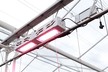
JumpLights' fixtures themselves, lightweight, high-efficacy, and designed for both top and under canopy use, are part of that approach. But Matteo emphasizes that service and technical support are equally important. "Retrofits succeed when someone can look at the system holistically and make sure the grower gets the right outcome. That's what we focus on."
For more information:
JumpLights
www.jumplights.com