

Genetics is the foundation of any cannabis operation. It's no wonder that many growers boast in-house breeding programs. Breeding, however, it's certainly not an easy game. Phenotyping is always carried out with a clear goal in mind, to select those traits you want in your plants. This has been the focus of a recent study in Crop Science, where researchers developed a phenotyping method with image segmentation to study inflorescence size and compactness. They have applied this method to examine the undesirable indeterminate characteristic, such as foxtailing. Their findings suggest it's possible to genetically control foxtailing, evidenced by multiple varieties displaying the trait in differing environments.
Some varieties like their comfort zone.
Not all cannabis plants are equally adaptable. While some varieties performed consistently across both highly controlled and variable greenhouse environments, most others had clear favorites. One, for instance, thrived in a controlled environment setting, whereas another one shone in the variable greenhouse.
 © Eric Limon | Dreamstime
Foxtailing
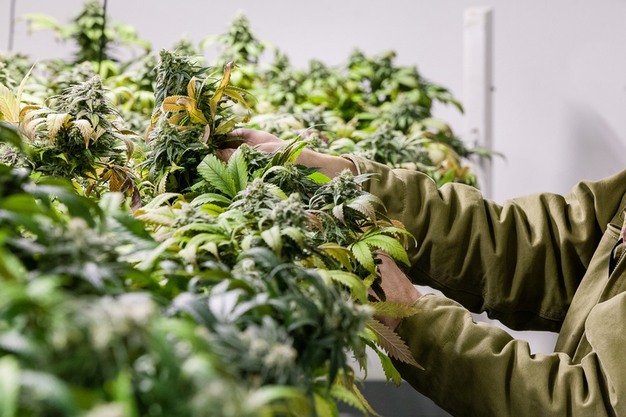
"Foxtailing" indicates floral clusters becoming loose and spindly. More prevalent in variable conditions, the study shows it's mostly cosmetic. Even loose buds maintain mass, and image analysis confirmed that area, solidity, and perimeter are still reliable predictors of yield. In other words, foxtailing isn't a tragedy, it's just the plant responding to its environment.
Yield
Across the board, Δ9-THC–dominant varieties outperformed CBD chemotypes in apical inflorescence yield, no matter the environment. At the same time, environmental factors often push THC-rich plants to show off, but that can come at the cost of uniformity.
Heritability
Vegetative traits like plant height and stem diameter showed moderate-to-high heritability, meaning breeders can reasonably select for these. Reproductive traits like inflorescence weight, density, and structure were less heritable but more stable, likely due to evolutionary constraints. At the same time, individual inflorescence weight is highly heritable and strongly correlated with total yield. Breeders who target this could reliably increase flower production without battling foxtailing.
Environment rules
The study highlights how much the environment can override genetics. Variable conditions suppressed vegetative growth but boosted reproductive growth, a likely survival tactic to maximize pollination in challenging conditions. Humid environments promoted looser flowers, while arid conditions favored compact clusters. Understanding these nuances can indicate those varieties that can thrive in specific cultivation setups.
So what?
Cannabis yield and quality aren't written in the plant's DNA alone. Image analysis provided actionable insight. By measuring area, solidity, circularity, and perimeter, growers can identify foxtailing early, optimize harvest timing, and guide selective breeding. Research suggests once more how crucial is to understand the cultivation environment, and how equally crucial genetics selection is.
Source: acsess.onlinelibrary.wiley.com