

In the first part of this series, we looked at dynamic DLI targeting and how cannabis plants count photons over time. But photons don't just differ in quantity, their quality matters, too.
When we talk about dynamic lighting, it's important to separate dynamic DLI from dynamic spectrum. They're related, but not the same: you can adjust DLI without touching the spectral mix. Dynamic spectrum, on the other hand, is about tailoring the light recipe to a crop's growth stage and cultivar-specific tolerance. As Theo Tekstra from Fluence puts it: "Every spectrum decision is a money game, and a risk management game."
More light, more yield? Not so fast
Cannabis' response to light isn't endlessly incremental. At some point, the curve flattens out. "You can put in 10% more light, but you won't get 10% more yield," Theo explains.
Where that plateau lies depends heavily on genetics and on getting the basics right first: temperature, CO₂, humidity, nutrients. Only then does spectrum really enter the picture. "By contrast, in The Netherlands tomatoes and cucumbers are typically lit at relatively low levels (200–350 µmol/m2/sin greenhouses), where yield still scales linearly with light. Push them harder, and the economics fall apart. Cannabis, meanwhile, is a money crop, lower volume per square meter, but far higher value, so the thresholds and payoffs play out differently," Theo remarks.

Photomorphogenesis
Different wavelengths trigger different plant responses. Short wavelengths such as blue keep plants compact, while green and far-red drive elongation and longer internodes. That makes spectrum a tool for morphogenesis: steering plant height, branching, and flowering.
But genetics set hard boundaries. "You won't stretch an Afghan into a haze just by tinkering with red light," Theo points out. "Some cultivars tolerate heavy red loads, others max out quickly. And not all photons come at the same energy cost, some wavelengths are pricier to generate than others. That's where spectrum becomes the money game."
Peaks, dips, and efficiency
Most fixtures today mix red, blue, and white. White LEDs are essentially blue diodes with a phosphor coating that spreads emission across the visible range, still the most efficient way to also create usable green light, for example. Red diodes, meanwhile, are the most efficient LEDs in terms of photon-per-watt output, though also among the most expensive components. That's why cannabis fixtures lean heavily on them.
But red has to be handled carefully. "Push too hard and photobleaching shows up: white tips that might not tank cannabinoid content but definitely dent bag appeal. Extract-focused growers may tolerate it, but for flower production it's a non-starter."
Tailoring the spectrum
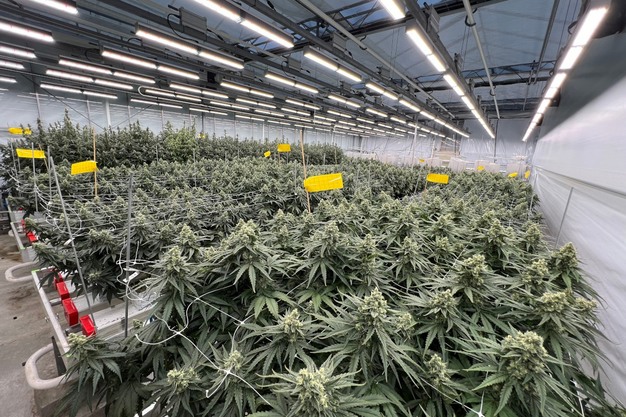
Dynamic spectrum allows crop-specific fine-tuning. A mother plant thriving at 400-500 µmol, for instance, can sit under 80% red without bleaching, though, of course, mothers don't flower, so bleaching isn't even a concern. More red can actually contribute to a higher biomass.
Flowering plants are another story. "Early in flower, before buds form, pushing red can improve efficiency," Theo explains. "Once flowers develop, however, cultivars diverge: some tolerate high red percentages, others are far more sensitive. Indoors, conditions are stable enough to manage this. In greenhouses, sunlight complicates the picture. When the sun provides enough blue and green, growers can lean harder on efficient red, but balance is everything. Low PPFD with high red can be safe, while high PPFD with high red quickly gets dangerous."
 © Fluence Bioengineering
A money game
Spectrum is powerful, but it isn't cheap. Dynamic fixtures require higher upfront investment, plus intelligent controls and the discipline to use them. Mismanage the recipe, and you risk bleaching, wasted energy, or lost yield. Get it right, and the payoff is obvious: Fluence trials in greenhouses showed up to 30% energy savings by shifting to efficient red at low intensities whenever sunlight carried the rest.
"From an OPEX point of view, spectrum is a money game," Theo says. "You can save a lot by tuning it, but you need the infrastructure, the knowledge, and the discipline. If you don't want to invest in intelligent controls, dynamic spectrum isn't for you."
The UV question
Spectrum myths have been floating around the cannabis industry for years, especially the idea that UV boosts cannabinoid and terpene content. But controlled trials show little to no effect on yield or cannabinoid content in high PPFD cultivation. "Though UV light results in a more resilient plant and hardens the plant, the only clear effect is that plants stay shorter under UV," Theo says. "And you don't need to add risky wavelengths for that, blue achieves the same thing at lower cost and risk, while also adding photosynthesis."
Green – complexity grows
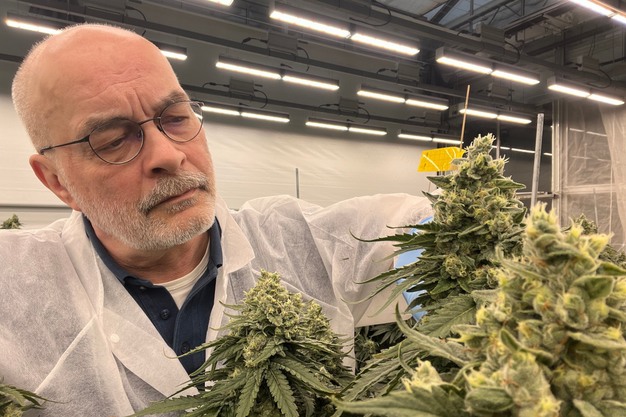
For years, LEDs were sold on the red-and-blue story: that's all plants need. But at high PPFD, the picture changes. Green light gets often dismissed as there's the widespread belief that plants reflect it. "Not quite," points out Theo. "Plants look green because blue and red are absorbed closer to the surface of the leaf, while green is absorbed deeper into the leaf." Some research even suggests that green can drive photosynthesis more efficiently than blue or red in strong white light.
"The complexity grows layer by layer," Theo says. "Many growers already find it challenging to deliver the right PPFD and manage photoacclimation. Add spectral control on top, and you need full insight and precision, there's no room for mistakes."
 © Fluence Bioengineering
Dynamic spectrum is no silver bullet. It's a lever, powerful if you know what you're doing, expensive if you don't. "The level of control and understanding of your cultivation needs to be top notch," Theo warns. "You must know when your cultivar reaches its red-light ceiling, at which stage to tweak the recipe, and so on."
Used with discipline, dynamic spectrum can cut energy costs, tighten control, and even improve quality and yield. Without that discipline, it's just an expensive extra layer of complexity. "Fluence can help you by providing baseline recipes and tune these to your needs and specific situation," he concludes.
If you want to learn more about applying dynamic spectrum recipes, please check out the webinar we organized about this subject recently. You can find it here.
For more information:
Fluence
fluence-led.com