

The eyes of the horticulture world are currently shining on the substrate industry. Supplies of peat are at what experts call a "historic low," and even coconut fiber is scarce at the moment. At the same time, the market is in transition, working toward a higher share of renewable raw materials in substrates to reduce environmental impact.
At RHP, the European knowledge center for substrates, this increased attention is easy to notice. Media requests are piling up, and good communication has become more important than ever, say Marco Zevenhoven and Martine Holtkamp of RHP.
The knowledge center is based right next to the greenhouses of Geest Potplanten in 's-Gravenzande in the Westland area. In other words, they are at the heart of the horticultural sector, close to the growers themselves, and deeply involved in the substrate market. For instance, RHP recently attended the Baltic Peat Producers Forum in Latvia, and its technical advisors regularly visit or speak with the 76 certified companies that are part of the RHP network worldwide.
Although the shortage back in 1998 was even more severe, today's situation is still a clear sign of pressure in the market. For crop advisor Ruud den Dulk of Horti-Scan, this is reason enough to remind growers of their own responsibility. For RHP, it is the right moment to show the industry how substrate quality is monitored and safeguarded, even in times of transition.
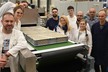
 © RHPMartine Holtkamp and Marco Zevenhoven
Properties
With peat supplies running low and coconut fiber becoming scarce, growers can expect to see more mixes made with alternative raw materials, according to the Dutch Association of Potting Soil and Substrate Producers (VPN). "That means substrates may start to look different and sometimes behave differently in use," the association cautioned in a recent press release.
Marco, operational director at RHP, also points to these changes. "It's not about the recipe of a mix, but about the properties," he explains. And when those properties change, cultivation practices often need to be adjusted as well. In practice, that is where things sometimes go wrong. Marco has seen plenty of examples. In cases where damage occurs, RHP's expertise can be called upon to investigate and advise.
To help growers and substrate producers work more effectively with renewable raw materials, RHP introduced, in Dutch, a "Roadmap and Opportunities Guide for Renewable Raw Materials" at the end of last year. The goal is to expand practical knowledge and make the transition smoother for the entire industry.
New renewable raw materials
Renewable raw materials are already becoming a regular part of substrate production. Within the Convenant Milieu-impact Potgrond en Substraten, for the Dutch market (Covenant on Environmental Impact of Potting Soil and Substrates), clear agreements have been made about their use. With the Dutch professional market now reaching a 33 percent share of renewable raw materials in 2024, the covenant is well on track to achieve its 35 percent target for 2025.
It's the substrate producers who work with these materials on a daily basis, often in close cooperation with growers, driving innovation together. RHP supports this process through its RHP Innovation Support program. "We've seen a sharp rise in requests for this support recently," says Marco, operational director at RHP.
Under strict conditions, RHP companies are allowed to experiment with raw materials that are not yet RHP-certified. Examples include biochar and miscanthus. If research shows that these materials are both promising and sufficiently available, they may eventually be added to the list of certified raw materials.
At present, RHP certification for professional horticulture covers 16 raw materials, in addition to finished substrates. Well-known examples include peat and coco, but also compost, wood fiber, and perlite. Materials like biochar and miscanthus are not yet certified, as there is still too little knowledge about their practical performance. Work is ongoing to fill these gaps.
Package insert
Every quarter, RHP organizes a webinar for certified substrate companies to share knowledge. But in practice, Marco and his colleague Martine notice that the information held by substrate producers does not always reach the grower, the end user. Marco points to some materials known to immobilize nitrogen. "If growers know that, they can simply adjust by adding extra nitrogen during the first few weeks of fertilization."
The challenge is that many growers aren't aware of these details. To bridge this gap, RHP wants to help substrate producers communicate more effectively with their customers. In the long run, the idea is to provide a standard "instruction leaflet" with every delivery of substrate or potting soil. "This would give growers clear information about the specific properties and points of attention for their particular mix," explains Martine, RHP's general director.
 © Horti-ScanCrop advisor Ruud den Dulk of Horti-Scan welcomes the idea, even calling it "a kind of plant passport for substrate materials." With renewable raw materials playing a bigger role, such a leaflet could be a valuable tool. For now, though, the concept is still in development. "Despite the pressure, we want to proceed carefully," Martine emphasizes. "We never compromise on quality or safety."
Photo right: Ruud den Dulk, Horti-Scan, advises growers to intensify their input control.
Analyses
Where growers used to work with peat and perhaps one additional raw material in a substrate mix, it is now increasingly common to find two or more alternatives alongside peat. "That makes things more complex and requires both knowledge and proper quality assurance," acknowledges Marco.
For Ruud, who has been in the field for some time, today's situation brings back memories of when peat often came from many different sources, and quality could vary. Back then it was all about peat, but today the challenge lies in the much wider diversity of raw materials. He urges growers to pay close attention to the quality of the substrates that enter their greenhouse, to ask about the origin of the raw materials, and to request analysis results—or, if needed, to take their own samples from the crop. "Personally, I think it's also the grower's responsibility to make sure that information comes to the surface for the sake of their own business."
His call is reminiscent of similar warnings about incoming inspections for pest insects in plant material. The difference, Marco points out, is that with substrates, problems are often invisible from the outside. Proper analysis is essential.
At RHP, sampling is already a standard part of their certification scheme. Yet Marco observes that many growers still don't ask their suppliers for substrate analyses, even though the option is there and the tests are already carried out under RHP certification. RHP encourages growers to take advantage of this. "Growers can ask their supplier for a chemical and physical analysis. With that knowledge, they can fine-tune their cultivation strategy if needed."
Such analyses provide insight into EC, pH, and trace elements in a substrate, but also into WOK (water uptake characteristics). "That's still a somewhat overlooked factor," Marco notes, "though we're seeing more and more large companies already working with it."
Safeguarding quality
One piece of straightforward advice RHP gives growers during this period of transition is to stick with RHP-certified products and suppliers. Market shortages are tempting new players to step into horticulture, but Marco has seen what happens at trade shows: plenty of coco suppliers on display, while only a handful are actually RHP-certified. "We monitor the certified companies. With non-certified suppliers, the quality of their product is simply unknown."
Due to the shortage of peat, RHP is introducing a temporary protocol to make more peat available under controlled conditions. Certified suppliers can apply to RHP for so-called batch inspections. This extra layer of sampling and control will apply until June 1, 2026. "The sector still needs peat," says Martine. "We have extensive knowledge of peat, and this approach allows us to maintain oversight on quality and safety."
For other raw materials, however, such a protocol is not directly applicable. Sometimes it's because too little is known about the material, and in other cases, the issue is availability. "You can't just build a new factory for wood fiber overnight," Marco explains. "The factories that exist will already be running 24/7 to keep up with demand."
 © RHP
© RHP
For more information:
RHP
[email protected]
www.rhp.nl
Horti-Scan
[email protected]
www.hortiscan.nl