

Vapor pressure deficit, or VPD, is one of those topics in cannabis cultivation that everyone talks about, but hard data is still thin. The concept itself isn't the problem, though there's always more to learn, the real issue is controlling it. In drying and curing, companies like Cannatrol have already shown that vapor pressure can be managed with precision. In cultivation, though, it's a whole different story. Constant swings, especially when lights flip on or off, make it nearly impossible to keep VPD steady throughout the cycle. Growers have had to work around that reality for years, bracing for humidity spikes during light ramp-down. But what if VPD could actually be kept stable?
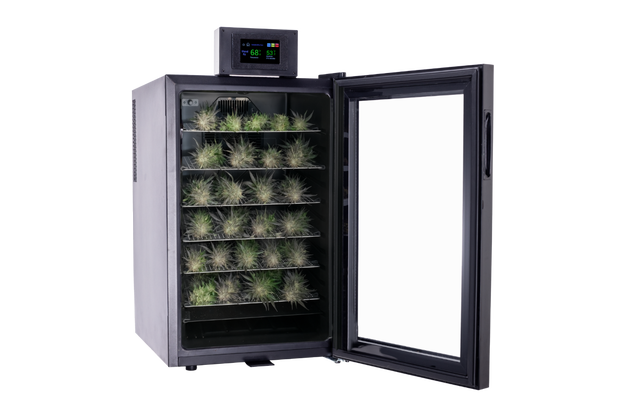
As mentioned, Cannatrol has built its reputation on post-harvest precision. Its drying and curing systems introduced stable vapor pressure control control into a process long dominated by anecdotal science. Now the company is taking the same approach to cultivation, zeroing in on vapor pressure control.
"Plants are essentially differential pressure devices," says CTO/ founder David Sandelman. "They are constantly releasing water vapor through their stomata as a byproduct of photosynthesis. Plants may transpire excessively if the vapor pressure difference between the room and the leaf is too high, which causes more nutrients than can be used to be pulled. On the other hand, if the vapor pressure difference is too low, moisture lingers around the leaf surface, promoting mold and microbes. The goal is to maintain a steady VPD between the leaf and the room."
 © Cannatrol
What VPD really means
At the leaf surface, water vapor is produced as a natural byproduct of photosynthesis. The surrounding environment, has a specific dew point which is another way of expressing vapor pressure. The difference between the two is the VPD. David points out that traditional grow room symptoms like "overfeeding" or "underfeeding" often mirror what VPD stress looks like. "When a grower describes those symptoms, and I ask about VPD, they line up," he explains.
The photoperiod problem
Managing that balance isn't easy with standard equipment. Light cycles, in particular, wreak havoc on consistency. "Lights contribute a huge amount of sensible heat into the room," David explains. "When they shut off, that heat source disappears, and the air conditioning turns off since it is no longer needed for cooling. The amount of water that can be retained by warm air is quite substantial, which is why relative humidity spikes when temperature drops."
When that happens, dehumidifiers usually kick in thus removing that water, while simultaneously releasing heat as a byproduct. That cause the air conditioning to go on again. All of that creates a sort of never-ending cycle of AC cooling the room, making humidity rise, which activates dehumidifiers again, all the while plants just sit there, caught in the swings.
Standard air conditioning units, David notes, typically have a fixed ratio of sensible heat (cooling) to latent capacity (moisture removal). They can't adjust to the shifting demands of a cultivation room moving from photoperiod to dark cycle.
A different approach
Cannatrol's patented system works differently by separating sensible and latent capacity. "When we put our system in a grow room, it can shift its capacity as needed," David says. "During lights-off, for example, the room needs more latent capacity to remove water from the air, not additional cooling. Our system adjusts accordingly, while conventional HVAC can't."
That ability to "flatline" the environment, keeping VPD stable rather than bouncing between extremes, is what convinced early adopters to push Cannatrol into cultivation. Two years ago, a facility in Massachusetts installed the system, and the anecdotal results were strong enough to draw in the Cannabis Research Coalition (CRC) for a formal side-by-side study.
The CRC study aims to put numbers to what has so far been mostly intuition. "Until now, people were guessing at ideal VPD curves for cannabis," David says. "We're trying to establish benchmarks so cultivators can replicate results with confidence."

First results from trials
The trial is still underway, with more data expected in 2025. But the early signals suggest that VPD could be one of the most important variables in cultivation, just as Cannatrol proved control of vapor pressure was in post-harvest.
"If we can prove that consistent VPD control not only stabilizes yield but also enhances cannabinoid development, it shifts the entire conversation," David says. "The industry has always focused on yield first. But quality matters just as much. Stable VPD may be the lever that lets growers unlock both."
For more information:
Cannatrol
www.cannatrols.com