

A new study has looked into how light spectra and defoliation practices affect cannabis morphology and cannabinoid production. Commercial growers usually carry out both, and it's only natural that research catches up with the well known bro science. In fact, results show that both factors shape plant growth in distinct ways, but they do not really interact in a meaningful capacity. In other words, light is obviously essential, defoliation can be at times, but the two do not work as a team, according to researchers.
The research, led by Aaron L. Phillips, tested four LED spectra, broad, blue red white (BRW), blue white (BW), and red white (RW), alongside defoliation treatments in two low THC cultivars of Cannabis sativa: Black Label and Mountain Strong CBD 1. The plants used in the experiment were cloned and grown in CEA conditions. Then, they were measured for architecture, biomass, and cannabinoid yield.
Guiding light
Among the four tested spectra, BRW consistently produced the most balanced outcome. Plants under BRW light showed compact, uniform canopies with stable cannabinoid levels, making this spectrum particularly suitable for space limited indoor setups.
Red white light encouraged vertical stretching, creating tall plants with larger canopies but poorer space efficiency. That led to higher concentrations of CBDA and THC, for instance. BW, on the other hand, made plants shorter and denser, but researchers reported a marked reduction in total floral biomass, which limited overall cannabinoid yield.
In other words, while blue enriched light concentrated potency, it came at the expense of quantity. The BRW spectrum offered a middle ground, delivering both manageable plant structure and reliable cannabinoid output.
Defoliation tells a different story
Fan leaf removal produced mixed results depending on the cultivar. In Black Label, defoliation decreased total flower mass but increased cannabinoid concentrations, particularly CBD, CBC, and THC. In Mountain Strong CBD 1, the same practice increased CBC but reduced CBDA and CBGA.
Across the board, however, defoliation did not improve total cannabinoid yield once the loss in biomass was factored in. The authors note that while removing fan leaves may assist airflow or light penetration, it does not appear to boost overall production and adds substantial labor cost.
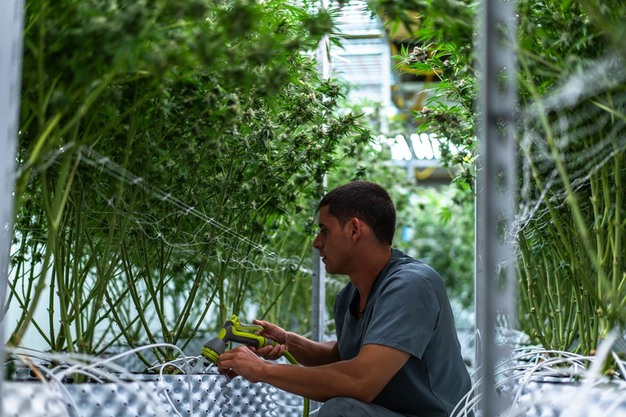 © Olesia Chikova | Dreamstime
Different levers, similar limits
The study found little interaction between light spectra and defoliation, meaning that the two factors influenced plants independently. One of the most interesting things however was that there seems to be a trade off between flower weight and cannabinoid concentration. In other words, the more biomass plants produced, the slightly less potent flowers were. In this case, the blue red white spectrum provided the most efficient compromise between yield, potency, and space management.
At the same time, both tailored spectra and defoliation practices must be adapted to a grower's operation and their goal, as well as the genetics they are growing. As Phillips and his team conclude: "Both light and canopy management strategies must be tailored to specific cultivars and production goals."