


Cannabis research is gaining increasing momentum, and the release of the TILLCANN platform by the Barcelona based Centre for Research in Agricultural Genomics (CRAG) is the latest result of the cannabis science efforts currently going on. "We started working on cannabis in 2019," says Jason Argyris, researcher at the Institute for Agrifood Research and Technology (IRTA) working in CRAG's plant genomics group. "Our idea was theoretically simple but practically challenging: apply the same genomic tools we use on other crops to cannabis. The plant had been left behind by prohibition, but the science doesn't care about stigma. We wanted to look at improving certain traits, disease resistance, flowering time, cannabinoid synthesis, using methods that were already standard in other species."
One of the first projects that is being released to the public is TILLCANN, a platform whose full name, Targeting Induced Local Lesions in Cannabis, sums up its purpose. It is a mutagenesis-based system that introduces targeted DNA changes in cannabis seeds. The result is a population of plants carrying thousands of new genetic variations. "Mutagenesis is not genetic modification," Jason clarifies. "It's been used for decades in crops like wheat or barley. You apply a chemical mutagen to a seed population, provoke random mutations in their DNA, and then study how those changes affect traits. We just adapted that process to cannabis."
 © CRAG
From phenotype to genotype and viceversa
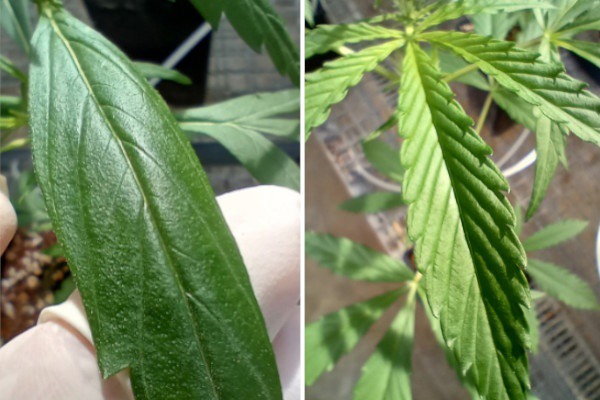
TILLCANN's value lies in what it unlocks. The platform currently includes more than 1,600 lines , with each carrying its own combination of mutations. By screening this population, researchers can connect traits they observe in the field to the genes responsible. "You can go from phenotype to genotype," Jason says. "For instance, you may have one plant that develops yellow leaves. With TILLCANN you can trace that mutation back to a specific gene, from phenotype to genotype. The same reasoning can be done with regards to those genes related to trichome development, or cannabinoid content, and we can study how those mutations affect cannabinoid content."
Although TILLCANN was born in the academia space, its uses are not necessarily for research only. For breeders, TILLCANN could mean a faster route to new varieties with unique chemotypes, stronger resistance to disease, or even improved tolerance to stress factors like salt or drought. "If you find a gene that gives you a better phenotype, you have a valuable asset for breeding," Jason says. "That's where the platform becomes exciting. It's not just about studying genes, it's about creating real-world tools that can be plugged into breeding programs."
There's also another practical advantage: cannabis remains a notoriously difficult plant for in vitro cultivation and genetic editing. "CRISPR is powerful, but cannabis is recalcitrant in vitro," Jason explains. "It's not easy to regenerate plants from tissue culture. The TILLCAN population gives researchers a way to validate gene functions without relying on CRISPR, which is a big deal for cannabis."
CRAG has already used the platform to explore genes linked to powdery mildew resistance, trichome density, and flowering time. Those areas have clear implications for both medical and industrial producers. "We know which genes are responsible for powdery mildew resistance in other crops," Jason notes. "By knocking out the same genes in cannabis, we can create resistant lines. It shows how we can translate knowledge from other species into cannabis improvement."
The platform is publicly available for collaboration, allowing other researchers or companies to license its use or work jointly with CRAG. "We've built not just the population, but also the protocol," Jason says. "A company could come to us and say, 'We want to look at these specific genes,' and we can help them do that. Or they can replicate the methodology and create their own population. Before this, there was basically nothing. Now there's a standard to work from."
 © CRAG
Seeds gaining ground
CRAG's efforts also tie into a broader shift in the cannabis industry, where molecular breeding and seed-based systems are beginning to replace the old reliance on clones and mother plants. "You can see the direction the industry is going," Jason says. "Some companies like already have hybrid seed lines. That's the future. Breeding will move toward seeds, and we want to feed into that to help improve those processes through research, whether it's through doubled haploids, mutagenesis, or other genetic tools."
For CRAG, the next step is to deepen collaboration with both public and private partners. "One of our pillars is private support, but another is building research collaborations," Jason says. "We're open to projects funded by government bodies or international grants, and we're especially interested in connecting with industry players who want to bring genomic tools into their breeding pipelines."
The timing may be right. With Spain taking cautious steps toward medical cannabis regulation and Europe's hemp sector gaining new energy, the environment for scientific innovation is becoming more favorable. "It's an exciting moment," Jason admits. "Physicians can now talk about cannabis in Spain, Germany is moving forward, and we're seeing what could be a domino effect across Europe. There's still a long way to go for companies to embrace genomic tools fully, but the interest is growing. Maybe we're a bit ahead of the curve, but that's where we want to be."
For more information: © CRAG
Centre for Research in Agricultural Genomics
08193 Cerdanyola BARCELONA
+34 935 636 600
[email protected]
cragenomica.es