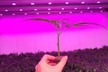

The morphological characteristics of grafting seedlings affect the quality of automatic grafting. Because of the nonuniform and unstable lighting conditions in greenhouses, it is difficult to implement targeted control over seedlings.
In contrast, plant factories are able to cultivate grafted seedlings in a more optimal environment by adjusting environmental factors like light. This research aims to propose an intelligent control method for seedling growth, in order to precisely cultivate seedlings that meet the requirements of different grafting machines. This research established an evaluation method for tomato seedlings (suitable for automatic grafting) and scored seedlings that underwent light recipe transitions at different time points. Based on the comprehensive weighting of tomato seedlings suitable for automatic grafting, combined with the growth data of seedlings under different light environments, six machine learning algorithms were used to establish growth prediction models. The results indicate that the length of the hypocotyl and the diameter of the stem are crucial factors influencing whether the seedling can be mechanically grafted. And the transition of light recipes during cultivation can regulate seedling quality. XGBoost achieved the best accuracy for predicting rootstock and scion growth, with R2 values of 0.9253 and 0.9334, respectively. A smart light control system was established and grafting experiments were conducted.
The results showed that the automatic grafting success rate and post-grafting survival rate of light-regulated seedlings were 8.3% and 1.4% higher than those of commercially available seedlings, respectively. This demonstrates the feasibility of the model and highlights the practical application of the system in precision agriculture.
Wang, Y., Deng, H., Li, H., Mu, Z., Gu, S., & Mu, Y. (in press). A machine learning-based model for the precise regulation of tomato seedling growth for automatic grafting. Frontiers in Plant Science, Section: Sustainable and Intelligent Phytoprotection
Source: Frontiers in Plant Science