

Throughout his career as a crop advisor, Simon Voogt worked with crops grown under both glass and plastic. Now retired and back in the Netherlands, he shares what he has learned about one key factor in propagation: water.
"Water, like sunlight, is essential for life," Simon says. In horticulture, a plant's water need is driven by growth and by transpiration, which increases as plant temperature rises. Most of this heat comes from sunlight. Heat from pipes plays a smaller role. Air movement and humidity inside the structure add to the total water requirement.
Impact on water demand
According to Simon, the single biggest driver of a crop's water demand is the amount of sunlight it receives. In the 1960s and 70s, extensive research on the relationship between radiation and crop transpiration was already being done at the Naaldwijk Research Station. Even today, Simon sees that a great deal of scientific work continues in this field. (2). "It is encouraging that three major research groups, WUR, Plant Lighting and Delphy, are working closely together, so we can expect a lot of detailed insights for greenhouse production in the coming years."
Daily water requirements differ greatly between crops. Variety choice, plant density, substrate type and the chemical quality of the water all play a major role, he explains. And then there are the differences in structures. Whether the propagation area is covered with glass or plastic, whether the crop sits under standard polyethylene or in mesh tunnels, whether screens are used, whether there is a growth pipe between the plants, or if lighting is installed, and if so whether it is LED, hybrid LED-HPS or full HPS. "All of these factors influence water requirements, and the differences can be huge," he says.
Quality of irrigation water
No matter how the water is delivered, whether through overhead irrigation, drip systems or hose watering, the water that reaches the plants must be completely free of diseases and pests, Simon stresses. "It is strongly advisable to have the water thoroughly tested for bacteria, fungi and any possible viruses before using it. This must be done by an accredited and experienced laboratory."
If anything is found, the water must be disinfected very thoroughly before use. "In my experience, the most reliable method is heating the water to 70 degrees Celsius. Above this temperature all bacteria, fungi and viruses are killed, making the water completely safe." Simon adds that due to viruses like Tomato Brown Rugose Fruit Virus, recommended disinfection temperatures may be even higher today.
Besides choosing a good location with a suitable climate for commercial production, the chemical composition of the available irrigation water is extremely important, especially when working with substrates where each plant has only a small root volume. Water should naturally contain low concentrations of sodium (Na+) and chloride (Cl−). In a limited root zone, these ions accumulate quickly to levels that reduce production and cause financial loss. "Sodium levels of 0.5 to 1.0 mmol per litre and chloride levels of 1.0 to 1.5 mmol per litre are acceptable," Simon explains.
Much of the early research into sodium and chloride in irrigation water was conducted by Dr. J. van den Ende and Ing. C. Sonneveld. (3). If the Na or Cl levels exceed the recommended values, the irrigation water should be blended with rainwater, Simon advises. "If this is not possible, then you must first invest in a reverse-osmosis unit to desalinate the water."
Ion exchange
Reverse osmosis has been used for decades in various industries as a way to remove excess salts. Water that contains high levels of specific ions, such as potassium (K+) or sodium (Na+), can be treated using special resin-based ion-exchange systems, lowering those concentrations. Simon has seen this applied many times throughout his career.
"In horticulture, most growers already disinfect their drain water, often using heat, so that it can be reused. This saves large amounts of water and fertiliser and is far better for the environment. However, especially in small substrate volumes and when starting with high sodium levels in the incoming water, sodium can accumulate to unacceptable levels. This leads to reduced production and other negative effects."
Simon points out that in recent years, high-end electrodialysis technology has become available, allowing sodium to be selectively removed. "These systems are already being used successfully at various nurseries, and the treated drain water can then be reused."
 © Simon VoogtSource water with high levels of bicarbonate (HCO3-)
In the provinces of Utrecht, Gelderland, North Brabant and Limburg, where greenhouse production is common, growers often rely on well water, Simon explains. "This well water usually contains acceptably low levels of sodium and chloride, but it is often rich in bicarbonates, the HCO₃⁻ ions."
These HCO₃⁻ ions must be neutralized using acid. This can be done with hydrochloric acid (HCl), nitric acid (HNO₃) or sulphuric acid (H₂SO₄). The amount of acid that needs to be added to the nutrient solution must be calculated very precisely by qualified specialists, and depends entirely on the bicarbonate concentration present in the well water.
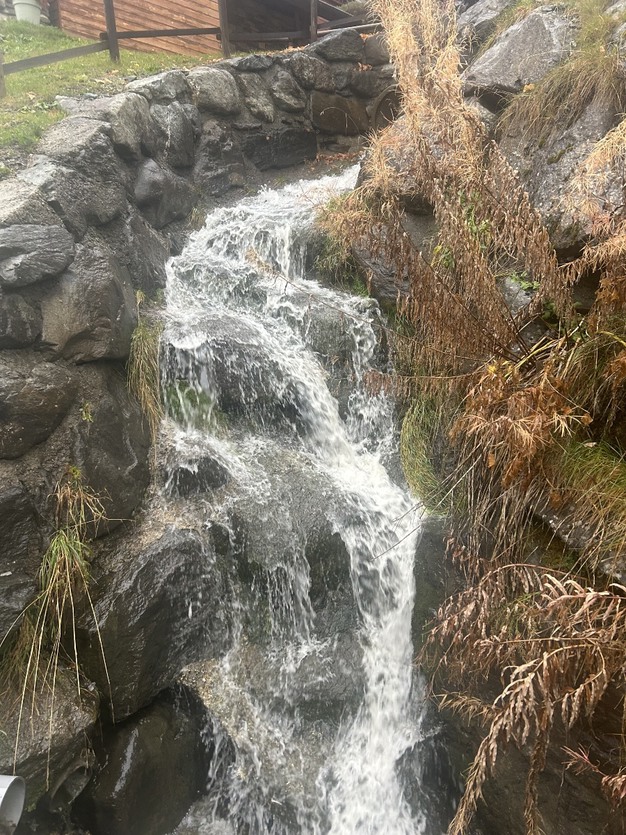
Photo on the right: Waterfall in the French Alps. Photo by Simon Voogt
Nutrient recipes must be calculated and mixed correctly, especially when using drip irrigation systems, the crop advisor stresses. "If the bicarbonates are not neutralised properly, they will react with the calcium in the water and form deposits that severely clog the drip system. When the nutrient solution is calculated or mixed inaccurately, the pH in the root zone will rise."
A root zone pH above 6.5 reduces the plant's ability to take up key trace elements such as iron (Fe), manganese (Mn) and zinc (Zn), Simon explains. "When these micronutrients drop too low in the leaves, chlorosis develops and the foliage becomes noticeably paler. Crops then assimilate less efficiently, and the balance between assimilation and respiration shifts unfavorably, ultimately leading to lower production."
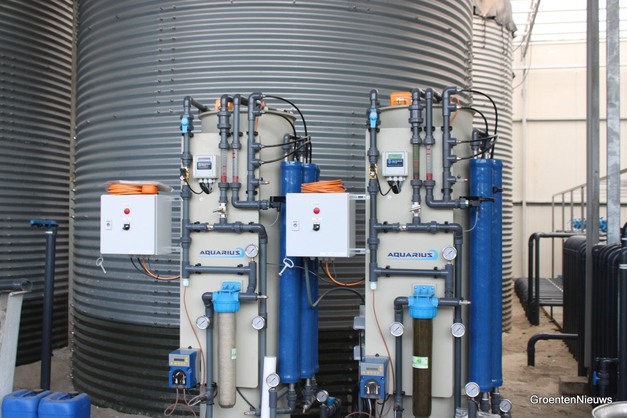 © Thijmen Tiersma | MMJDaily.comReverse osmosis installation, here in an archive image from GroentenNieuws
Clean water
Clean water means keeping biological activity as low as possible, with little to no algae or bacteria, the experienced crop advisor concludes. "Some anaerobic bacteria produce slime, which clogs drippers and leads to very uneven water distribution to the plants."
Dosing hydrogen peroxide (H₂O₂) into the drip water helps prevent blockages, Simon emphasises. "It kills bacteria and, as a nice bonus, slightly increases the oxygen (O₂) content of the drip water. Dust, organic particles and fine sand grains form sludge at the bottom of rainwater tanks, and this must never be drawn into the system."
Everyone knows, he adds, that all water entering the irrigation system must be thoroughly filtered. "And every filter needs regular, proper maintenance. My advice is to replace drip lines after two years of use. This ensures uniform water delivery from every dripper throughout the entire propagation season."
In a previous contribution, Simon discussed the importance of oxygen in irrigation water and shared his practical experiences. He also wrote about sunlight and the role of this natural energy source in horticulture (link in Dutch).
Sources Simon refers to:
2) Proefstation Naaldwijk; Internal reports written by Dr. P.A. de Lint, Ing. G. Hey, Ing. R. de Graaf
- (3) Proefstation Naaldwijk: Internal reports written by Dr. J. van den Ende and Ing. C. Sonneveld