

In controlled cultivation, every detail matters, from light intensity and nutrient balance to humidity and air circulation. But one crucial factor often overlooked is leaf temperature. While most growers closely monitor air temperature, the temperature of the leaves themselves can tell a much more accurate story about how the plant is actually responding to its environment.
Why leaf temperature matters
Leaf temperature plays a central role in plant metabolism. It determines how efficiently a plant photosynthesizes, transpires, and absorbs nutrients. When conditions are right, leaves maintain a temperature that is slightly lower than the surrounding air, usually around 2 to 3°C lower. This difference indicates that the plant is transpiring properly, cooling itself naturally through the evaporation of water.
However, when the leaf temperature rises too high, plants close their stomata to conserve moisture, reducing CO₂ uptake and slowing down photosynthesis. Conversely, if the leaves are too cool, it can signal excess humidity or limited air movement, both of which can reduce nutrient uptake and slow growth. Maintaining the ideal leaf temperature is therefore essential for a balanced and efficient growing environment.
The science behind leaf temperature
Leaf temperature is a reflection of the balance between light, humidity, airflow, and transpiration. When light intensity or radiation is high, the plant's surface warms up. If the humidity is too low, transpiration increases rapidly, potentially drying the plant out. On the other hand, high humidity restricts transpiration, causing the plant to overheat internally.
This balance is captured in the concept of Vapor Pressure Deficit (VPD), a key parameter in climate management. VPD measures the difference between the moisture in the air and the moisture the air can hold when saturated. It essentially determines how much "pull" the air exerts on the plant to transpire. By managing both leaf temperature and VPD, growers can steer their crops toward vegetative or generative development, a technique widely used in professional cannabis cultivation. Review our article about VPD during cannabis cultivation for more information. Light quality and source type also play a major role in determining leaf temperature. Different lighting technologies, such as high-pressure sodium (HPS) and modern LEDs, emit varying amounts of radiant and infrared energy, directly influencing how much heat the leaf absorbs. Understanding these differences helps growers interpret leaf temperature readings correctly and adjust climate settings accordingly.
What can affect leaf temperature? LED vs. HPS
Growers using legacy technology like HPS typically run in a cooler room compared to those utilizing LED lighting. This is because HPS lamps physically heat the leaf surface through both radiant mechanical heat and heat in the form of light. Radiant mechanical heat is the energy produced by electricity and reflected down onto the canopy from the HPS reflector. Additionally, HPS fixtures emit a high amount of infrared (IR) light, which is absorbed by water in the leaves. This IR radiation can raise the leaf temperature by a few degrees above the ambient room temperature.
Although LEDs also generate mechanical heat, it is typically much less due to lower wattage and efficient heat dissipation through heat sinks. LEDs also lack the infrared spectrum, meaning plants grown under LED lighting must rely more on ambient air temperature for leaf heating. As a result, the climate setpoints, particularly temperature and VPD, must be adjusted accordingly when transitioning from HPS to LED systems.
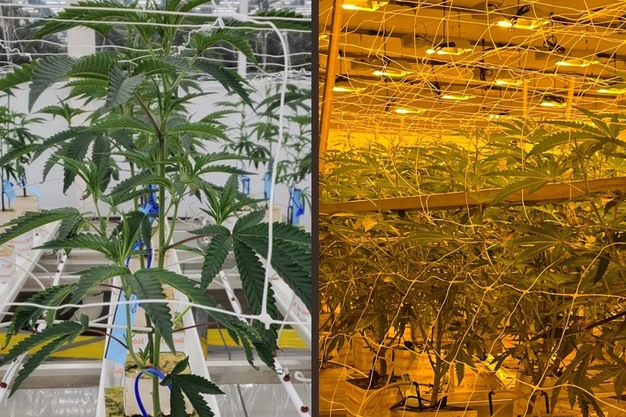 © CultiwoolFigure 1: left - cannabis plants grown under LEDs. Right – cannabis plants grown under HPS lamps
How to measure leaf temperature
Measuring leaf temperature is easier than many growers think. The most common method is using an infrared (IR) thermometer, which provides quick spot readings on leaf surfaces. For more advanced setups, thermal cameras or infrared sensors can continuously monitor large canopy areas, detecting even small variations that might go unnoticed by the eye.
In modern high-tech facilities, integrating leaf temperature sensors into the climate control system allows for real-time adjustments to lighting, humidity, and air circulation. Regardless of the tool used, consistency is key. Meaning, measure at the same canopy height and under stable light conditions for reliable data.
Using leaf temperature to steer cultivation
When growers understand how to interpret leaf temperature data, they gain a powerful tool for optimizing plant performance. For instance, if leaves are consistently warmer than expected, it may indicate that the environment is too dry or the light intensity is too high. Increasing humidity slightly or improving air circulation can bring the leaf temperature back into balance.
If the leaves are cooler than the surrounding air, this could signal that humidity levels are too high, slowing transpiration and nutrient flow. In this case, reducing relative humidity or increasing light intensity can help restore balance. These subtle environmental adjustments allow growers to fine-tune their climate strategy and achieve the ideal growing conditions for each stage of the crop.
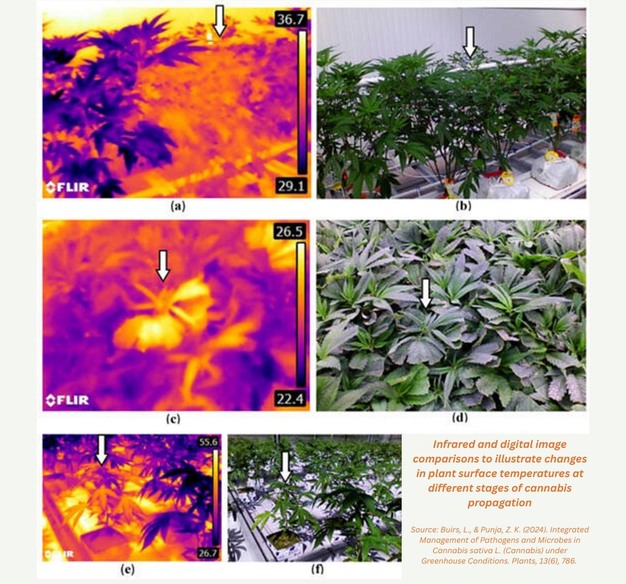 © CultiwoolFigure 2: Infrared and digital image comparisons to illustrate changes in plant surface temperatures at different stages of cannabis propagation. (a,b) A stock plant (arrow) exhibiting a low transpiration rate (and high temperature, in yellow) compared to an adjacent plant with high transpiration (and lower temperature, in purple) shows a difference in surface temperatures that was attributed to infection by a root pathogen. (c,d) A cutting in the center of a tray (arrow) with low transpiration (in yellow) surrounded by cuttings with higher transpiration rates. While the former cutting showed no obvious visual symptoms (d), early signs of pathogen infection and reduced rooting were observed. (e,f) A vegetative plant (arrow) with low transpiration (seen in yellow), among other plants with higher transpiration rates.
Leaf temperature and stone wool cultivation
For growers using Cultiwool stone wool substrates, monitoring leaf temperature becomes even more valuable. Stone wool provides precise control of the root zone, moisture levels, EC, and temperature, but to truly optimize plant performance, the canopy environment must be equally well managed. Leaf temperature completes the picture, helping growers align the plant's root and shoot balance for consistent growth and quality.
By combining root-zone data from sensors (e.g., CARA MET ) with leaf temperature readings, cultivators can make informed, data-driven decisions that directly impact yield, energy efficiency, and plant health. This holistic approach embodies the Cultiwool philosophy, where technology, sustainability, and plant performance come together.
Practical tips for growers
Measure leaves at both the upper and lower canopy to spot microclimate differences, and keep IR thermometers clean and calibrated to ensure accurate readings. Avoid taking measurements right after the lights turn on or off, since the readings can fluctuate. For a fuller view of plant health, pair leaf temperature data with EC, drain percentage, and VPD.
Understanding and managing leaf temperature is one of the most effective ways to improve consistency and yield in cannabis cultivation. It offers a direct window into the plant's health and allows growers to make smarter decisions about climate and irrigation.
For more information:
Cultiwool
cultiwool-substrate.com