


Mars colonization has become a popular talking point, though discussions rarely dwell on who is actually positioned to reach the planet first, and who remains firmly earthbound. This aside, let's assume you get to Mars, after an entire day of work, how you are going to relax? Perhaps this was among the things Chu Chai from Martian Grow thought when they planned on sending cannabis seeds into the space.
The project behind the company has been running for over a year, and it began as a question. What happens to cannabis seeds if you send them into orbit and bring them back? "The initial idea was not commercial at all," Chu says. "A friend of mine had this idea to send seeds to orbit and study them. I asked him why, and he just said, out of curiosity."
That friend had spent over a decade in cannabis as an activist and researcher. Curiosity, however, does not pay for rockets. Chu was brought in to do what curiosity alone cannot sustain. "You cannot do this experiment once," she says. "You need to do this repeatedly. It has to be an ongoing project, and for that you need funding. That is why I came on board, to figure out how to make a commercial plan out of it."
 © Martian Grow
This is the first point where Martian Grow separates itself from novelty science. Space breeding only works if it is done again and again. "A single launch is unlikely to succeed in positive changes. A program does," Chu points out.
Not science fiction
One may be taken aback by this plan, at first. Chu admits it took time to see the point. "At the beginning, I was asking myself, what is the point of this, and for what?" she says.
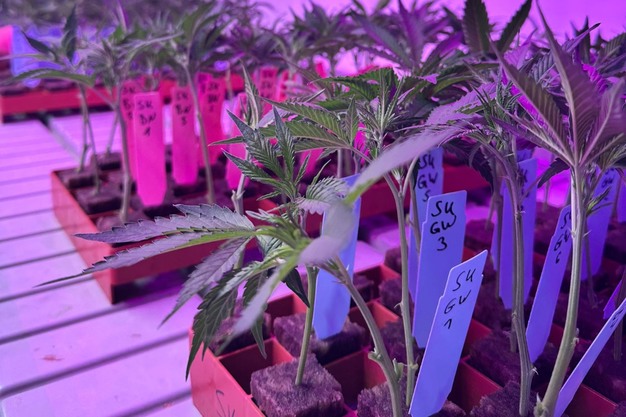
That changed when she was presented with data from outside cannabis. "Space breeding is not speculative theory," she explains. "China has used it for decades to improve crop performance. One of the most widely grown wheat varieties in the country was developed through exposure to space conditions, delivering 10-30% yield increases alongside strong drought resistance. When I saw those numbers, I was in. This is established methodology. It is not science fiction."
 © Martian Grow
Cannabis, as it turns out, is an ideal candidate for this type of research. Not because it is trendy, but because it is sensitive. "Cannabis reacts visibly to stressors, and that sensitivity is the foundation of modern breeding, where light, nutrients, temperature, and mechanical stress are already used to push new expressions from the same genetic material."
Space adds two stressors that cannot be fully recreated on Earth. Cosmic radiation and microgravity. "Cosmic radiation is a complex mixture," Chu says. "You can simulate parts of it on Earth, but not the full package."
Microgravity is even harder to replicate meaningfully. Plants are deeply attuned to gravity. They rely on it from the moment germination begins to determine up and down. Remove that reference point and the entire system is stressed. "When a plant starts to germinate, it knows where up is and where down is," Chu says. "In microgravity, that detection system does not make sense anymore. The entire system gets stressed."
To infinity and beyond
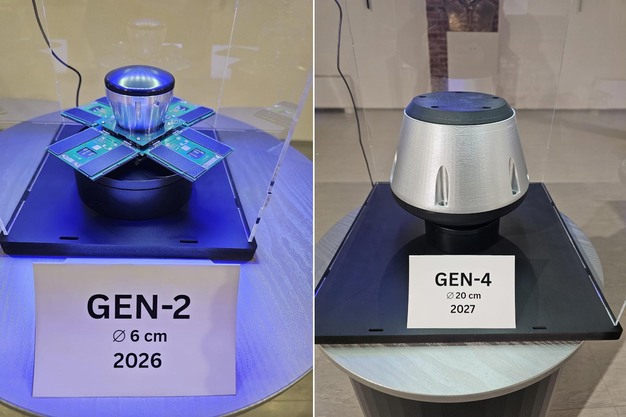
Martian Grow launched its first capsule in June. The pod successfully entered orbit and returned, but the signal was lost after landing, and the seeds were never recovered. "The capsule floated, it landed, and then we lost the signal," Chu says. "We do not know where those seeds are."
 © Martian Grow
From a publicity perspective, the project had already done its job. Coverage followed, including a Wired article that brought unexpected attention. "Within weeks, a message came through LinkedIn," Chu recounts. "An American group had attempted something similar two years earlier. They had developed the science and business model, but never launched. Regulatory barriers around THC required an agricultural signature they could not obtain. So, the mission was aborted."
Martian Grow had done what they could not, the two teams decided to join forces. "We did what they could not do," Chu says. "So we decided to join forces." The partnership completed the picture. Martian Grow brought momentum, visibility, and a working launch framework. The US team brought a revenue model centered on genetics. "Suddenly, it felt complete," Chu says. "We had the marketing plan, and they had the US side figured out in terms of revenue."
Regular meetings followed, and the project moved from speculative experiment to structured pipeline. "That is when we started having two meetings per week," Chu says. That pipeline is where the implications for the cannabis industry become tangible.
So what?
There are two types of change that space exposure can trigger, Chu explains. The first is genetic mutation. DNA level changes that are heritable and permanent. These are rare, unpredictable, and impossible to control. "If it happens, we do not know if it is positive or negative," Chu says. "It is like drilling for oil. You cannot control if there is a mutation, or what the mutation is. It is kind of like gambling."
The second type of change is epigenetic. These are not new genes, but new expressions of existing potential. Stress activates traits already present in the plant but normally dormant. "Whatever potential is there, it is already built in," Chu says. This is far more common and far more immediately useful. "Epigenetic changes mainly increase plant resilience, that has been the result of most space breeding projects. For cannabis growers facing climate instability, water scarcity, and increasingly demanding production environments, resilience is crucial."
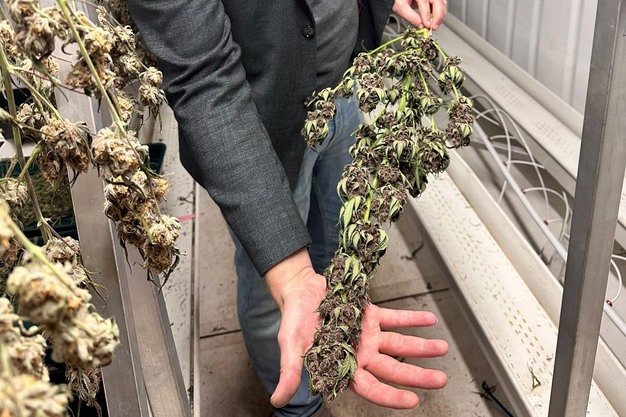
Preserving these changes is the real challenge. While genetic mutations are easy to stabilize through seeds, epigenetic traits can fade over generations. "You can breed epigenetic change out of existence," Chu says. "It might persist for a couple of generations, but it is tricky."
 © Martian Grow
That is why Martian Grow is pairing seed work with tissue culture. Maintaining mother plants and cuttings allows specific expressions to be preserved and banked. "That is very typical for mother plants and cuttings," Chu says. "It allows you to preserve a single expression."
The company is now working with a tissue culture partner in the US, with the goal of distributing preserved space exposed genetics globally. Over time, this would form a portfolio of cannabis genetics shaped by conditions no indoor room or outdoor field can replicate. "If we run a few launches and give it five to ten years, we would have a portfolio of space genetics to provide to the world," Chu says.
And as pointed out initially, the end goal is indeed Mars. "The end goal is to grow cannabis on Mars," Chu says. "It will not happen before twenty generations, but that is the direction." For now, Martian Grow is not trying to escape Earth. It is trying to prepare cannabis for a harder version of it.
For more information:
Martian Grow
[email protected]
martiangrow.com