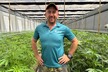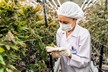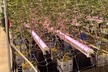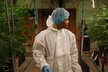


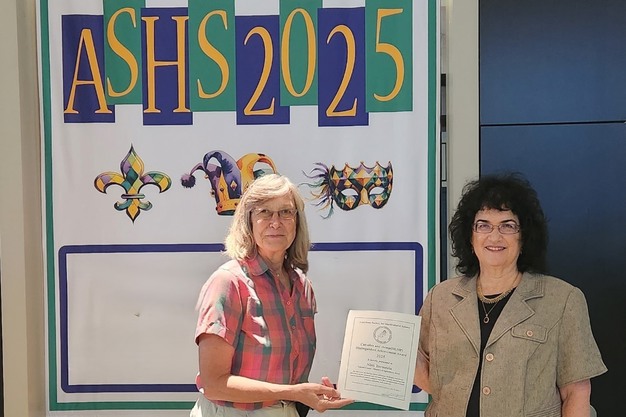
Recognition for one's work can take many forms, from peer acknowledgment to institutional awards, and in some cases it arrives repeatedly over the course of a career. This is the trajectory that Volcani Institute's Prof. Nirit Bernstein's cannabis research work has taken, culminating recently with the 'Cannabis and Hemp Distinguished Achievement Award', given to the Israeli researcher by the American Society of Horticultural Science.
 © Nirit Bernstein
The beginning of modern cannabis science
Nirit began working on cannabis roughly 14 years ago, well before the crop acquired its current institutional legitimacy. At the time, she was approached by Israel's Ministry of Health, through its Medical Cannabis Unit, with a daunting request: help define cultivation protocols for a crop barely understood from a plant science perspective, to ensure that the plant product is safe for consumers, and to supply the needed agronomic support to the growers. "There was almost no information back then about cannabis plant-science and agronoy," she says. "It was very difficult to establish a cannabis research program then because there were no funding, but I felt a very strong responsibility to do it."
She did what any academic would do, turning to the scientific literature. For any other well studied crop, answers would have been abundant. For cannabis, there was essentially nothing. "Cannabis is not a new crop, people have used it basically forever, so I expected to find some useful information" Nirit recalls. "But when I looked, there was basically zero. That was the moment I understood that if we wanted answers, I would have to start from the very beginning."
That absence pushed her to redirect her research activity almost entirely toward cannabis. The early work focused on fundamentals, not to barge into the cannabis party reinventing the wheel, but because every discipline needs a framework to build upon if complex topics need to be addressed. "How the plant responds to mineral nutrition across its life cycle. How vegetative and reproductive stages differ in their demands. What happens when inputs are pushed, restricted, or misaligned. This is all decade-old knowledge in every crop, but for cannabis it was all a new territory." Nitrogen became one of the first focus, followed by potassium, phosphorus, and magnesium, each studied systematically. "Every time we found an optimum level, that became the baseline for the next study," she explains. "It was a very cumulative process."
Academia in support of cannabis growers © Nirit Bernstein
As soon as Nirit began presenting early data at conferences, it became clear how starved the industry was for validated information. Growers, advisors, and companies began reaching out in volume, often with very specific questions about nutrient ratios and cultivation decisions that until then had been guided largely by inherited practice. "For years, I received hundreds of emails and requests every week," she says. "People would ask about nitrogen, potassium, light, irrigation, crop steering, and what not.., very practical things. You really feel the responsibility, because you know the industry is listening."
Cannabis plant science moving forward
That sense of responsibility dictated her lab's direction. Her research expanded into environmental drivers, light spectra, HPS versus LED, pruning strategies, plant density, and plant architecture, including some of the earliest peer reviewed work on achieving canopy uniformity in cannabis chemistry. "We had very little information on the plant, but at the end of the day, cannabis is just a plant," Nirit notes. "An interesting one, yes, but it still follows physiological rules that need to be understood."
As the field matured, so did the questions. Attention shifted toward inflorescence development, trichome maturation, and harvest timing, areas where industry conventions still struggled to get fully away from legacy practices. "There has been a big shift over the past 9 years," she says. "In the past, people harvested when about 50% of trichomes were amber. Today, many harvest as soon as they start turning amber, but we don't really have enough information on how cultivation conditions affect that process."
That gap is now central to her current research. Working with international collaborators, including projects funded by the Institute of Cannabis Research in Colorado, Nirit is examining not only pesticide residues, but how pest management strategies influence secondary metabolism. "It's not just about residues anymore," she explains. "If we spray the plant, even with botanical products that contain terpenes, that can have a tremendous effect on secondary metabolite production."
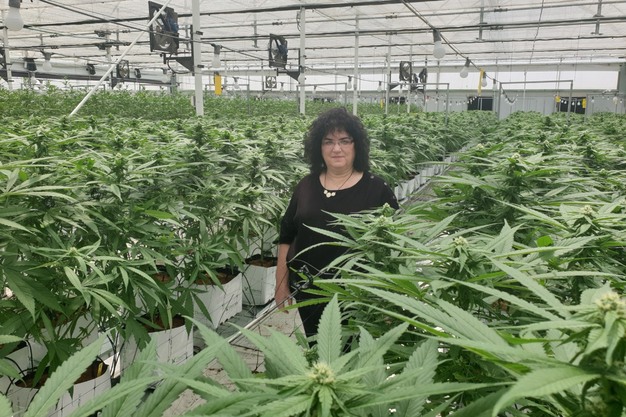
Stress physiology has become another key focus. Repeatedly, her work has shown that the highest concentrations of cannabinoids and terpenes often coincide with the plant reacting to stressors, an observation long familiar to growers. "Stress conditions many times affect secondary metabolism," she says. "What we are trying to do now is develop elicitation methods, to fool the plant into thinking it is under stress, while it is actually growing under optimal conditions."
 © Nirit Bernstein
This willingness to investigate entrenched practices has constantly pushed her research to challenge if not outright validate legacy methods. Physical wounding, long dismissed as superstition, proved to have some stimulatory effects on secondary metabolites. "They told us it worked, and they were right," she says. Flushing, another divisive topic, showed no consistent increase in cannabinoid levels, but also no harm. "My recommendation is to flush," she adds. "It helps save money, it doesn't damage the plant, and it improves soil conditions, especially when growers have used too much fertilizers."
More experimental work continues in parallel, including carefully timed salinity stress in the final days before harvest, prolonged light or darkness immediately pre harvest, and studies on heavy metal uptake. "Hemp is a hyper accumulator, and 'drug-type' cannabis was never really tested for this in a medical context," she explains. "Some of the nutrients we give to plants, like iron, zinc, manganese, cupper, are heavy metals. The question is how much we can give without reaching critical thresholds in the inflorescences, and in the produced extracts."
Across all these lines of inquiry, the methodology remains consistent. "We put a lot of effort into understanding the physiology and biology of the plant," Nirit says. "Not only agronomy, but also chemistry and plant physiological function. Then we translate that knowledge into practical applications. That's how we work in my lab."
This approach has earned Nirit a series of international recognitions in recent years, from the 'American Chemical Society', 'American society of Agronomy', 'American society of Horticultural sciences', to agronomy and horticultural organizations across Europe and Israel. The 'Cannabis and Hemp Distinguished Achievement Award' now joins that list as confirmation that cannabis plant science has reached a level of maturity where foundational work can finally be acknowledged as such.
"Cannabis is a fascinating plant," Nirit reflects. "Not only because of the chemistry, but because the physiology can differ so much between cultivars. The more we learn, the clearer it becomes how much we still don't know."
For more information:
Volcani Instiute
+9723-968-3226
[email protected]
agri.gov.il