

Indoor cannabis cultivation has long been at the forefront of CEA innovation. Because cannabis is a high-value crop, growers and technology providers alike have been willing to push systems to their technical limits in pursuit of yield, consistency, and quality. Over the past decade, this has resulted in increasingly powerful luminaires, higher PPFD targets, tighter fixture spacing, and aggressive toplighting strategies becoming standard practice.
However, as facilities scale up and modern genetics continue to evolve, it is becoming clear that traditional lighting approaches are no longer sufficient on their own. In many state-of-the-art grow rooms, the primary limitation is what happens to photons after they strike the first layer of leaves.
This shift presents an opportunity to rethink CEA lighting more holistically, and to redefine how light is distributed within a cannabis canopy to better align with plant physiology and commercial realities. Currently, the focus is beginning to move toward optimizing light distribution throughout the entire plant.
The physics of a dense canopy
Most commercial indoor cultivators aim for 1,000–1,500 µmol/m²/s at the canopy top, a range that sits close to photosynthetic saturation for cannabis. At that level, the uppermost leaves operate near their maximum carbon assimilation rate. The problem is that those same leaves also intercept the majority of incoming photons.
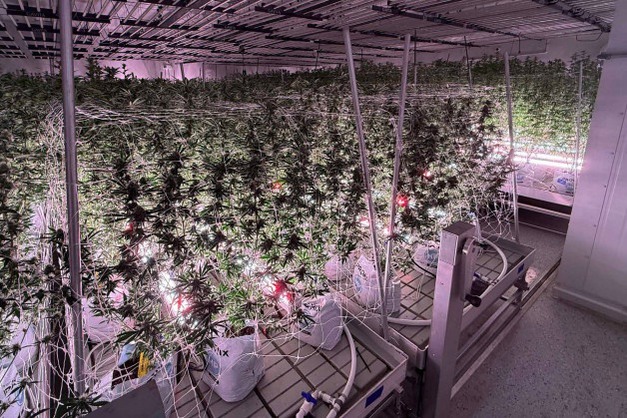
Light attenuation through a cannabis canopy is steep. It is not uncommon to measure PPFD values of 300 µmol/m²/s, or significantly less, at the lower third of the plant, even in rooms with aggressive defoliation programs.
Photosynthesis and light intensity largely go hand in hand, as long as the light saturation level isn't reached. In other words, when PPFD decreases, the photosynthetic output follows suit. Once levels approach the compensation point, lower leaves no longer support flower development. In fact, they consume resources. If a canopy performs unevenly from top to bottom, that's when yield loss builds up.
 © Gavita
Defoliation can only go so far
The industry's default response to shading has been manual intervention. Strategic pruning, heavy defoliation, and "lollipopping" are all attempts to force light deeper into the canopy. However, they can be effective only so much.
These techniques are labor-intensive, stressful for plants, and fundamentally compensatory. They remove biomass to accommodate a lighting strategy, rather than adjusting the lighting strategy to match the biomass. In high-density commercial environments, that trade-off can hardly be afforded.
Rethinking where light comes from
Under-canopy lighting reframes the problem by addressing the vertical light gradient directly. Instead of relying on downward photon penetration, it introduces light into the lower canopy from below, reducing the disparity between top and bottom. One persistent concern has been whether light delivered to the underside of leaves is used efficiently. The assumption, common but largely untested in cultivation circles, was that abaxial illumination would be less productive due to leaf anatomy or stomatal distribution.
Controlled studies suggest otherwise. Under high-light conditions, leaves appear capable of processing photons with comparable efficiency regardless of whether light enters from the top or bottom surface. From a metabolic standpoint, a photon is a photon.
Manufacturers like Gavita have begun developing fixtures specifically designed for this role, such as low-profile under-canopy LEDs that integrate into existing control systems and operate independently or in sync with toplights. In practice, these systems are redistributing responsibility within the canopy.
Timing over wattage
One of the more understated insights emerging from under-canopy trials is that when supplemental lighting is introduced may be just as important as how much.
If lower leaves spend most of their lifecycle adapted to deep shade, suddenly exposing them to high-intensity light late in flower can trigger stress responses, including photoinhibition. That's why under-canopy lighting should be introduced at the end of the vegetative stage, so that the plant can get acclimated to it rather than reacting to it later on. This is less about pushing extra energy into the system and more about maintaining continuity. A leaf that never drops below functional light levels remains an asset instead of a liability.
 © Gavita
Environmental effects
Adding light below the canopy does not happen in isolation. It changes the microclimate within the plant mass itself. Additional heat sources closer to the substrate increase the importance of horizontal airflow. Without proper circulation, localized hotspots and elevated humidity pockets can develop, conditions that invite both stress and disease pressure.
Increased airflow, in turn, raises transpiration rates. Facilities experimenting with under-canopy lighting often find that irrigation strategies need adjustment, not because plants are "drinking more" arbitrarily, but because a more uniformly active canopy demands more consistent water and nutrient delivery. These are not drawbacks so much as reminders that lighting decisions are environmental decisions.
Implications for toplighting strategy
Perhaps the most interesting long-term implication of under-canopy lighting is what it suggests about overhead fixtures. If light distribution becomes more uniform throughout the canopy, the argument for ever-higher toplight intensities weakens.
Initial tests and trials by Gavita show that it's possible to achieve comparable if not improved total photosynthesis with slightly reduced toplight wattage, which is balanced out by targeted lower-canopy supplementation.
For more information: Gavita
gavita.com