

If it isn't broken don't fix it. This is the approach Alex Babich, CEO of Nuravine, felt the industry was having towards fertigation systems. "Once a system reaches a point where it works reliably, most companies stop asking what else it could do," he says. "Not because they do not have the capability, but because the market is small and the focus shifts to selling, installing, supporting. R&D becomes secondary." It doesn't take much to see that in indoor cultivation. Hardware that is expensive because it is designed to cover every possible use case at once. Systems built for massive facilities, sold to growers who only need a fraction of that capacity, but are forced to buy the whole thing anyway.
Alex wanted to cut that assumption at the root, and that's Nuravine's core mission. "We wanted to solve the actual problems growers deal with every day, not the imaginary ones," Alex says. "Dosing nutrients accurately, mixing consistently, managing multiple reservoirs without duplicating hardware, and doing it in a way that can grow or shrink with the operation."
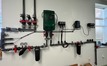
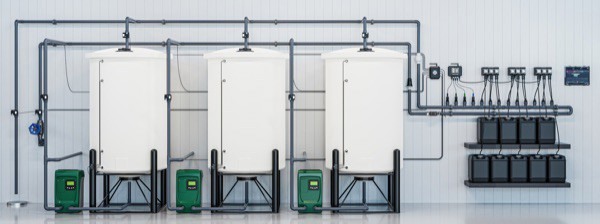
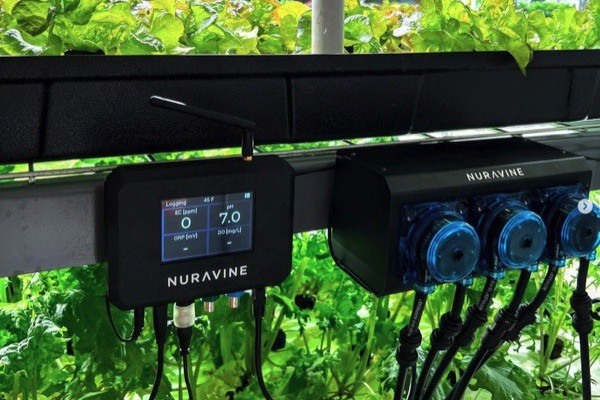
The result is a modular system that can handle recirculating systems, batch dosing, and routing nutrients to different reservoirs on different schedules through automated valve control. One system to rule them all, some may say. After all, nutrient dosing is a constant task that requires daily attention, and sometimes even several times a day. On top of that, it pulls growers into repetitive work that does not reward skill or experience. "This is the kind of work that keeps you busy without making you better," Alex says. "You are mixing, checking, adjusting, instead of focusing on plant health or long term decisions."
 © Nuravine
With Nuravine, growers move from daily manual intervention to periodic oversight. Nutrients are replenished every few weeks. Inventory levels are visible remotely. Reservoir status is known without being physically present. For some operations, especially those small, single-person grows, it basically results in reclaiming time. "For some people, it means they are not chained to the room every day," Alex says. "For others, it means they can finally think about expanding without burning out."
Different recipes, one system
The ability to manage multiple reservoirs from a single system becomes critical as operations scale. Traditionally, different nutrient recipes meant different machines, which translate into increased cost and necessitate more hardware to control all of that. "With Nuravine, one system can manage many reservoirs at once. Each with its own recipe, its own schedule, its own logic."
On top of dosing pH and nutrients, the system can fill reservoirs, drain them on a schedule, and perform full water turnovers automatically. A grower can decide that every few weeks
a reservoir is emptied, refilled, and brought back online without manual intervention. All of this is controlled through a software interface that was built on community feedback. "We did not design the interface in isolation," Alex says. "We kept building what customers were asking for, one function at a time."
 © Nuravine
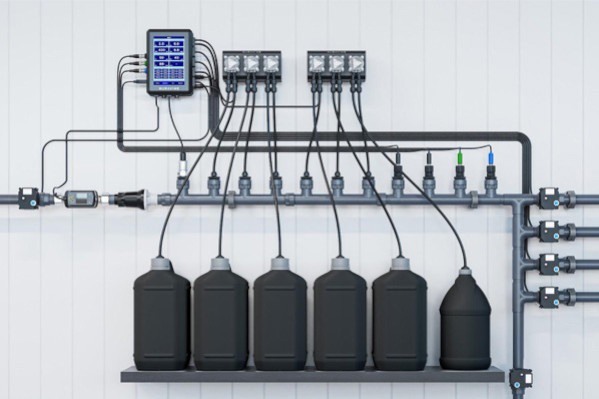
Inline dosing is one of those requests. Instead of mixing a large batch in a tank and then distributing it, inline dosing eliminates the tank entirely. Water flows through the system, and nutrients are dosed in real time. "By the time it leaves the doser, it is what it needs to be," Alex says.
Nuravine is finalizing its inline dosing system alongside batch dosing, crop steering, and API integration that allows the platform to both receive data from external sensors and feed data into other control systems. "We want to integrate into whatever setup the grower already has."
This approach has become especially relevant as price pressure reshapes cannabis economics. Alex points to Michigan, where Nuravine gained early traction as the industry expanded rapidly, and then contracted equally fast. "One of our clients told us he used to make good money with one grow," he says. "Now he needs five to make the same amount."
If that's the reality growers live on a daily basis, it comes without saying that running multiple facilities with no automation is hardly feasible, nowadays. "That is why he keeps working with us," Alex points out. "Our system is the only way he can run that many grows without physically being there every day."
 © Nuravine
Affordability as a design constraint
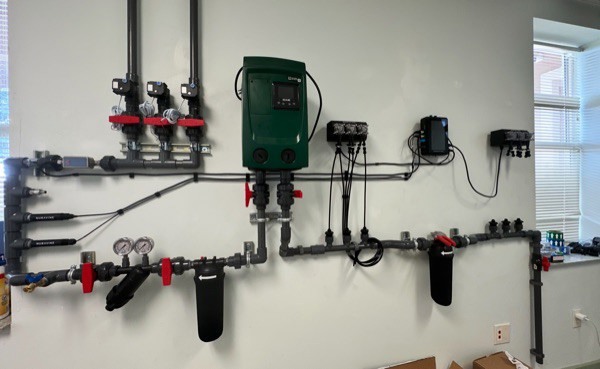
Affordability is a concept that has recently entered public discourse, and cannabis is no less. When it comes to operating large grows, however, affordability is also seen as a design constraint. Alex remarks that changing scale doesn't necessarily mean to rebuild everything from scratch. Rather, it's mainly about rearranging modules, swapping pumps and valves where needed, as well as adjusting flow rates. "The movement is the same," Alex says. "Water is water. Scale is about pipes, pumps, and valves."
 © Nuravine
In a market where growers are forced to do more with less, indoor farming is going to survive through systems that finally stop asking growers to work around them. "If the technology gets better and more affordable at the same time, more farms survive," Alex concludes.
 For more information:
Nuravine
Alex Babich, CEO
www.nuravine.com