


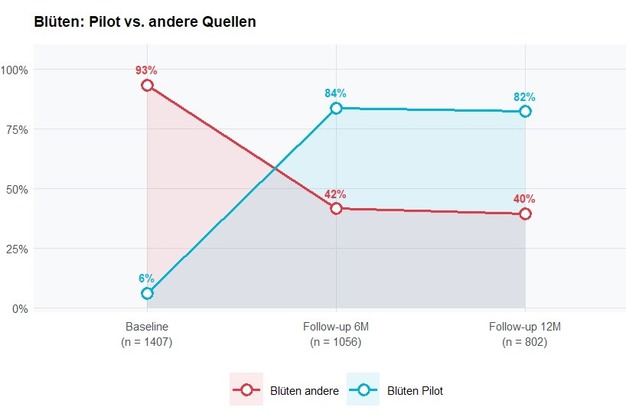
For more than two years, the scientific pilot project "Grashaus Projects" has been underway in the Swiss canton of Basel-Landschaft. The study examines the regulated, legal sale of recreational cannabis to registered participants through licensed specialty stores, operating under clear legal requirements and providing individualized professional counseling. Implemented operationally by the Sanity Group under the scientific leadership of the Swiss Research Institute for Public Health and Addiction (ISGF), the project is now delivering robust, up-to-date data on how controlled access to recreational cannabis can function in practice. The central findings: legal specialty stores can help push back the illicit market, strengthen consumer competence, and promote harm-reducing behavior – factors that are highly relevant both for Switzerland's ongoing legislative process on cannabis legalization and for Germany.
 © Sanity Group
Professional counseling as a reliable source of information
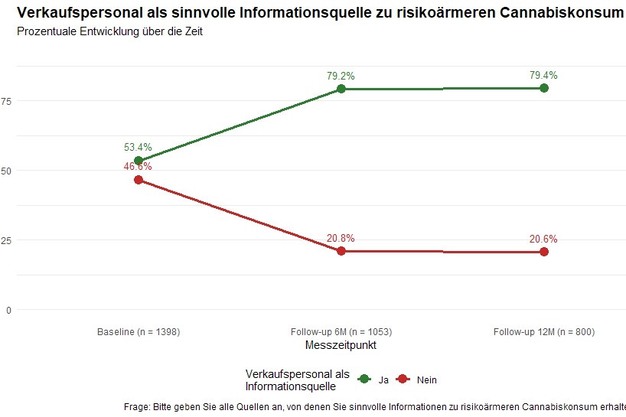
Professional counseling in the specialty stores is also becoming increasingly important for participants. The trained sales staff – so-called "budtenders" – are viewed as a useful source of information on lower-risk cannabis use by a majority of participants. Many subjects report having adjusted their consumption behavior following counseling sessions, for example with regard to dosage, THC content, product choice, or method of consumption. "We see a clear link here between a regulated setting, counseling, and responsible consumption," Schaub adds. "This central element is, of course, completely absent from the illegal market."
 © Sanity Group
Safer use: harm-reducing accessories and lower-risk consumption methods
Changes in consumption behavior can also be observed in terms of harm reduction. Particularly striking is the increase in the use of activated charcoal filters, which can reduce health risks of smoking more effectively than conventional cigarette filters, paper, or cardboard. The growing spread of such "safer use" practices indicates that consumers in a legal framework are more receptive to health education and risk-reduction measures. Positive trends can also be observed with regard to consumption methods: over time, study participants are increasingly engaging with less harmful options such as edibles, drops, or vaporizers.
 © Sanity Group
"Germany is taking the opposite path"
For Finn Hänsel, founder and CEO of Sanity Group, the results send a clear message to policymakers in both Switzerland and Germany: "While in Switzerland we can now see that regulated specialty stores can help strengthen health protection and effectively curb the illicit market, pilot projects in Germany – such as those proposed in Frankfurt am Main, Hanover, or Berlin – have recently been rejected. Germany is taking the opposite path and, in our view, the wrong one. Anyone who truly wants to achieve legalization goals such as comprehensive health protection and sustainable suppression of the illicit market must be willing to test them scientifically, rather than foregoing evidence for ideological reasons."
Switzerland, by contrast, continues to consistently prioritize evidence generation. "Switzerland understands that sensible regulation has to be adaptive," says Leonhard Friedrich, Managing Director of Sanity Group Switzerland. "Pilot projects like this provide the data basis for a realistic, responsible cannabis policy. After two years, we can draw an entirely positive interim assessment and remain in close dialogue with the authorities. It is encouraging that the evidence being generated here can make a meaningful contribution to legislation."
In Germany, comparable evidence is still nowhere in sight, according to Finn Hänsel: "Without corresponding model projects, such important data and insights will continue to be lacking."
For more information:
Sanity Group
[email protected]
sanitygroup.com