

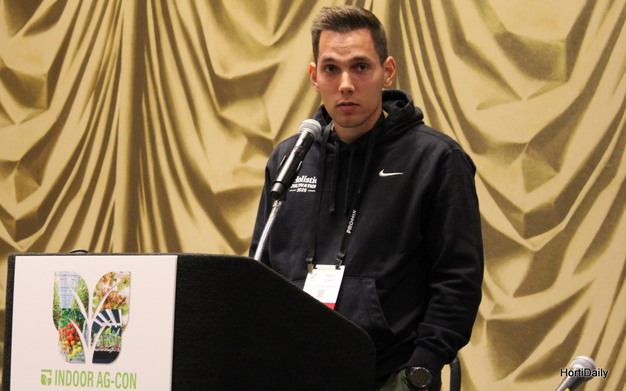
During the latest edition of Indoor Ag-Con, Nick Denney focused his presentation on a problem many growers are very much familiar with. After all, genetics form the basis of cultivation, and genetics banks are often described as a grower's treasure trove. In his talk, Nick explained how genetic selection only works when it is aligned with business objectives, regulatory constraints, and the realities of indoor production.
Nick currently serves as Senior Director of Product Innovation and National Director of Cultivation at Holistic Industries, a multi-state operator running CEA facilities across six states. Before joining Holistic more than six years ago, Nick came up through controlled environment food production, managing hydroponic vegetable operations in South Florida after completing degrees in economics and agronomy.
A matter of metrics
It may be tempting to look at genetics as a trend-driven choice only, but Nick immediately positioned it as a decision tied directly to performance metrics. In indoor cultivation, he explained, the question is not whether a cultivar is interesting, but whether it delivers against clearly defined goals, whether that means yield, speed, potency, biomass efficiency, or quality consistency.
 © Eelkje Pulley | MMJDaily.com
Regulation, as cannabis growers know very well, is the king, queen, and the whole court. Nick pointed out that many MSOs operate in states with some of the strictest microbial limits in the country, which immediately narrows the pool of viable genetics. Cultivars that may perform well in less restrictive markets can introduce compliance risk in tighter regulatory environments, which makes genetic selection also a risk management process.
To pheno hunt or not to pheno hunt?
Nick described two main pathways operators use to bring new genetics into their facilities. His preferred approach is starting from seed and running internal selection programs. While resource intensive and time consuming, this process allows teams to evaluate phenotypic variation directly within their own systems and select cultivars that fit both their facilities and their customer base.
Nick pointed out how that variation is a defining characteristic of cannabis. Unlike crops such as tomatoes, where genetic uniformity is the norm, cannabis shows significant diversity even within the same seed line. That variability introduces uncertainty, but it also creates the opportunity to develop genetics that are both operationally compatible and commercially distinctive.
If a grower doesn't have the means to do a pheno hunt or simply doesn't want to, the alternative approach is sourcing starting material from nurseries, effectively outsourcing part of the selection process. While this can reduce internal workload and speed up deployment, Nick cautioned that it does not eliminate risk. Even when working with well-regarded nurseries, variability can still emerge once genetics are scaled across production rooms.
Nick shared that he has seen variability in the range of 10 to 15% when introducing external genetics, a level that carries real financial consequences. Underperforming plants still consume space, labor, and inputs, turning genetic inconsistency into lost margin. Popular or recognizable cuts may offer marketing appeal, but visibility does not guarantee alignment with a specific operation's constraints.
Finding the rarest, most unique genetics is every grower's dream. At the same time, Nick's presentation argued that the first mistake is considering genetics selection in a vacuum. In fact, the point is to find those cultivars that work within a defined regulatory environment, meet specific business objectives, and perform reliably inside the systems an operator actually runs.
For more information:
Indoor Ag-Con
www.indoor.ag