


Labour is one of the largest cost items in the Dutch greenhouse industry. At the same time, wage costs are rising and skilled workers are becoming increasingly scarce. Where labour registration was previously used mainly for payroll and administrative purposes, it is now developing into a strategic tool for planning, cost price calculation and real-time adjustments.
Software developer ProCC BV, which specialises in labour and crop registration for horticulture, works with growers in the Netherlands and abroad to digitalise processes and improve production insight. Kainz & Mayer, Florensis and Jungpflanzen Scherr provide three examples of how labour registration is applied in practice and the concrete benefits it delivers at company level.
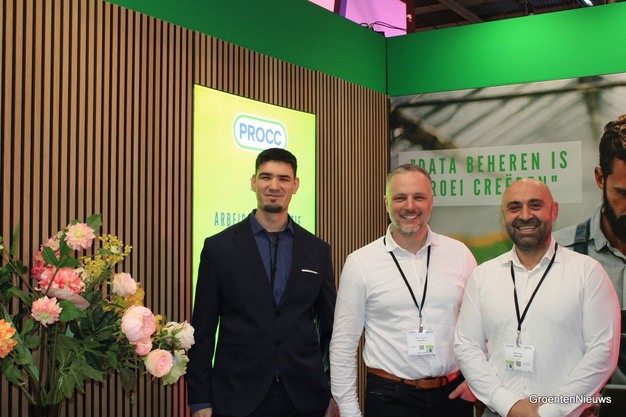 © Eelkje Pulley | MMJDaily.comDaniel Hoszczewski, Jeffrey van Uunen, and Sadik Usluer at HortiContact 2025
Real-time insight per variety as the basis for daily planning
At Florensis in the Netherlands, speed and accuracy are central to the cutting propagation process. In cooperation with ProCC, a registration method has been developed using QR codes and handheld scanners linked to a tablet. Each employee cuts cuttings per variety, while a team leader supervises a group of 20 to 30 workers. Every 20 to 30 minutes, the cuttings are collected and registered with a handheld scanner. The quantities are immediately linked to the individual employee, and the number of cuttings produced per variety becomes instantly visible.
Registration is deliberately carried out by the team leader so employees are not interrupted in their work. This helps maintain production speed and limits administrative tasks on the work floor. At the same time, it provides real-time insight into progress.
The number of cuttings per variety plays a key role in daily planning. Because it is immediately clear how many cuttings have been processed per crop, planning for the following day can be prepared accurately. Previously, quantities were recorded manually and later processed in multiple Excel files, a time-consuming and error-prone process. Digitalisation through ProCC has eliminated duplicate administrative steps and made up-to-date management information directly available for planning and operational control.
Tomato grower combines labor registration and mobile weighing technology
At Kainz & Mayer in Germany, several tomato varieties are grown. During peak season, more than 120 employees work in the greenhouse each day. At this scale, accurate task registration is essential to measure and compare performance. Together with ProCC, a system was set up to monitor performance based on clear benchmarks, such as plants per hour, kilograms per hour and the time required to complete a row.
Employees are expected to meet defined performance levels. Objective registration creates transparency and makes differences between teams or varieties visible, enabling targeted adjustments.
A key challenge was measuring kilograms per hour. The sorting and weighing process sometimes took considerable time, causing employees to wait for empty harvest trolleys. This affected workflow as well as the reliability of performance data. At Kainz & Mayer, accurate and objective measurement of kilograms per hour is important because these figures partly determine the bonuses employees can earn when exceeding established targets. Reliable registration is therefore not only a matter of production insight, but also of fair and transparent performance-based pay.
The solution was to weigh directly in the greenhouse. Harvest trolleys are weighed using a mobile weighbridge equipped with a battery and easy to move. Through a dedicated app, the weights are sent directly to the cloud and linked to the correct employee. As a result, employees immediately have access to an empty trolley again, minimising waiting times. Production data are simultaneously available in real time to team leaders and management.
The combination of labour registration and mobile weighing technology ensures that performance measurement is not only more accurate, but also better aligned with daily greenhouse operations.
More control over the cost price
At Jungpflanzen Scherr in Germany, various young plants are produced, including tomato and cucumber plants. For this type of production, insight into the cost price per plant is essential. In cooperation with ProCC, a registration structure was implemented that enables precise calculation of how much labour has been invested in each batch of plants and what this means for total cost price.
Employees register their daily activities, such as sowing, pricking out and potting. Quantities per task are recorded on the work floor. The team leader plays a key role in this process. The recorded numbers are entered into the system by the team leader and linked to the relevant tasks and batches. This ensures that the registration is complete and accurate before being finalised.
Previously, all registration was paper-based, after which the data were manually entered into Excel files. This resulted in duplicate administration, delays in data availability and a higher risk of errors. By digitalising the process through ProCC, information is now immediately available in digital form. Labour and production data are structurally linked, providing faster insight into labour costs per batch and per plant. This enables better control over planning, capacity and pricing.
From registration to strategic management
The three examples show that labour registration is no longer limited to recording working hours. In cooperation with ProCC, it has evolved into a tool for daily planning, performance measurement, cost price calculation, process optimisation and real-time operational adjustments, says Jeffrey van Uunen, owner of ProCC.
There is also growing international demand from the ornamental and plant sectors. Companies worldwide are looking for ways to keep labour costs under control and organise production processes more efficiently.
"For ProCC, this means development never stands still. Together with our customers, we continuously expand the system so that data become available more quickly and can be used directly for operational decisions."
With labour costs expected to continue rising in the coming years, insight is becoming a necessity rather than a luxury, Van Uunen adds. "Companies that have real-time visibility of performance and costs can respond more quickly and remain competitive in a changing market. Labour registration is no longer an administrative obligation, but an essential part of modern, data-driven horticulture."
 For more information:
ProCC
[email protected]
www.procc.nl