

If your biocontrol program keeps feeling 'one step behind,' the issue may not be the insects, it might be the calendar. One of the most important factors in making a biocontrol program effective is the timing of introduction. A well-timed beneficial release can save weeks of frustration, and a poorly timed one can undo a whole season's effort. Ensuring the biocontrol occurs before its host is crucial for effective pest reduction, Jenn Blom, Sarah Stuive and Jenna Straughan, with Global Hort explain.
Let's take Western Flower Thrips as an example. This is an incredibly common pest in a variety of crops, and despite extensive research and knowledge, some growers continue to struggle with control year-after-year. When faced with persistent pest challenges, many questions naturally come up: Are there pesticide residues in the crop? Does the greenhouse have the right conditions for the beneficials? Are quality control checks happening to make sure the beneficials are coming in strong? Are the insects being applied quickly and correctly? Every input shapesthe program — but what is perhaps the most critical question is often asked last: Is the timing right?
Thrips biocontrol works best when it is stratified – meaning you have beneficials working at multiple levels within the crop. Ideally, this includes something in the root zone targeting pre-pupae and pupae, something in the foliage feeding on larvae, and when possible, a mobile predator, attacking adult thrips.
It is often easiest to start in the root zone. Beneficials such as Stratiolaelaps scimitis, Dalotia coriaria, Gaeolaelaps gillespiei, entomopathogenic nematodes, or a combination of these can usually be introduced very early — well before any pest pressure is visible. Once the greenhouse is up and running and temperatures are consistently above 15°C / 59°F, these introductions can begin.
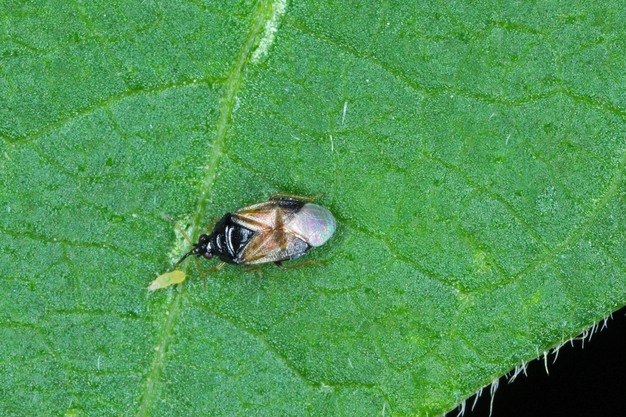 © ShutterstockKlejdysz, T. Minute pirate bugs or called flower bugs (Anthocoridae) is a family of bugs. Anthocorids are predacious and feeds on many insects pests of crops - in the picture with a hunted thrips.
The next layer, the plant canopy, is where timing becomes more critical. "Beneficial mites play a huge role in any successful thrips program. Some growers prefer Amblyseius cucumeris, some prefer Amblyseius swirskii. Since greenhouse conditions vary, both approaches can be effective depending on the specific production context, and time of year. What is universal is the way these mites feed: they mainly target first-instar (L1) larvae, and, to a lesser extent, small second-instar (L2) larvae. Knowing this means that timing releases of predatory mites prior to thrips presence in the greenhouse ensures that those early life stages are caught and stopped. This means that if you don't have a large population of beneficial mites around when you have a lot of thrips, you're already behind, as the mites would have to wait for the next generation of thrips to emerge as L1's in order to be able to consume them.
While the predatory mites are masters at targeting the larval stages, another tool to keep on hand is the predator Orius insidiosus. This voracious bug can (and will!) happily kill thrips, of all life stages, and oftentimes will kill far more thrips than it can consume!
Here timing is just as crucial.
Typically, Orius needs a minimum of 12 hours of daylight to be effective. For most parts of Southern Ontario, this would be mid-March. However, since thrips don't experience diapause, a period suspended development, waiting until then could cause a setback in a bioprogram, as thrips can establish during the winter months. Thrips rarely follow our calendars.
In response to this, some growers in Southern Ontario decided to test how early Oriuscould be released. Over time, and through trial and observation, success was seen with releases as early as mid-February. This allowed for an Orius population to begin building earlier in the season, slowing down thrips establishment and providing a headstart for the Orius population to hit the ground running once their ideal light levels arrived in mid-March.
This observation is based on the understanding that diapause is more complex than a permanent stop and start date. Its initiation and completion is determined by multiple factors, including each insect's unique response to light and temperature. This can vary within a single species even between localities, causing experiences to change from one grower to the next.
Timing of your insect releases can be a very important factor when building your biocontrol program. We are never done learning in this industry, and the insects are never done adapting. Keeping curious and trying new strategies can be a powerful tool in exploring new options and testing traditional boundaries. Perhaps there is untapped potential for your biocontrol program within the products that you are already using!
A strong biocontrol program isn't built in a moment of panic — it's built quietly, early, and with intention. When timing becomes part of the strategy, beneficials stop feeling unpredictable and instead feel dependable. Explore the introduction timing that works for you, your farm, and your crop. Then you can trust the process, trust your calendar, and remember that the best pest control decisions are often the ones made before there's a problem to see.
For more information: 
Global Horticultural
1-800-668-9567
www.globalhort.com
Jenn Blom
[email protected]
Sarah Stuive
[email protected]
Jenna Straughan, M.Sc.
[email protected]