

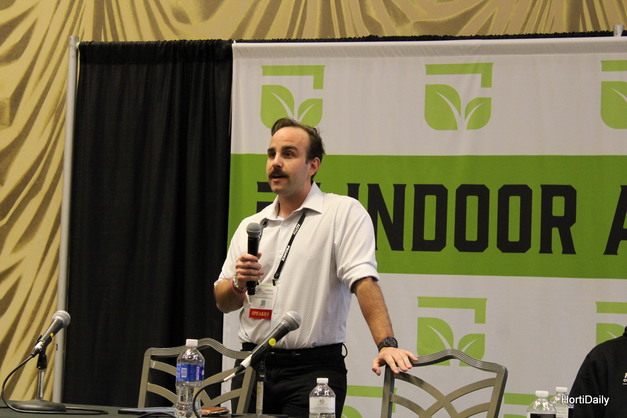
During the latest edition of Indoor Ag-Con, Jeremy Shechter focused his presentation on why data collection in commercial cannabis cultivation needs to function as an operational tool.
Jeremy, founder of Open Source Horticulture, opened by challenging a common assumption inside cultivation teams. "We are not as good as we think we are," he said, specifically pointing to the gap between perceived performance and what can actually be demonstrated. Without data, he argued, operators tend to rely on preconceived notions rather than evidence.
Genetics, Jeremy explained, cannot be evaluated in isolation. "Genetics are not formed in a vacuum," he said. In other words, collecting data becomes the only reliable way to understand how genetics behave across different rooms, facilities, and operating conditions.
Yield figures alone, he added, rarely tell the full story. Teams may be able to state a number, but struggle to explain how that outcome was achieved. "Show me the dashboard," Jeremy said, describing situations where performance claims fall apart because historical data does not exist or cannot be accessed. In those cases, memory fills the gap, even though, as he put it, "our memory is so bad."
 © Eelkje Pulley | MMJDaily.com
The importance of goal setting
Jeremy framed data as the mechanism that allows teams to move toward defined objectives. "One of the most important drivers for people is moving towards a goal," he said, and progress only becomes visible when it is measured consistently. Without robust data, goals remain abstract.
A recurring point throughout the presentation was the need for restraint. To make the point, he quoted Leonardo Da Vinci: "Simplicity is the ultimate sophistication," Jeremy said, to describe the tendency to overcomplicate data systems for their own sake. He argued that not all data is worth collecting, and that excessive measurement often creates noise rather than insight.
Deciding what data matters, Jeremy stressed, should not be left to chance. "Data is not created equal," he said, "Teams can easily spend time collecting information that has no impact on outcomes. KPI selection needs to be driven by leadership and tied directly to business performance, then clearly communicated to cultivation directors."
Actionability becomes then the key. "If a data point does not inform a decision, it should not be treated with the same rigor." Jeremy used room pressure as an example, explaining that while deviations from a set point can signal an issue, they do not necessarily belong in long term performance tracking. In other words, trends are more important than isolated readings.
Data collection systems
Jeremy also discussed the structure of effective data collection systems. "It has to be tip to tail," he said, describing the need to track every step of the process from cultivation through packaging. "Those systems must be custom built for each facility." He stressed a lot again how keeping it easy and simple is essential. "If you want to keep doing something, keep it easy," Jeremy said. Adding steps to any process increases friction and reduces compliance, whether in cultivation or data entry.
Paper based workflows were singled out as a persistent problem. Jeremy described operations where data is written down and later transferred to a computer, a process he characterized as inefficient and error prone. Fully digitized systems, using tablets or mobile devices, were presented as a baseline requirement for reliable data entry.
Toward the end of the session, Jeremy touched on how data influences decisions beyond cultivation metrics. He noted that some cultivars may deliver strong yields but perform poorly after drying, becoming fragile or difficult to handle. Without tracking those outcomes, operators risk optimizing for numbers that do not translate into finished product performance.
For more information:
Indoor Ag-Con
www.indoor.ag