


Due to legal restrictions, no research on cannabis was conducted for decades, and we therefore lack basic science-based information on all aspects of cannabis, from plant-science, to cultivation, to medical. With recent changes in regulations and the increased ability to conduct research on all aspects of cannabis, a fundamental question that had to be answered first was how to grow a cannabis plant for best yield production and quality, and how to do it for research purposes, when nobody really agrees on what standard growing conditions are. To allow research on cannabinoids, terpenes, stress responses, there was a basic starting point that needs to be studied: minerals, or NPK more precisely.
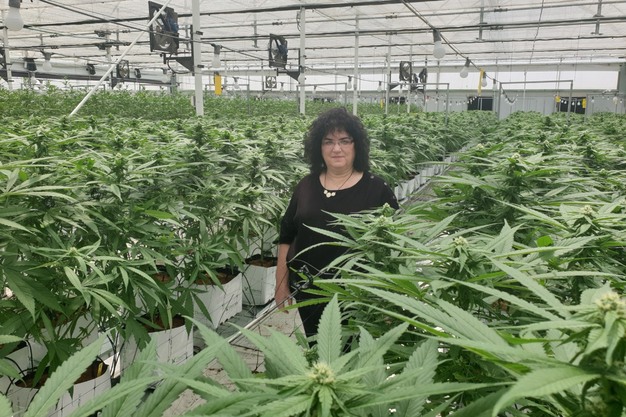
"The first thing we had to ask ourselves was how should we grow cannabis for research," says Prof. Nirit Bernstein, head of the cannabis physiology and agronomy lab at the Volcani Institute in Israel. "Since no research was conducted on cannabis for decades due to its legal status, there was no science-based information regarding optimal cultivation conditions for the plant. This information is obviously essential for growers to achieve optimal yield quality and quantity. And without knowing how to grow thriving, vigorous plants it is also impossible to conduct research studies and make generalized reliable discoveries."
To achieve this information, Nirit is testing the response of the cannabis plant to key factors which affect plant growth and function, starting with mineral nutrition. Each mineral nutrient is tested across five concentrations, from clearly deficient to clearly excessive level. "We wanted to see the response of the plant to a wide mineral concentration range," Nirit explains. "From a low-deficient concentration, to a high-toxicity level, for identifying what the optimum really is, not what we assume it is."
 © Nirit Bernstein
Nitrogen, phosphorus, and potassium
That approach had already delivered results for N, P, K. In all three cases, the highest cannabinoid and terpene concentrations surprisingly appeared when plants were deficient. "Under deficiency of N, P or K, the plants were small, yellowish, and clearly stressed," she says. "Obviously nobody is going to grow commercially such small stressed plants that produce very low yield, even if chemically, these plants produce the highest secondary metabolite concentrations."
Nirit and her team were genuinely shocked when they saw the results. At first, they may sound counterintuitive, yet, Nirit has advanced a hypothesis that she's currently investigating. Nitrogen offered the clearest explanation. "When there is not enough nitrogen, the plant cannot produce compounds that contain nitrogen such as proteins or DNA, so growth stops," Bernstein explains. "But photosynthesis does not stop at the same rate. So the plant still produces carbohydrates and energy, which it cannot use for growth." So she hypothesized that under these conditions this energy is used for production of compounds that do not contain nitrogen, such as cannabinoids and terpenes. Metabolic studies from her lab indeed showed where that excess energy ends up. "We saw that nitrogen deficiency indeed trigger a metabolic shift toward production of compounds that do not contain nitrogen, like cannabinoids and terpenes."
Magnesium enters the fray
But NPK are not the only mineral nutrients that plants including cannabis need for growth and optimal function. It may seem like an exercise in intellectual power, to look at every minuscule detail of an object many claim to know already. But you can't produce medical products and rely on anecdotal evidence. Nirit took up on herself the task of creating the foundations of cannabis plant science required for development of optimal cultivation schemes, and her investigations couldn't stop at NPK, when other crops have received the full academic treatment – so to say. Together with her Master's student Dalit Morad, Nirit studied the response of the plants to another major plant macronutrient: magnesium. The results of this study were recently published. (doi.org/10.1186/s42238-025-00358-9)
"When we moved to magnesium, we expected something similar to what we saw for NPK," Nirit says. "But we saw the opposite. The highest concentration of cannabinoids and terpenes were produced when the plants received sufficient concentration of Mg, and plant growth and function was optimal. And under magnesium deficiency, cannabinoid and terpene concentrations dropped sharply. There was no deficiency-stress related increase in the secondary metabolite production. "
The results touch upon the very basis of plant physiology. Magnesium is required for chlorophyll formation, photosynthetic pigment biosynthesis, energy metabolism, nucleic acid synthesis, and carbohydrate transport. "Magnesium is involved in many key plant functions," she explains. "So, it is not surprising that when magnesium is deficient, plant growth, function, and metabolic activity goes down."
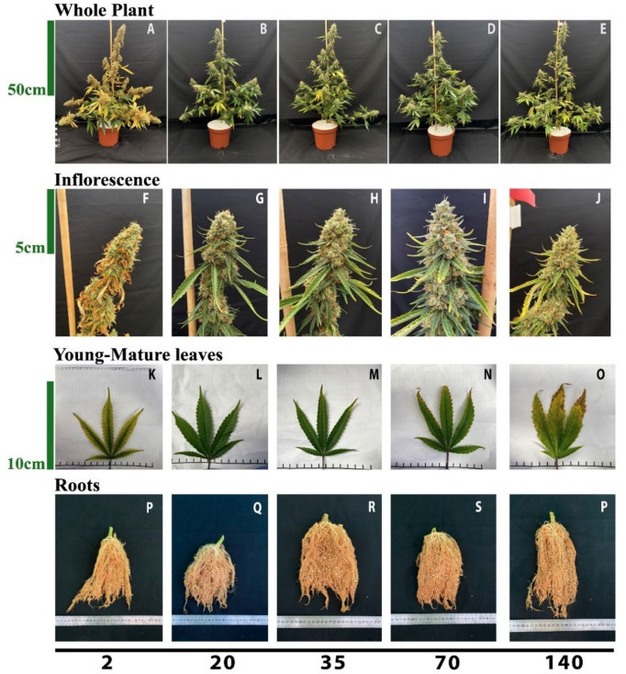 © Nirit Bernstein Appearance of the plants (top row A-E), inflorescence (second row F-J), young-mature leaves (third row K–O) and roots (bottom row P–T) under increasing Mg supply. Plants were cultivated under 2, 20, 35, 70, 140 mg L−1 Mg. Young leaves images are of the youngest, fully developed leaf on the main stem. Images of leaves, inflorescences and whole plants were taken 45 days after the initiation of the Mg fertigation treatments. Roots images were taken 59 days after the initiation of the Mg fertigation treatments
Finding the optimal concentration
The experimental range was intentionally extreme. Magnesium concentrations were tested from as low as 2 ppm up to 140 ppm. "Two ppm is ridiculously low," she says. "And 140 ppm is very high. We were aiming to identify both deficiency and toxicity levels to clearly identify the optimal range of magnesium for cannabis." They did, but not quite where expected.
At 2 ppm, plants suffered from magnesium deficiency, they were small and yellowish, with reduced physiological function and yield. "At around 140 ppm, plants also suffered," she explains. "from magnesium toxicity, but cannabinoid and terpene production were not harmed". "What we found is that 35 ppm is in the optimal range. That is where we see the highest plant biomass production, and also the highest cannabinoid and terpene levels."
Two treatments near the optimum level, 20 ppm and 70 ppm, already showed reduced plant function. "Those are already within the deficiency and the toxicity levels," she notes. "And if you reduce or increase concentration further, the situation only gets worse."
Almost naturally, however, a question arises: why the plant doesn't react to magnesium deficiency the way it does to NPK?. "Cannabinoid biosynthesis starts from cannabigerolic acid (CBGA), which depends on geranyl diphosphate, a precursor shared with terpene production. Magnesium is required for the formation of Geranyl-diphosphate, as well as for the activation of key enzymes in the biosynthesis pathway of cannabinoids and terpenes," Nirit remarks. "If the plant does not have enough magnesium, it cannot produce enough of these precursors. So, terpene and cannabinoid production goes down." In other words, magnesium deficiency straight up blocks plant's metabolism.
There is one important caveat, timing. "If you start with mother plants that were cultivated under sufficient fertilizer supply, the clones already contain magnesium," she says. In experiments where plants were grown with sufficient magnesium during vegetative growth and only switched to deficient conditions at flowering, plants initially produced a lot of biomass. "They are using magnesium reserves," she explains. "But once those reserves are gone, the problems appear." That delayed response explains why magnesium issues often surface late in the cycle, when correction options are limited.
In the academia, sweeping generalizations are often considered problematic, and Nirit too is cautious. "What this really shows is that the impact of mineral deficiencies is not the same for all mineral nutrients," she says. "The responses are mineral specific, and not a general response to deficiency-stress. While cannabinoid concentrations increase under nitrogen, phosphorus, and potassium deficiencies, they are reduced by magnesium deficiency. What makes me happy about these experiments is that we are no longer guessing. We now know what are the optimal concentrations for many macro and micronutrients.
Main source: link.springer.com/article/10.1186/s42238-025-00358-9
Additional sources: doi:10.3390/agronomy12051242; doi:10.3389/fpls.2021.657323; doi:10.1016/j.indcrop.2021.113516.
For more information:
Volcani Instiute
[email protected]
agri.gov.il