

After almost thirty years, Alfred Boot is leaving Herkuplast, now part of the Bachmann Group, and the horticulture sector. His career has run parallel to a period of profound change in the industry: from manual labour and seasonal production to automated, year-round supply chains with high demands on uniformity, hygiene, and circularity. His successor, Kasper Rietvelt, is now ready to take Bachmann-Herku into its next phase.
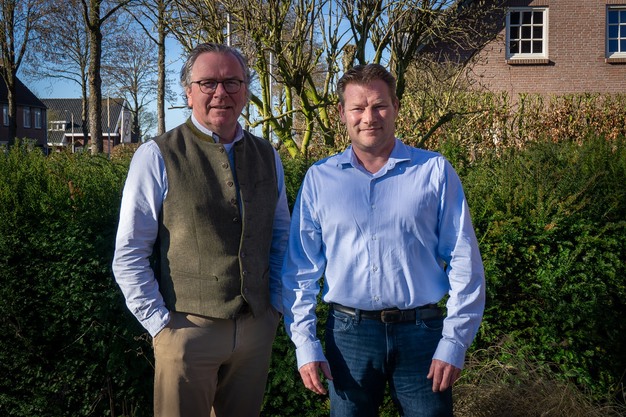 © Arlette Sijmonsma | MMJDaily.comAlfred Boot and Kasper Rietveld
From 26 models to custom automation solutions
"I fell into it by chance," says Boot, reflecting on 1987, when he entered horticulture after completing commercial school. "At Rovero, I immediately found myself in a world where technology and practice go hand in hand." In the mid-1990s, he was asked to set up the export operation for Herkuplast, the German thermoform tray manufacturer he had already been working with for several years.
"We started with 26 models. It all fitted on a single A4 sheet," he recalls. At the time, the majority of Herkuplast's range consisted of multi-use trays, while other tray manufacturers in the Dutch market had already shifted toward a broader offering of thin, single-use models. Boot saw room to chart his own course. "We had one thin-walled model, but there was demand for more. I was given carte blanche to develop thin models. With Herkuplast owner Mr Kubern, the collaboration was focused on exactly that: if you have a good idea, we make it happen."
The rise of automation in the sector placed new demands on trays. Precision became critical for push-out plates and automated processing lines alike. "Centred drainage holes, exact dimensions, everything had to be right. Otherwise the line would jam. We always prioritised that, and it earned us recognition in the market."
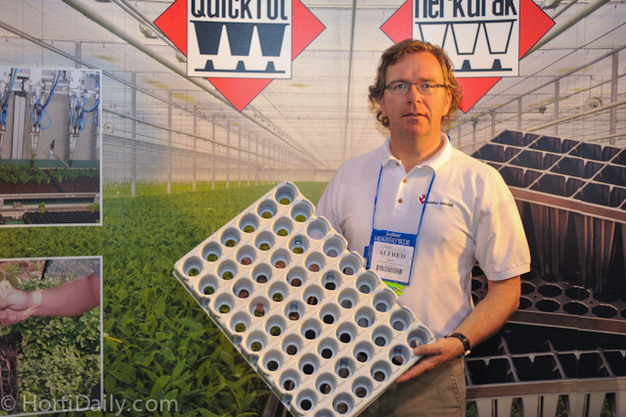 In 2013 at the OFA Short Course in Columbus, Ohio, the predecessor of Cultivate
Internationalization and hygiene requirements
Alongside the Dutch market, Boot also moved into international markets from an early stage, France, Spain, the United Kingdom, the United States, and beyond. The reasoning was largely practical: in the 1990s, the sector still had a clearly defined summer shutdown. "Production closed for three or four weeks. Demand simply dropped. But we wanted to produce year-round, so we looked for markets that required it — soft fruit and cutting propagation, for example."
Demand for trays used in strawberry, raspberry, and blueberry production enabled year-round manufacturing and became a strongly growing market segment. "Retailers and consumers expect it. That is reflected in volumes and specifications."
At the same time, hygiene requirements in propagation increased under growing virus pressure and a shrinking range of approved crop protection products. "Multi-use trays are easy to clean, they are cheaper than injection-moulded alternatives, and they are nestable. And because thermoform trays are thinner, if something goes wrong in an automated line, you lose the tray, not the robot arm," Boot explains.
That said, the preference has always been to maximise the use of plastic through reuse. This too has shifted considerably over the decades. "When I started, plastic was treated as waste. It was thrown away or burned. That is now completely out of the question." Herkuplast, working with partners such as Van Krimpen, has invested heavily in circular solutions. "Our propagation and seeding trays do not enter the consumer market. They go from the dealer to the potting operation. In the Netherlands, used trays are collected, ground down, and reprocessed as raw material for new trays or other applications. We close the loop: our trays are made from recycled material from day one, both the multi-use QuickPots and the single-use HerkuPaks." What began as a personal conviction became a marketing asset and has since become a requirement from retail.
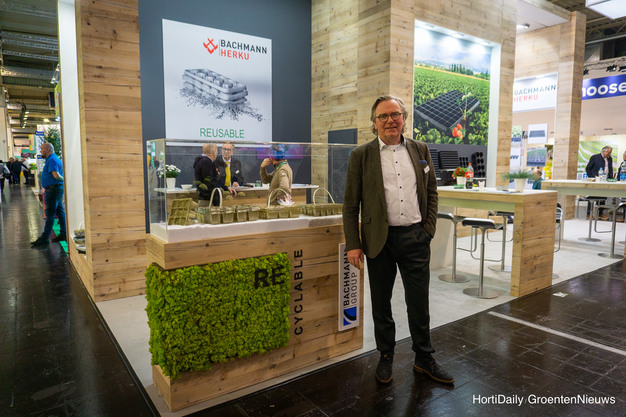 © Arlette Sijmonsma | MMJDaily.comAlfred Boot at IPM 2026
Internationalization and family businesses
Boot emphasises the importance of strong chain partners. "We believe in collaboration." Within Europe, the company has always worked with agents "from Portugal to Finland." Outside Europe, the company goes to market directly, which has meant travel as far as New Zealand, journeys Boot describes as memorable.
North America has also been a rewarding market. Growth there has been notable. "With our reusable QuickPot trays and our expertise, we can genuinely add value there." Is that his favourite market? He is reluctant to pick one. "I enjoyed going there because we could make a real difference. But the Netherlands remains perhaps my number one. Not just because it is our largest market, but because so much originates here, seeds, ornamental horticulture, plant breeding, greenhouse construction. This is the hub of knowledge and quality. Growing with minimal residues, maximum biological inputs, under constant price pressure. That is not always appreciated externally. The role of the Netherlands is enormous, and this sector is vital. The mentality is pragmatic, but the achievements are extraordinary."
That has driven him throughout his career. "This sector is essential. You are working on food or on greening the world. Is ornamental horticulture necessary? Yes, I believe it is."
It is also why Herkuplast, a family business at heart, chose during the pandemic to do everything in its power to continue serving customers. After a brief shutdown, the factory reopened as quickly as possible, adapted to strict German requirements. "For horticulture it was an enormous peak period, but raw material prices also rose sharply. We took the risk of buying at high prices and kept delivering, even though it cost us margin. But we wanted to keep supplying our customers. The importance of continuity is too great, for our customers, our people, and our sector."
Following the pandemic, Herkuplast entered a significant transition period. Owner Mr Kubern had passed his seventieth birthday, and there was no succession within the family. A sale was the expected outcome, and in 2024 Herkuplast was acquired by the Swiss family business Bachmann Group. "I am pleased it was Bachmann. Our strong preference was for a private company that understands the European market, understands horticulture, and would keep the factory in Germany." With a motivated team focused on international scale-up and the launch of the new Bachmann-Herku brand, ambitions are high. "And when you see how the sector is changing, automation, robotisation, AI in plant selection, it is moving at tremendous speed. It is fascinating."
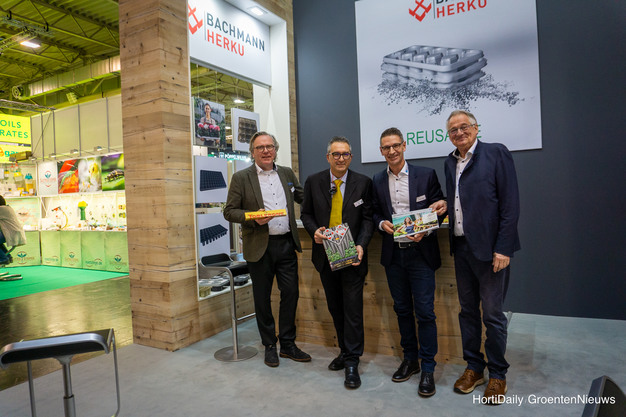 © Arlette Sijmonsma | MMJDaily.com And with the new colleagues from Bachmann Herku, IPM 2026
Farewell
But Boot is also candid: from a professional perspective, he will not be there to see it unfold. His final working day at Herkuplast falls at the end of March. "It is a purely personal choice. I am not tired of the work, and I am not tired of the sector. But you only live once, and life has a great deal to offer." The caravan is ready. Together with his wife Astrid (familiar to many in the industry) and their dog, the couple will set off on a long-distance walking journey. "I have averaged around 100 days per year abroad. Certainly when the children were young, we have triplets, so balancing work and family was a constant juggling act. Now we go together."
He adds: "If I were 45 with a long horizon ahead of me, I would gladly do again what we did in 1997 with Herku. But I consider myself too old for that now." He laughs. "And over the years I have become something of a clone of Herkuplast myself, while the product range has changed with the acquisition. We are now Bachmann-Herku, and the portfolio is being integrated quickly. Kasper has been working in the new company from his very first day. That too is a natural process. It feels right."
For more information:
Bachmann Herkuplast
Alfred Boot
[email protected]
Kasper Rietvelt
[email protected]
+31 653 215 514
Tel: +41 41 914 72 00
[email protected]
www.bachmann.ch