

Greenhouse digitalization is progressing quickly, with autonomous drones emerging as a key technology for monitoring crop health. Corvus Drones, a technology company whose drones are distributed in Spain by Burés Innova, has developed such drones. They are increasingly being used in nurseries, seedbeds, and horticultural farms to analyze plant growth, identify diseases, and improve agronomic decisions.
 © Burés Innova
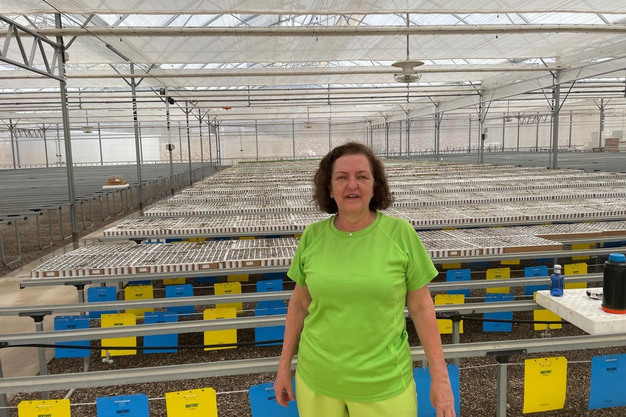
Silvia Burés from Burés Innova states that drones offer a new method for monitoring crops, providing detailed observations that are difficult to obtain manually. "Drones enable quality control of plants: counting open flowers, fruit numbers, or assessing whether the fruits are ripe and market-ready," she explains. "These analyses are performed using cameras and AI systems that interpret images captured during drone flights."
"One of the main applications is monitoring crops in seedbeds. In these environments, where the number of plants can be very high, drones enable the automation of tasks that traditionally required manual inspections: you can count healthy plants, living plants, and even detect those that are diseased," Burés stated.
The drone autonomously navigates within the greenhouse, capturing images of trays or crop rows. The data is then analyzed by algorithms that generate indicators of the condition of the plant material.
"This technology also enables precise crop inventories. In systems where each batch or tray is labeled with QR codes, the drone can automatically capture the information and update the greenhouse data," she stated.
 © Burés Innova
Early disease detection is crucial in intensive production systems, especially as regulations on crop protection products become more stringent.
"You can program the drone to identify specific diseases, such as powdery mildew or other fungi, and pinpoint exactly where the problem is. This allows growers to act locally. Instead of treating the entire greenhouse, the grower can intervene only on the affected plants, reducing the use of plant protection products and preventing the spread of the problem," she explained.
Using artificial intelligence to monitor crop growth.
Integrating artificial intelligence is essential in this type of solution. "Based on images captured by the drone, the system can assess parameters like plant size, vegetative growth, or phenological stage and identify the ideal growth point. This is particularly useful for ornamental crops or varietal improvement programs. In floriculture, for instance, the drone can count flowers or determine when a flower is open or about to open, aiding in predicting when the plants will be market-ready," she stated.
 © Burés Innova
A fully autonomous process
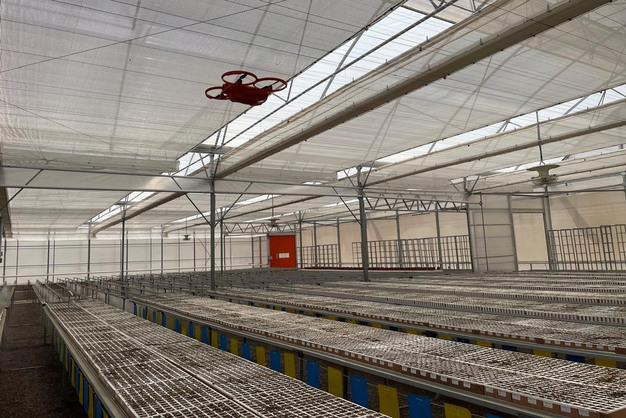
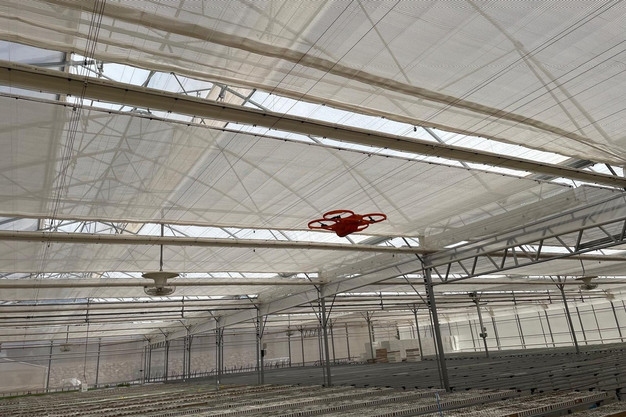
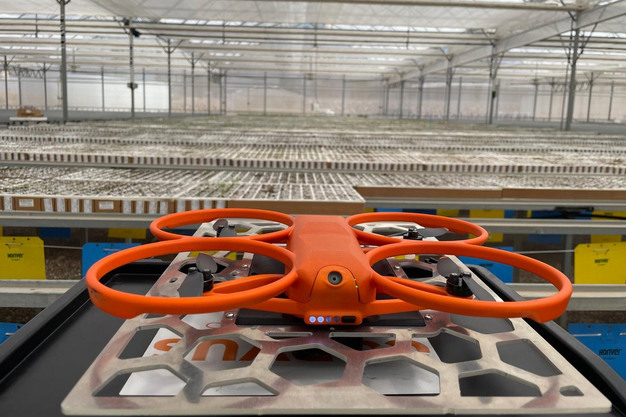
Drones designed for greenhouse interiors are compact, fully autonomous devices. "They operate from a charging base located in the agricultural facility. When programmed, they leave the station, fly around the greenhouse, and then automatically return to recharge their batteries," Burés stated.
"These drones are specially designed for indoor use, where GPS signals are unavailable. They utilize visual navigation systems and sensors to safely navigate between crop rows, even within complex greenhouse structures. The equipment flies autonomously along predefined paths and takes high-resolution images of each section of the crop," she added.
"The data gathered during the flight is processed in a digital platform, enabling growers to view crop maps, development indicators, and incident alerts."
 © Burés Innova
Experiences on commercial farms
In other European countries, like the Netherlands, some growers are already employing this technology to enhance crop monitoring. Although its potential is significant, its adoption remains limited in the Spanish market.
"One of the ongoing projects has been developed in collaboration with KWS, an international seed company, where drones are utilized to count germinated seedlings and evaluate their viability. In commercial greenhouses, adoption remains gradual; however, despite these challenges, automation is increasingly recognized as an inevitable trend in intensive agriculture," she said.
"While purchasing a drone involves a cost, the expense of employing someone to check the plants regularly is typically much higher," Burés stated. Additionally, finding specialized labor for greenhouse monitoring is becoming more challenging.
"We are just beginning to explore this technology. The potential is huge, especially when combining drones with artificial intelligence to analyze data and make decisions. As greenhouse digitalization advances and growers seek tools to optimize resources and boost productivity, solutions such as autonomous drones could become a vital part of the future of protected horticulture," she stated.
 For more information:
Burés Innova
Email: [email protected]
www.buresinnova.com