

It takes a minute for the eyes to adjust as Joe Chiera and Mike Beddoe badge through the greenhouse doors at NC State University's Plant Sciences Building.
It's so bright that at the entrance is a box of sunglasses.
"When the sun is shining on the white floor it's a bit like being snow blind," Beddoe says.
The 24-foot-tall glass and steel behemoth that sits atop the Centennial Campus building might look like an ordinary greenhouse.
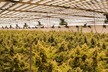
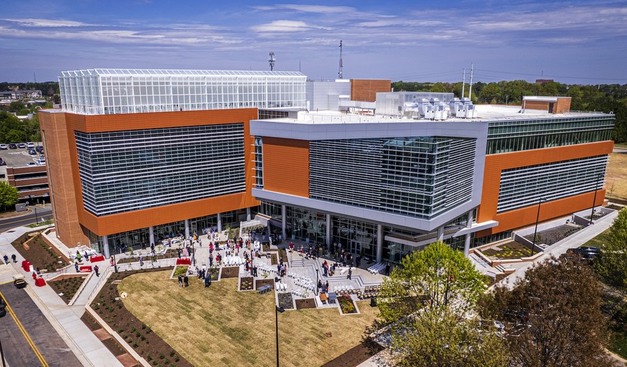 © NC State UniversityThe 10,000-square-foot Plant Sciences Building controlled environment lab features 11 greenhouse bays (top left) providing fully conditioned, under-glass growth environments for research.
But inside the computer-controlled facility, researchers work year-round to tackle some of the biggest challenges farmers face from diseases, pests and extreme weather.
Plants for dozens of ever-changing research projects are grown here at any given time, all with different needs, requirements, growing times, and Chiera and Beddoe are responsible for overseeing them.
"We serve the entire campus," Chiera says.
Growing innovation
Researchers in one room tend to rows of blue-green saplings. They're eucalyptus, the most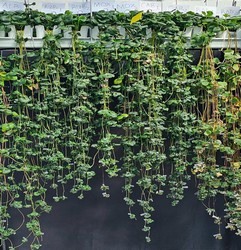 © NC State University widely planted hardwood pulp trees worldwide.
By editing specific eucalyptus genes, NC State researchers like forestry professorJack Wang and genome editing expert Rodolphe Barrangou are developing trees that are better for making paper and other wood products, cutting emissions and boosting sustainability for paper mills.
In another room, racks of hanging strawberry plants put out string-like runners that can be rooted and used to grow more strawberries.
Associate Professor of Horticultural Science Mark Hoffmann is researching new ways to propagate strawberry plants to minimize the spread of pathogens before they're shipped from nurseries to growers.
Growing plants for this work requires precise control of light, humidity and other conditions.
Controlled environments for research precision
Shouting over the hum of fans, sprinklers and other equipment, Beddoe leads down the hall to a back office.
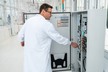
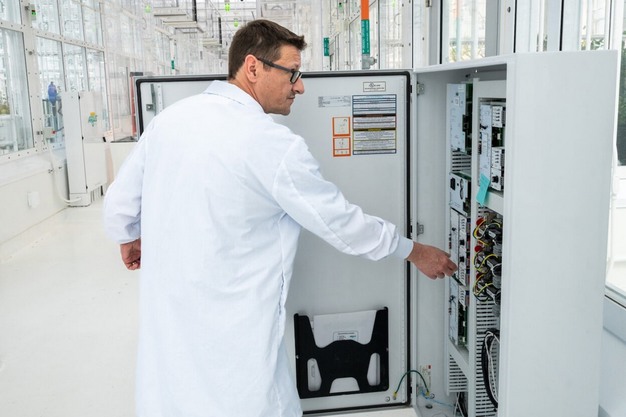 © NC State UniversityEach bay in the greenhouse is individually controlled, helping ensure that experiments meet the researchers' needs for rigorous standards. Pictured: Mike Beddoe.
"This is the brain for the entire greenhouse," Beddoe says, logging into a control system that lets them adjust the environment in each room according to researchers' needs.
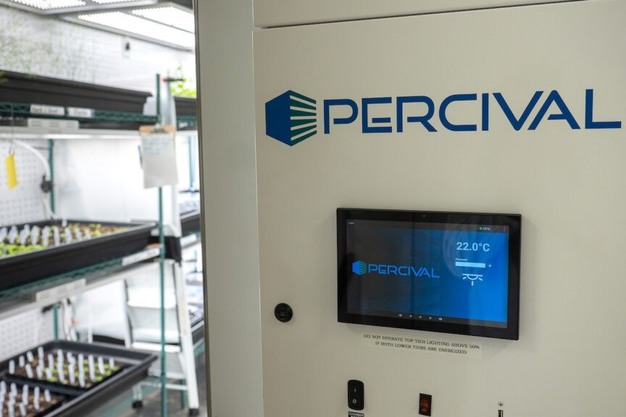 © NC State UniversityThe Plant Sciences Building has 25 growth chambers of different sizes, where plants are grown for food, fiber and even erosion control.
The facility consists of 11 independently controlled greenhouse rooms spanning more than 10,000 square feet, as well as 25 plant growth chambers.
Sensors in each room continually monitor the temperature, soil moisture, CO2 concentration and more.
The data are then sent to a central computer, where they're analyzed and compared against optimal standards before the system issues commands to, say, adjust the shade screens or turn on the misters. Even the watering schedules are programmed in.
"We try to automate everything," Beddoe says.
Safety first
Wending his way past stacks of pots and vats of soil, Chiera leads to one of the more unique rooms on the fifth floor.
It's the biocontainment greenhouse, one of a few facilities nationwide designed to safely study agricultural pests and pathogens.
Each year, farmers around the world lose up to 40% of crops they grow to pests and diseases.
As new threats continue to emerge that could jeopardize global food security, NC State isn't taking any chances.
So they've turned one wing into a specialized, high-containment facility known as a biosafety level 3 lab.
Research here could be used to test treatments for crop diseases, for example, or develop fruits and vegetables with enhanced resistance to insect pests.
The space itself is only accessible only to credentialed personnel, who work under the gaze of security cameras.
Chiera steps through the self-closing doors and into an airlock where researchers suit up into gowns, gloves, face shields and other protective gear before entering the lab.
What comes here, stays here
Everything from air and water handling to waste disposal is designed to make sure that what comes here, stays here.
All the water discarded from the BSL-3 greenhouse goes down separate pipes and is boiled before leaving the facility.
Solid waste is treated in a special oven called an autoclave, which uses steam and pressure to ensure any microbes are dead before disposal.
Even the air is designed for safety.
A negative pressure ventilation system creates directional air flow to prevent the escape of anything airborne, and all exhausted air is filtered before being released outside.
"So if we're dealing with a plant pathogen that produces spores, for example, it will capture those and not let them out," Chiera says.
Supporting diverse research to tough challenges
Back in the main corridor, Chiera and Beddoe make their way down the hall to their next meetings, passing thousands of lush green plants along the way.
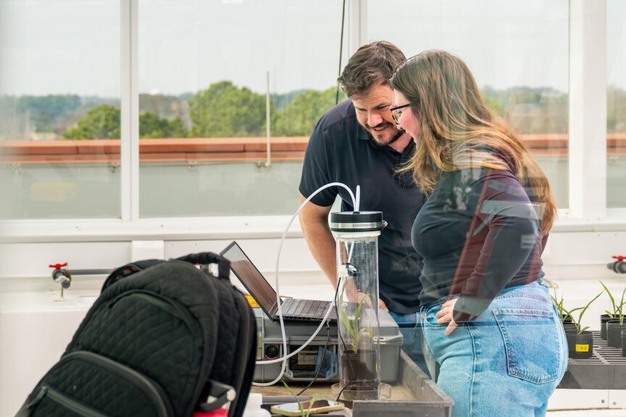 © NC State UniversityAlex Woodley (left) and Raine Lookabill study greenhouse gas emissions from soils in the greenhouse as part of his efforts to find ways to lower them and mitigate their effects.
Back in the main corridor, Chiera and Beddoe make their way down the hall to their next meetings, passing thousands of lush green plants along the way.
In one room, studies are underway on sweet potatoes. Electrical and Computer Engineering Professor Wenye Wang and her team are developing ways to help farmers monitor the starchy, swollen roots as they grow underground, using low-cost Wi-Fi signals (PDF) instead of pricey buried sensors.
in another room, NC State Professor Dorith Rotenberg, of the Department of Entomology and Plant Pathology, is growing corn. The plants will eventually become dinner for insects such as planthoppers and aphids to eat, to better understand how these insects spread viruses that can stunt growth and reduce yields in one of the world's biggest crops.
A fan favorite
Beddoe pauses in front of a room at the far end of the hallway. "This is my favorite bay," he says.
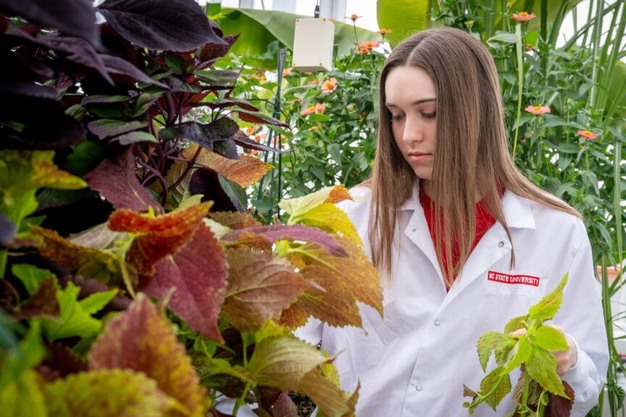 © NC State UniversityGrayson Cothran tends plants in a popular greenhouse bay where students get a chance to tend a variety of plants and learn about greenhouse operations.
Inside, there are soybeans and banana trees soaking up the sun, cotton plants with their hibiscus-like blooms, even a genetically engineered petunia that looks like a plain white flower by day but glows by night, using bioluminescent mushroom genes.
"These plants are mostly for our students," Beddoe explains. "So they can learn different ways to irrigate and propagate and stuff like that."
Always on call
Beddoe will be back here before heading home, as part of his twice-daily inspections.
That's because keeping the greenhouse running still requires plenty of hands-on work.
"One of us is always on call," says Beddoe, whose phone buzzes on evenings and weekends if anything needs attention.
"Plants don't take vacations," he adds.
Source: NC State University