

The cannabis industry is full of abandoned cultivation facilities, as a testament to the initial unbridled rush to enter the market at any cost. As tragic of a story each of those carry, it's undeniable that they represent a great opportunity to jump start a cultivation without the need to go through a whole design and build phase.
Grown Rogue International is entering the Illinois adult-use market by leasing a fully constructed cannabis facility in Dwight that was operational until December 2025. The 66,000-square-foot facility in Dwight was previously operated by PharmaCann and is owned by Innovative Industrial Properties. The company expects to begin operations in Q2 2026, with product availability targeted for Q4.
Total project capital comes to approximately $4 million, while a comparable new-build entry would typically require $10 million or more and roughly a year of pre-occupancy construction, according to Grown Rogue CEO, Obie Strickler.
 © Grown Rogue
Infrastructure, speed, capital discipline
Obie says the Dwight facility cleared three simultaneous criteria. "What stood out was that it checked three important boxes such as infrastructure, speed, and capital discipline. First, the facility was recently operational and remains in good condition. That matters. When you're evaluating distressed or idle assets, you're underwriting how quickly and predictably you can bring it back to life. This site has established flowering rooms, post-harvest infrastructure, and core mechanical systems already in place. We're not starting from a shell. Second, it meaningfully reduces time to the first harvest. In most new markets, we underwrite roughly a year of construction before the first plant. Here, assuming regulatory approvals move normally, we expect to be growing in under nine months from signing. That's a material advantage. Third, the capital efficiency aligns with how we operate. Instead of $10 million or more for a new build, we're entering with approximately $4 million of total project capital, including working capital. That improves return on invested capital while still giving us room to hit our quality and yield targets. More broadly, we are most actively pursuing markets where we believe there is a shortage of true craft-quality flower, not necessarily a shortage of supply overall, but specifically differentiated, indoor flower grown with discipline. In markets dominated by large-scale operators, we often see room for a focused, flower-first approach. We evaluate a lot of assets, but we pursue the ones where our operational playbook can create a clear edge and where we're excited to introduce Grown Rogue flower to more customers. We genuinely enjoy sharing what our team builds with new markets."
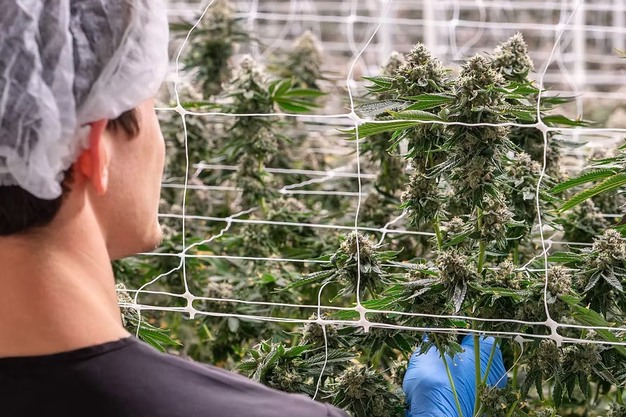
The facility currently includes approximately 10,000 square feet of indoor flowering canopy, with room to expand to the 14,000 square feet permitted under the craft grow license. In other words, this building can only be expanded so much, which is obviously an aspect that shapes the production strategy. "The craft grow framework in Illinois caps canopy at 14,000 square feet, which naturally forces discipline. You don't have unlimited scale to hide inefficiencies. From our perspective, that's a design parameter. We've built the company around indoor flower with tight environmental control, strong genetics, and consistent turns. A 10,000 to 14,000 square foot flowering canopy is well within the range where we believe we can drive strong grams per square foot and healthy turns per year without sacrificing quality. It also sharpens the focus on SKU mix and room utilization. Every room has to perform. Every strain has to earn its space. In capped-license environments, you win by optimizing yield, minimizing downtime between cycles, and maintaining quality that retailers consistently reorder. Rather than pushing toward scale for scale's sake, the craft framework reinforces our flower-first strategy and execution mindset. If a market is undersupplied in craft-quality indoor flower, the opportunity isn't about being the biggest, it's about being consistently excellent."
A template for distressed assets
According to Grown Rogue CSO, Josh Rosen, the Illinois deal represent the the execution of a strategy the company has been cooking for some time. Using industry-wide distress as a pipeline for growth, that is. "We view the current industry distress, as demonstrated by many announced restructurings over the past year, as an additional pipeline for future growth. We believe our team is well positioned to step into underutilized cultivation assets and leverage our disciplined, low-cost approach to generate meaningful returns."
In 2020, Grown Rogue acquired a second indoor facility in Oregon, previously owned by Acreage Holdings. Currently, the site now produces more than 650 pounds of flower per month, more than five times its past output. Obie points to sequencing as the main driver of those improvements. "Standardization before optimization," he says. "When we acquired a second indoor facility in Oregon in 2020, it was underperforming relative to its potential. The first step wasn't chasing higher yields. We implemented disciplined environmental setpoints, irrigation strategy, genetics management, labor workflows, and data tracking. We made the operation predictable. Once you have consistency, then you optimize. That facility now produces more than 650 pounds per month of craft-quality flower or more than five times what it was producing when we took it over. That improvement came from disciplined execution across dozens of small variables, not from one major change. In Illinois, we'll take the same approach. Stabilize the rooms. Align the team around SOPs. Measure what matters such as yield per square foot, turn times, cost per pound. Then layer in improvements. In volatile markets, discipline compounds. That's the lesson we're bringing with us."
For more information:
Grown Rogue
[email protected]
www.grownrogue.com