

Germany's medical cannabis imports crossed 200 tons in 2025, according to new data published by BfArM, the country's federal medical cannabis authority.
Total flower imports for the year reached 201,094 kg, nearly tripling the 72,706 kg recorded in 2024. The growth has been consistent across quarters: from 37,686 kg in Q1, to 47,707 kg in Q2, to a peak of 59,076 kg in Q3, before a slight dip to 56,625 kg in Q4.
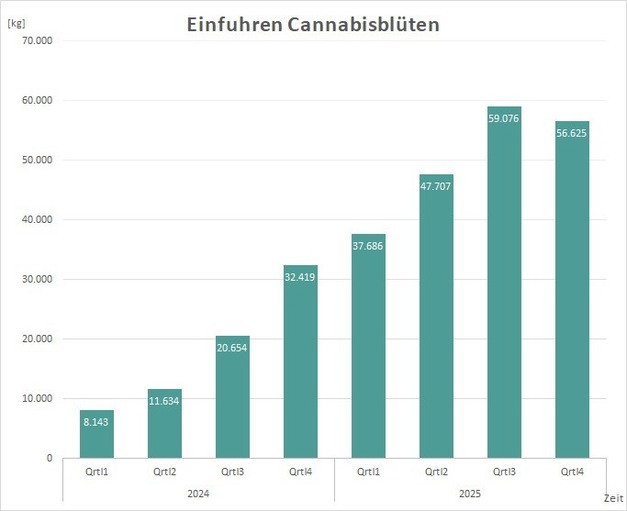 © BfarM
Canada remains by far the dominant supplier. The country shipped 93,006 kg to Germany over the course of 2025, up from 33,155 kg in 2024, accounting for 46% of total annual imports. Portugal came in second with 55,164 kg, against 17,230 kg the previous year. But Nuno Martens, CEO of Takodana, a Portuguese medical cannabis grower, says the headline figure tells an incomplete story.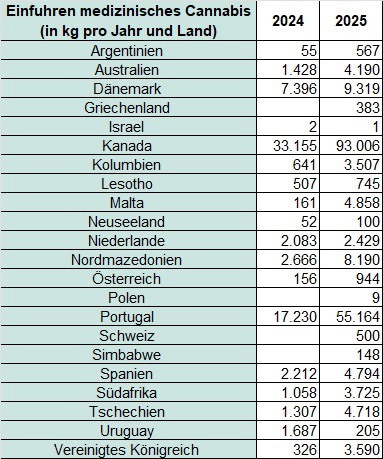 © BfarM
"Even though it's Portugal that shows up as doing the exports, whoever is winning is not the Portuguese producers," Nuno says. "It's either the guys in Thailand who are across the world, or the Germans buying it at a very low price. Big numbers for Portugal, Portugal losing on it, and everyone else winning on it."
He attributes the dynamic to a handful of wholesale license holders driving prices to levels most smaller producers cannot sustain. "For one to win, the others must lose, because the price crunch is being done by one or two wholesale licenses in Portugal," he adds. This is the same sentiment echoed at the end of last year by a Portuguese grower who didn't want to be named, when they even alleged price dumping happening in the country's MMJ sector.
Among the emerging suppliers, North Macedonia stands out. The country shipped 8,190 kg to Germany in 2025, up from 2,666 kg in 2024, a threefold increase. Stephen Malloy, CEO of PharmaRolly, a North Macedonian medical cannabis grower, says the country's natural conditions give it a structural edge that is only now getting the attention it deserves.
"Growing conditions in the country are frequently compared favorably to Northern California, however with longer and drier summers that support excellent cultivation, especially in greenhouses," Stephen says. "Sun-grown cannabis from North Macedonia displays distinctive efficacy characteristics that make it particularly appealing for medical use."
Not everything in the North Macedonian market has run smoothly, however. A producer in the country, who asked not to be named, notes that recent investigations have uncovered licensed operators diverting product to the illicit market. "These cases mostly concern unknown companies that received licenses under the previous administration," the source says. "The current government has adopted a progressive yet firm approach, prioritizing the rule of law. It has launched nationwide inspections and already revoked several licenses following major seizures and investigations." They add that removing non-compliant operators should ultimately benefit legitimate producers by freeing up regulatory resources and enabling faster delivery to international markets.
Australia more than tripled its shipments to Germany in 2025, reaching 4,190 kg for the full year, which is an impressive figure given that the country's total global medical cannabis exports stood at just 3.3 tonnes in 2024. Malta jumped from 161 kg to 4,858 kg. Denmark shipped 9,319 kg, up from 7,396 kg. The Czech Republic, Argentina, Colombia, and the UK all recorded significant year-on-year increases as well. Quarterly imports of cannabis flowers and extracts combined have climbed from 203 kg in Q1 2017 to 8,508 kg in Q4 2025.
Last year, Arthur de Cordova, CEO of processing equipment company Ziel and a former AstraZeneca country manager with a decade in cannabis, predicted Germany would reach 600 tonnes of annual imports without any slowdown along the way. The Q4 dip is a small but notable data point against that thesis, though whether it represents a genuine inflection or simply a seasonal blip remains to be seen.