

At a knowledge event organized by screen manufacturer Svensson in the Netherlands, growers and industry professionals gathered at the World Horti Center in Naaldwijk to discuss how to maintain a balanced greenhouse climate under full-LED lighting. The event, supported by the Greenhouse as Energy Source (Kas als Energiebron) program, was held for the eighth time and featured presentations from researchers and advisors, followed by a panel discussion.
Svensson consultant Ton Habraken opened the evening with a 10-step plan for energy savings in the greenhouse. When a photo of a poorly maintained screen installation appeared on screen, a grower in the audience immediately recognized his own greenhouse — prompting laughter, but also recognition from others in the room. A small gap in a screen cloth or a sagging cold trap strip are issues Habraken encounters regularly on farm visits.
The first step in his plan is straightforward: address deferred maintenance. From there, Habraken walked through investment options, including the installation of a measurement box above the screen, energy-saving screens, the Svensson Energy Monitor, and the ClimaFlow system for air movement. The event's broader aim, however, was knowledge sharing rather than product promotion.
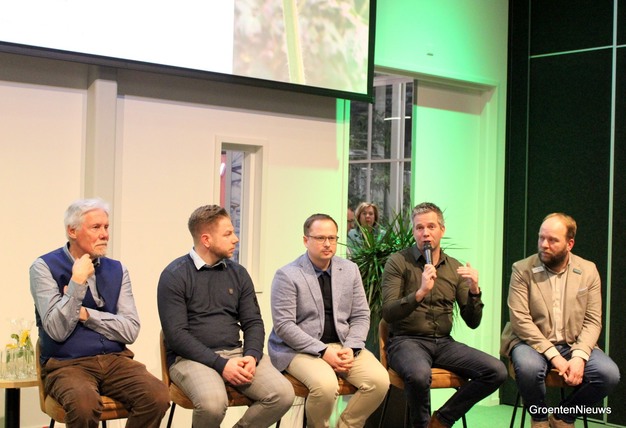 © Thijmen Tiersma | MMJDaily.comPeter van Weel (Weel Invent), the experienced tomato grower Dennis van Wingerden, Silvère Vialet-Chabrand (WUR), Erik Stappers (Horti-Consult International), and Ton Habraken (Svensson) during the concluding panel discussion
Do you measure air movement?
The evening opened with a presentation by Silvère Vialet-Chabrand, Assistant Professor in Horticulture and Product Physiology at Wageningen University & Research. His central question to the audience was direct: do you measure air movement in your greenhouse? Three hands went up. He was not surprised.
Vialet-Chabrand emphasized the distinction between the overall greenhouse climate and the microclimate directly around the plant. Even when the broader climate appears optimal, the conditions at leaf level that are critical for photosynthesis can be unfavorable.
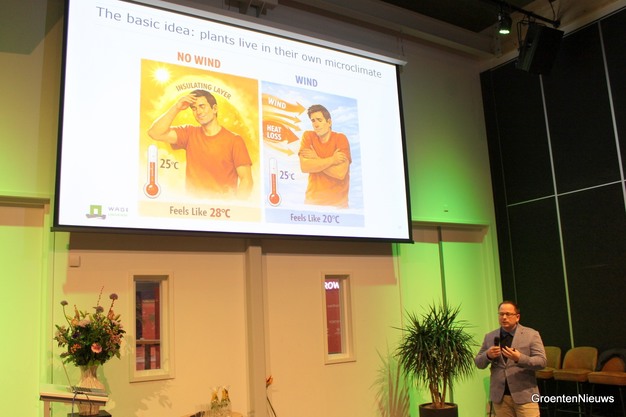 © Thijmen Tiersma | MMJDaily.comSilvère Vialet-Chabrand (WUR) explains why the microclimate is even more important for the plant than the general climate in the greenhouse.
The boundary layer
Around every leaf, there is a still air layer known as the boundary layer. Its thickness depends on the level of air movement in the greenhouse. This layer creates resistance to the exchange of heat, water vapor, and CO₂ between the leaf and the surrounding air, processes that are essential for plant growth.
Research shows that even small improvements in air movement can have a significant effect on crop growth. Plants also have a natural mechanism to protect themselves from excessive air movement: stomata never close completely, ensuring that photosynthesis can continue even under high air velocity conditions.
Vialet-Chabrand urged growers to start using air movement as an active management tool — for example, to distribute dosed CO₂ more evenly throughout the greenhouse.
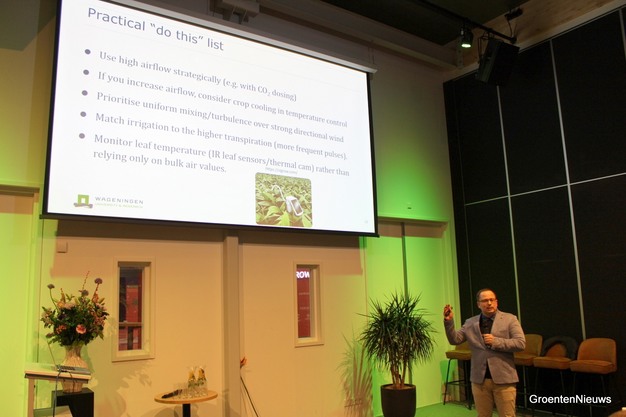 © Thijmen Tiersma | MMJDaily.comIn addition to scientific knowledge, also practical tips for growers in the audience.
Air movement as a control tool
Research has shown that a small improvement in air movement in the greenhouse can have a significant impact on plant growth. Moreover, a plant naturally protects itself from an overdose of air movement by never completely closing the stomata. In this way, a plant ensures that photosynthesis can continue.
The assistant professor from Wageningen University & Research calls on the audience to start using air movement as a control tool in cultivation. You should use air movement tactically, for example by properly distributing the CO₂ that growers dose through the greenhouse.
 © Thijmen Tiersma | MMJDaily.com
Bart Bakker speaks on behalf of Svensson about transparent energy screens and explains why the percentage of diffuse light that an energy screen allows through deserves more attention.
Evaporation in LED cultivation
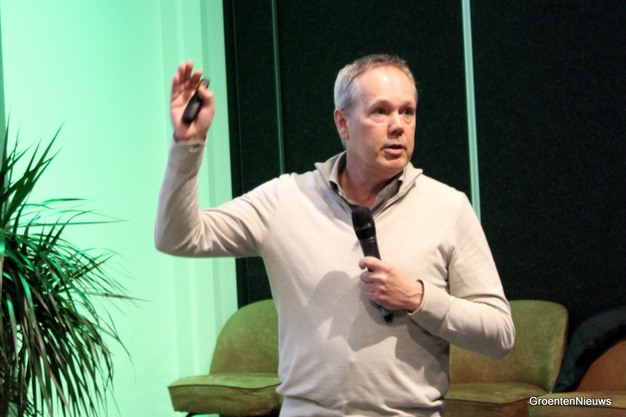
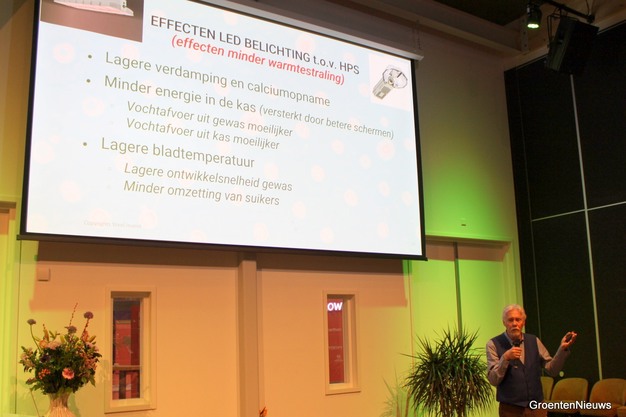
The role of air movement in LED cultivation was examined in more depth by Peter van Weel, formerly a researcher at Wageningen and now active in greenhouse technology development through his company Weel Invent. Van Weel explained why maintaining adequate crop transpiration is particularly important in LED-lit greenhouses and how air movement can support this.
He encouraged growers not to rely solely on data from a central measurement box, but to take measurements closer to the crop. He highlighted crop transpiration as an area that is still largely unmonitored in practice — and argued that it should be measured routinely.
 © Thijmen Tiersma | MMJDaily.com
Peter van Weel does not shy away from strong statements. It is clear to the experienced researcher where things are still going wrong in LED cultivation.
Practical experiences from last winter cultivation
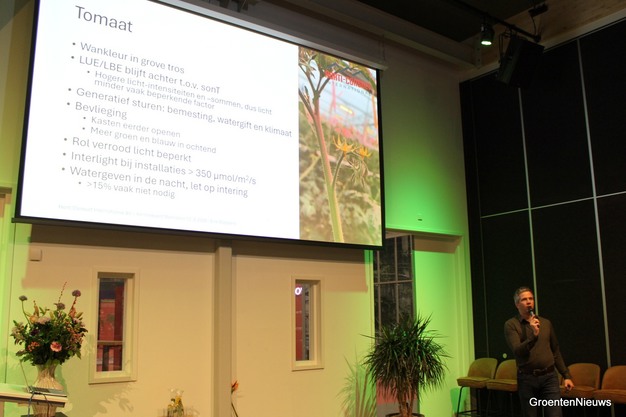
Cultivation advisor Erik Stappers, who previously worked for an LED supplier and now consults at Horti-Consult International, shared practical experiences from LED-based cultivation, with a focus on observations from the most recent winter growing season. The greatest challenge he identified is the conversion of sugars into fruit production, in other words, the efficient translocation of assimilates to the fruit.
Tomato color deviation
In illuminated tomato cultivation specifically, uneven fruit colouring remains a recurring concern. Additionally, light use efficiency has been observed to fall short of expectations. During the closing panel discussion, which included experienced tomato grower Dennis van Wingerden alongside the evening's speakers — vertical temperature distribution and air movement were identified as key areas for further attention.
 © Thijmen Tiersma | MMJDaily.com
Erik Stappers (Horti-Consult International)
Continued interest
"The fact that we again have such a full room is an encouragement for us to continue," said Hugo Plaisier on behalf of Svensson.
Growers who wish to discuss their situation ahead of the next event can request a personal Luxous Energy Saving Consultation with Svensson specialists. At the close of the evening, one grower who signed up for a consultation was selected to receive an infrared thermometer, a tool that may well generate new insights and topics for future events.
 © Thijmen Tiersma | MMJDaily.com
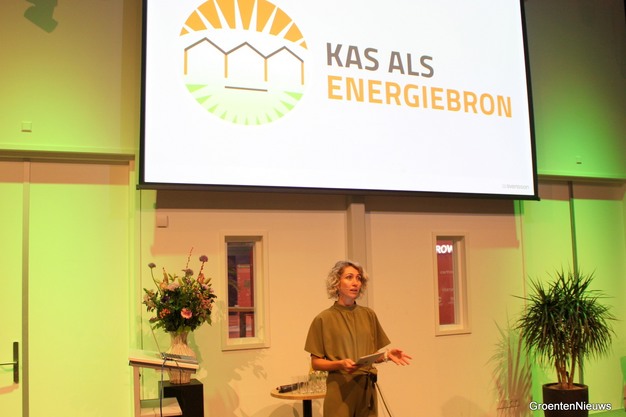
Patty Varekamp hosted the event, which was organized with the support of Greenhouse as Energy Source.
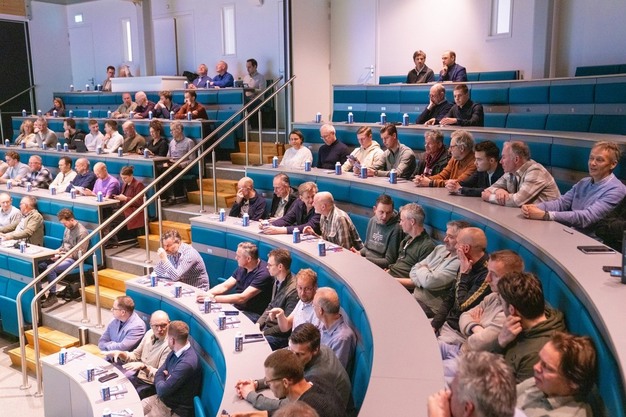
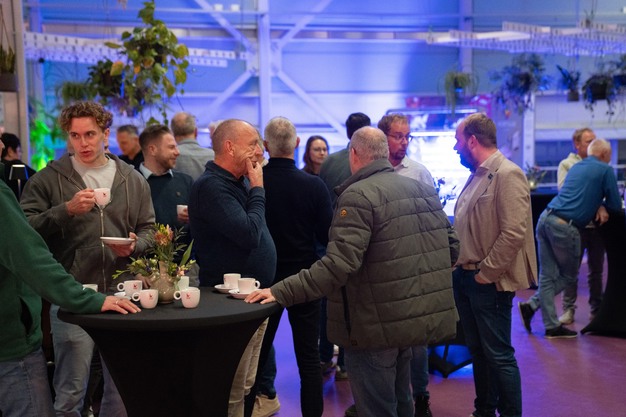
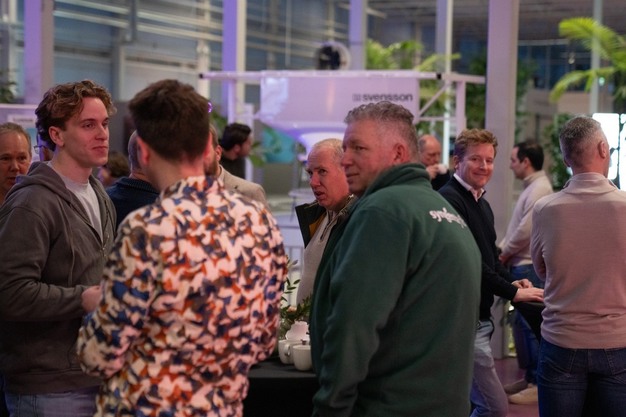
Johan Weesie of Svensson loves photography and provided a few atmospheric images on Thursday evening.
 © Ludvig Svensson
 © Ludvig Svensson
 © Ludvig Svensson