

When tissue culture laboratories first emerged in the 1970s, they quickly became standard infrastructure for propagating tomatoes, corn, and dozens of other crops. Decades of scientific literature followed, refining the formulas and SOPs that made the process reliable at scale. For cannabis, that body of knowledge simply doesn't exist, effects from the prohibition era. It's a gap that companies like Microhemp, a tissue culture lab based in Italy, are now working to close. "Tissue culture laboratories have been existing since the 70s," says Marco Bianco, founder of Microhemp. "But when it comes to cannabis, this is quite the new space."
 © Microhemp
Setting up in a vacuum
The scientific void has made the setup unimaginably difficult. "Tissue culture has been known inside and out since the 70s. In the Cesena area, where we are, there are plenty of labs, but they deal with traditional plants. Italy produces millions of plants in tissue culture every year, but the cloning formula for those plants is well known to the scientific community. Due to prohibition, there's not nearly as much for cannabis." That's why Marco says the value of Microhemp lies precisely in having found the SOPs for cannabis tissue culture. "We clean and preserve genetics, and obviously replicate them."
Before they got to that point, they first had to go through the garage phase. That was 2018. "We started our first tests in typical startup fashion. However, that couldn't work, everything kept getting contaminated, which reinforced our conviction that we had to set up a sterile lab." Thanks to a European grant, the Microhemp lab was finally a reality. "We built the lab inside two 12-meter containers. One holds a growth chamber, and the other holds the lab and a sterile growth chamber." Notably, Microhemp didn't purchase ready-to-use container farms, they acquired empty shipping containers and retrofitted them entirely to their specifications.
 © Microhemp
Micropropagating cannabis
That hands-on experience became the foundation for one of the company's secondary services: designing and setting up tissue culture labs for other facilities. But the core business remains micropropagation. "In micropropagation, every month, you triple the material."
The method sounds simple but isn't. "We start from small plastic pots, with 7 nodes left to grow. We reopen the pot, re-section the plant at those 7 nodes, and move to 3 final pots. If you do this every month, you can produce a huge number of plants, it's exponential. Within a very short time, we build the line, meaning millions of identical plants." Achieving that requires precise planning at every stage. "The plant I deliver to you today was pulled out of the sterile environment. To have that plant ready, we started two months before delivery, and there are at least two months of planning before that to get to the final clone. To deliver a plant to the client, I decided it would become a real plant four months before delivery. This creates challenges, as we have to be good at managing stock, but that allows us to fulfill numbers that a traditional nursery would have difficulty matching. Even though our strength is in the numbers, what truly sets us apart is our cleanliness. When you work in GMP, what matters most is starting from a plant that you can guarantee is not contaminated."
Synthetic seeds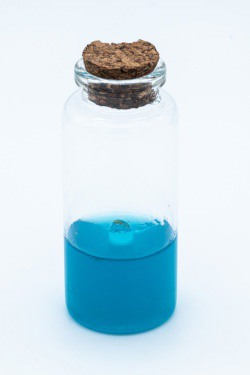 © Microhemp
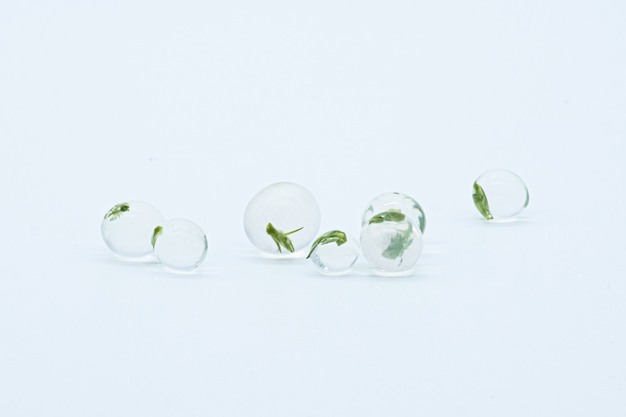
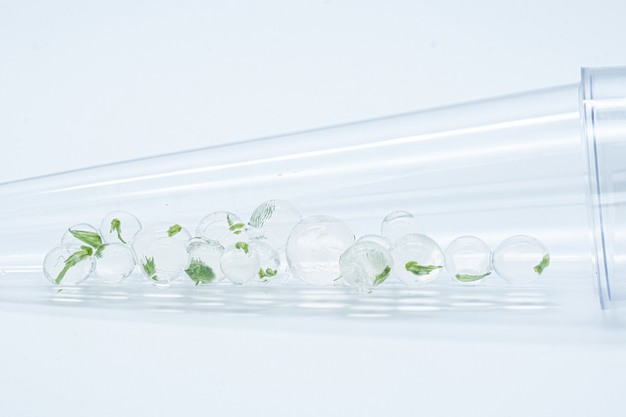
Genetic preservation at Microhemp can also take the form of synthetic seeds, a striking mode of storing genetics that keeps traits intact for the long term, and one that turns out to have a practical advantage that has nothing to do with biology. "It's an incredibly convenient option from a purely logistical standpoint," Marco explains. "If a multinational has facilities in multiple countries and opens a new site in North Macedonia, synthetic seeds are the best way to move a specific genetic. Just put the vial in your pocket," he says with a laugh.
The reality is more nuanced, as Marco is quick to acknowledge. Synthetic seeds cannot yet be germinated in rockwool, another lab is required on the receiving end. Microhemp has tested a middle-ground solution: a packaging format in which the synthetic seed and growth gel are held inside the same vial but kept mechanically separated. The user tips the seed onto the gel to trigger rooting. "It wasn't guaranteed enough. The seed did germinate with reasonable frequency, but not good enough," Marco says. For now, the project is on hold while the company focuses on scaling its core micropropagation and lab design services, the work, as Marco puts it, that a tissue culture lab actually runs on.
For more information:
Microhemp S.r.l.
Via Giuseppe Verdi 131, 41019 Soliera (MO), Italy
+393351736178
[email protected]
microhemp.it