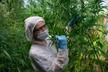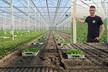


At 5,000 square feet, Flora Arbor is about as small as a licensed cannabis cultivator can legally get. That is not a problem the company is trying to solve. "We're a really small grow, which means we can control things very well," says David Myrowitz, director of cultivation. "It also means that we have to be successful on every round." Three flower rooms, harvested three weeks apart. No room for a bad batch to disappear into a larger average. Every round counts, and the operation is built around that reality.
It starts in the pump room
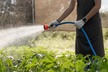
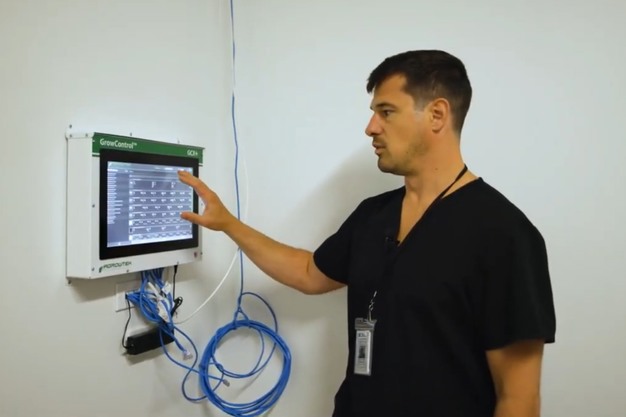
Reverse osmosis water feeds into holding tanks, nutrients are blended through an Agrowtek fertigation machine, and the whole system runs off a GCX controller that tracks moisture sensors, total dissolved solids, and soil temperature across every room. Canopy sensors feed directly into the HVAC, which Flora Arbor runs on Cultiva units. "If you talk to any grower, any cultivator, they'll tell you that the number one thing to running a successful grow is having a good HVAC system," David says. "It's somewhere that we've spared no expense."
 © Flora Arbor
Genetics and rooms
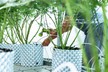
Mother plants are cycled out every three to six months so cuts are always coming off young stock. Clones move from propagation domes into a humidity-controlled room, then into veg, where a crop steering protocol runs multiple irrigation feeds a day to push growth. Moisture sensors in the grow bags track every dry-down cycle, and daily irrigation pictures are reviewed against the grow system's targets.
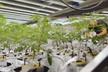
Flower rooms run a dual-tier rack system, taller plants on the bottom, shorter ones on top, grouped to keep microclimates out and light distribution even. A second trellis net drops down as plants develop to give each bud site its own square and keep airflow moving through the canopy.
At a recent walkthrough, rooms at different stages of the cycle were running concurrently. Hawaiian Rain crossed with Permanent Marker, Disco Fries, Cereal Milk. David pointed out the crystal development on the Hawaiian Rain cross, the citrus resin load on the Disco Fries, the height management challenge that comes with pushing a cultivar as big as possible without burning it on the lights. "We try to have a nice spread of genetics, a nice representative of each flavor profile and effect to make sure that everybody can get something that they like," he says.
Crossing the finishing line
Post-harvest is handled in-house, by hand. Product is sorted into A-bud, B-bud, and trim at the trimming table, kept strictly separated so the grade on the label means something. The tiered structure also serves a second purpose. "We think it's really important to make sure that quality flower is available to people of all means, not just people that can afford the premium," David says. The three-week harvest cycle is Flora Arbor's main argument to the consumer. Small batches, continuous rotation, nothing sitting in storage.
"Every time you get a bag, it's going to be fresh herb that was just harvested," David says. "Not something that's been sitting in some MSO's vault for six months because they harvested 2,000 lbs of it and they can't sell it." The bet is that in a market where consistency is the complaint nobody has solved, being small enough to catch every outlier is worth more than the economies of scale you give up to get there.
For more information:
Flora Arbor
1300 Abbott Dr, Elgin, IL 60123
847-504-8450
[email protected]
floraarbor.com