

Nevada is one of the most competitive cannabis retail markets in the United States, and Deep Roots Harvest has spent years betting that the way to win it is to control everything. Cultivation, processing, manufacturing, extraction, and 11 retail locations, all under one roof, or close enough to it. Chris O'Ferrell, senior director of cultivation at Deep Roots Harvest, runs the grow side of that operation across two facilities totaling 30,000 square feet of canopy, pushing 500 pounds of harvested cannabis a week and 2,000 pounds of biomass a month.
"The Source and Deep Roots harvest retail team sells approximately 75 pounds of cannabis daily, 500 pounds each week, with over a third being internal to support the High Heads, Neon Moon, and CAMP brands. We cultivate, extract, process, manufacture goods, and operate retail locations," Chris says. "We have one of the largest market shares in Nevada in terms of retail volume and gross sales."
That volume is produced by 60 full-time grow employees across both sites, and the cultivation program behind it is, by any reasonable measure, built for efficiency and quality. "Many of the genetics in our library consistently exceed 100 grams per square foot, which directly helps lower our overall cost per gram," Chris explains. "We operate with a consumer-first approach, focusing on cost-consciousness while delivering flavorful, competitive offerings. We operate below 70 cents per gram, a benchmark that reflects careful cost management. Getting there and staying there has required compressing costs at every input level while continuing to invest in the technology that actually moves the needle on costing, efficiency, quality, and yield."
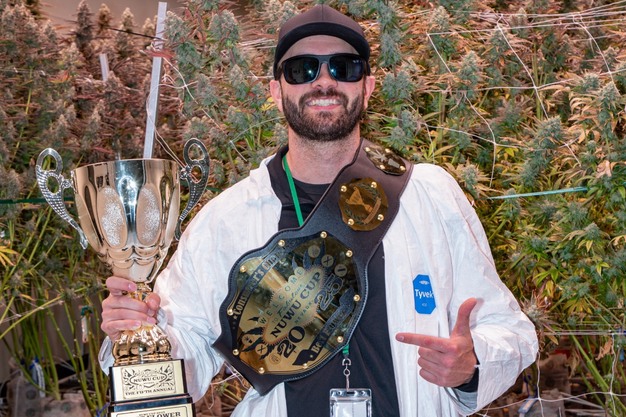 © Deep Roots Harvest Chris O'Ferrell, senior director of cultivation at Deep Roots Harvest
Genetics the way the grower intended
The lighting transition is a clear example of that, as it's often the case in cannabis. Initially, the company was using your classic HPS lights. As LED technology advanced, Deep Roots made the switch. However, it wasn't simply about improving energy efficiency. Chris and the team understood that the more precisely you can steer cultivation, the better the end product. Energy savings don't necessarily show up on retail shelves, but cultivation control does, in the form of flower that expresses its genetics the way the grower intended.
To achieve that level of control, spectrum became a critical tool. "We start with a spring setting, using blue light to regulate internodal spacing and control stretch," he explains. "As the plants progress, we transition to a summer spectrum through late week eight, shifting to a fuller, broad-spectrum light with a balanced distribution of wavelengths. This includes increased red light, alongside other portions of the spectrum to more closely replicate natural sunlight. We also increase light intensity throughout the flower phase to drive photosynthetic activity, improve plant performance, and enhance overall cannabinoid accumulation. Together, these parameters support floral initiation, accelerate maturation, and allow the plant to fully express its genetic potential."
Nothing left to chance
At the canopy level, plants in the larger of the two facilities go into two-gallon coco pots, chosen to accommodate longer veg times and larger plant structures. The second facility runs stonewool. Both use substrate sensors tied into fertigation control, tracking performance across different growth phases. Dissolved oxygen is injected to increase availability at the root zone, while a chlorine injection system keeps lines clean from pathogens with a relatively inexpensive setup compared to conventional cleaning programs. "The chlorine injection system is relatively inexpensive to implement, and it replaces approximately 40,000 dollars annually of other cleaning and sanitizing products," Chris says. "It's about staying ahead of the curve."
Pest management runs entirely on biologicals, implemented alongside mechanical and cultural controls. "We have had no pest issues whatsoever," Chris says. "This too was a decision based on reducing inputs while maintaining, if not improving, product quality."
Genetics are the backbone of cannabis operations and the gas in the company engine. They get the same systematic treatment as every other part of the operation. A steering committee reviews the portfolio quarterly, retiring underperforming cultivars and sourcing replacements based on market data pulled from multiple markets, cross-referenced against gaps in the current menu. The criteria are repeatable agronomic performance, yield, potency, a distinct flavor profile, and the ability to wash well for extraction, ensuring strong returns for both rosin and resin production. "Every genetic needs to fit the program," Chris says. "Yield, potency, and unique flavor expression that fills a gap in what we don't have on the menu. It's about finding the commercial cultivar that performs well and fits into our existing infrastructure. All the cultivars we grow now have a similar and predictable grow structure. What's different is the color, the smell, the experience. Agronomically speaking, they are very close."
For more information:
Deep Roots Harvest
deeprootsharvest.com