
For most growers, "stress" is something to avoid. But in cannabis cultivation, stress isn't always a bad thing, if it's managed strategically. "Stressors are part of how we signal plants to flower, to produce secondary metabolites, or to adapt to changing conditions," says Av Singh, cannabis cultivation consultant from Lav & Kush Consulting. "The trick is knowing which stressor to use, when, and how much."
Light as a stressor: quantity and quality
Every cannabis grower already uses light as a stressor, whether they think of it that way or not. The flip from 18 to 12 hours is itself a controlled stress event that tells plants to initiate flowering. "At the same time, it's crucial to remember that both the quantity and the quality of light shape how plants respond," Av points out. "Higher PPFD levels drive stronger cannabinoid expression, but only up to the point where photosynthesis is no longer the limiting factor. Push intensity too far, and other systems, climate, substrate, CO₂ management, quickly become bottlenecks."
Spectrum shifts add another layer. Blue light and UV are well documented to increase terpene expression, while far-red, when combined with a full white spectrum, can enhance photosynthesis by stimulating Photosystem I and II. "A grower's primary job is to optimize photosynthesis, and spectrum is one of the levers to pull," Av remarks. "Even subtler shifts in quality can determine whether traits like purple pigmentation in Kush varieties are expressed, which in turn may influence both medicinal and intoxicating properties. While the full benefits of flavonoid expression remain under-researched, the fact remains that light quality directly influences how those traits show up in the crop."
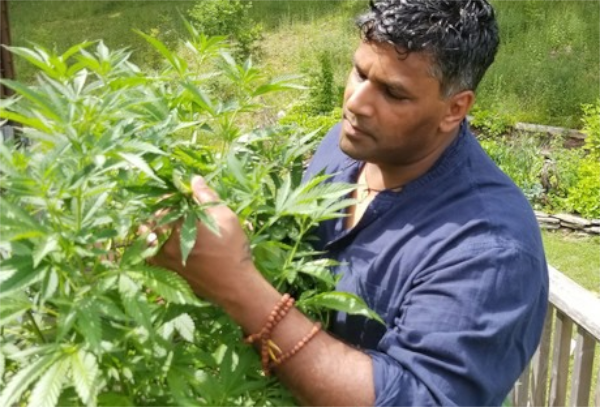 © Av Singh
Drought stress
Drought stress is another lever that requires nuance. "The popular belief is that less water means higher THC concentrations, but this often comes from measuring THC on a wet-weight basis," Av explains. The more practical application of drought stress lies in how it influences flowering initiation. "Applied early, shortly after the switch to flowering, drought stress can trigger plants to flower more uniformly and quickly. Without that stress, some cultivars may take three or four weeks before producing flowers, extending a cycle unnecessarily. In hybrids with blended flowering periods, early drought stress can help tighten up the schedule."
Nutrients, training, and defoliation: stacking stress carefully
Light and water aside, growers often rely on nutrient stress by raising EC levels, as well as training and defoliation techniques such as supercropping, trellising, and pruning. All of these are legitimate stress tools, but Av warns that stacking them without caution is a recipe for hermaphrodites. "Defoliation, transplanting, topping, the plant interprets all of these as predator or environmental threats," he says. "With today's genetics, unless they're extremely stable, you have to be careful. Too many stressors at once and the plant's response is to protect itself by producing pollen." For large-scale growers, that means resisting the urge to combine major stress events without a clear strategy, and paying close attention to cultivar lineage before deciding how aggressively to push.
Microbial signals: stress below the surface Stress doesn't stop at the canopy. Microbes in the rhizosphere act as constant stress signals that shape plant responses. "Terpenes are the language of microbes," Av explains. "When you introduce inoculants, whether it's lactobacillus, yeasts, or a full consortia in living soil, the plant responds by shifting metabolite production."
Healthy microbial communities function both as stressors and as protectors, building resilience against pathogens while supporting secondary metabolite synthesis. Av compares it to gut health in humans: if the microflora is balanced, the whole organism is healthier. In cannabis, surrounding roots with beneficial microbes creates stronger, more vigorous plants. He points to aquaponic and living-soil facilities where diverse microbial consortia correlate with lower pathogen counts and cleaner flower. "Healthy plants don't need irradiation," Av says. "They defend themselves."
Managing stress as a cultivation tool In the end, stress in cannabis cultivation isn't binary, it's a dial, not a switch. Light shifts, drought, nutrients, training, and microbes are all legitimate tools, but they must be timed and layered with care. For Av, it comes down to grower intent. "Stress is something to manage," he says. "Use it to optimize photosynthesis, to trigger secondary metabolites, and to bring out the best in your genetics. It's crucial not to overdo it. The plant will tell you when enough is enough."