
IPM in cannabis faces a dual challenge: there are many pests and pathogens that are craving to feed on your plants, but there's a very limited list of approved chemicals that can be used. This makes this practice a constant balancing act between biology, chemistry, regulations, and economics. According to Anoo Solomon, Owner, CannaProtect IPM Solutions, cannabis IPM specialist, the best way to approach crop protection in cannabis is through closed-loop IPM systems. "The closed-loop concept defines the continuous, data-driven programs that form the basis of any IPM regimen," she explains. "Every action is informed by scouting, monitoring, but also financial feasibility."
 © CannaProtectIPM
Is it physically closed?
If it wasn't clear enough, a closed-loop system is not a one-off intervention. "It's an ongoing, informed cycle," Anoo remarks. The loop begins with detailed scouting. "Trained staff members inspect the plants, check sticky cards, and assess pest presence." Currently, the industry is also witnessing the rise of AI-assisted tools, which supports human expertise with digital imaging to identify hot spots and changes in pest population dynamics. That is to say, scouting doesn't necessarily have to be a slow, manual process.
Once pests or pathogens are identified, thresholds must be established. A threshold represents the point where pest pressure becomes economically or biologically unacceptable, triggering an intervention. "Thresholds are the parameters that tell you how much action you need to take," she explains. "These thresholds can only be determined through disciplined monitoring over time, because a single pest sighting justifies action."
That's where the fun begins, assuming that is your idea of fun obviously. From there, growers decide how to intervene. Choices may include biological controls, chemical tools where permitted, or hybrid approaches combining both. The decision is guided not only by the biology of the pest but also by the financial and labor realities of the operation. "At that point, the action is dictated by budget and labor. Once that's covered, you've closed the loop, and you have the full picture."
Because the monitoring never stops, this loop is self-correcting. If pest numbers decline, interventions scale back. If thresholds are exceeded, action ramps up. Over time, closed-loop systems tend to reduce costs, because pests are managed preventatively rather than reactively. "By spending a bit at the beginning on prevention, you save much more later by avoiding major outbreaks."
How to close it
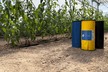
Closed-loop IPM relies heavily on monitoring infrastructure. Sticky traps remain standard, offering a low-cost and reliable way to detect flying pests. Trap and banker plants provide additional resolution, although their legality in cannabis remains inconsistent.
"Banker plants weren't previously allowed in cannabis cultivation," says Anoo. "In tomatoes and other food crops, banker plants are standard. In cannabis, their acceptance depends on the auditor and the facility's QA team." Outdoors, trap plants are generally permitted, but indoors, be prepared to stumble upon some regulatory walls.
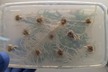
Aphid banker plants illustrate their potential. By cultivating cereal plants such as wheat, barley, oats, etc., strategically infested with a non-pest aphid, typically the bird cherry-oat aphid (Rhopalosiphum padi) as these do not harm greenhouse crops, growers can sustain populations of Aphidius parasitoid wasps: tiny, non-allergenic insects that naturally suppress cannabis-targeting aphids. With banker plants in place, these wasps breed within the facility, creating an endemic population and sparing the grower the repeated cost of purchasing new wasps. "It's a self-sustaining biological control system," Anoo explains, "and one that could dramatically reduce chemical dependency." Important to note, they are very small, and do not attack humans, so all wasp fearing growers can feel safe among their plants.
Main cannabis enemies (or best friends)
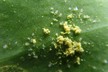
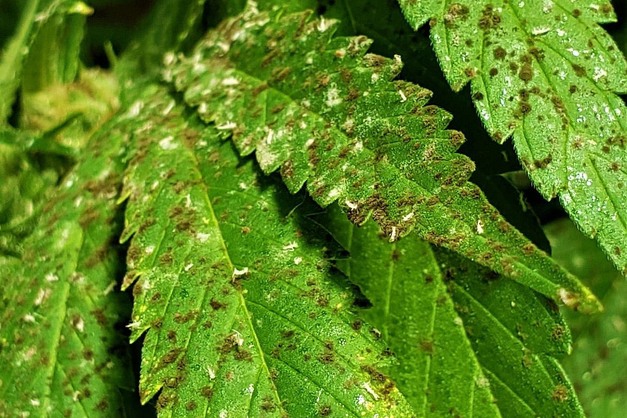
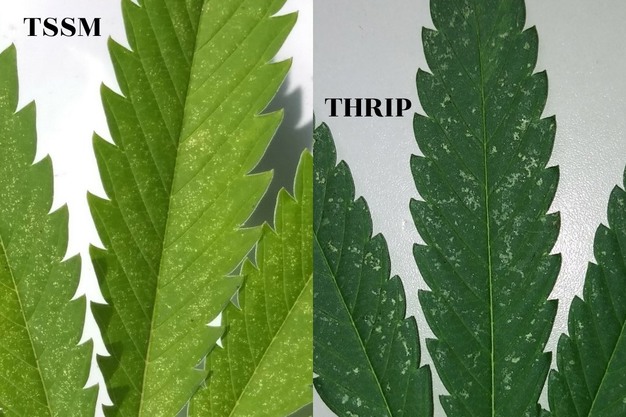
Cannabis IPM programs must be designed with several key pests in mind. The two-spotted spider mite (TSSM) is among the most common pest. TSSM leaves distinctive webbing across cannabis plants, but scouting should focus on the fine pin-prick stippling marks where the mites pierce the leaves with their stylet to suck out sap. Underneath the leaves, one will find not only adults but also eggs and nymphs, creating a layered infestation. "It looks like sand under the leaf surface," Anoo notes, "and the leaves appear dirty."
 © CannaProtectIPM
Thrip are another major pest, but they behave differently. Instead of hiding under leaves like spider mites, they move quickly across the surface, darting out of sight when disturbed. Their feeding leaves silvery stippling and scratch-like scars. Visual scouting of the upper leaf surface is key to identifying them.
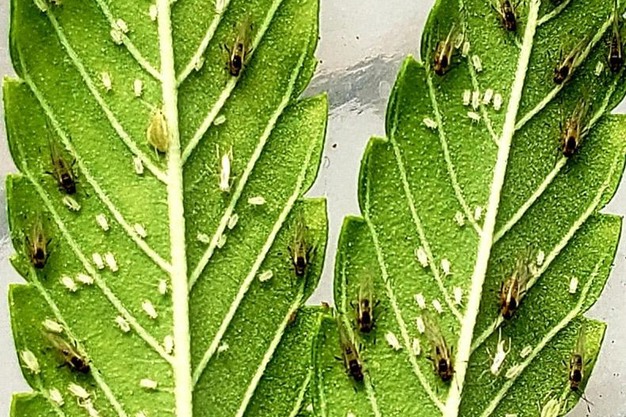
Aphids represent a dual threat. Stronger aphids tend to dominate the stems, feeding directly on vascular fluids of the xylem and phloem, while weaker individuals are pushed onto flowers and leaves, where they also remain close to the heat source of grow lights. Scouting must therefore cover both sites. Their feeding activity produces sticky honeydew, which not only signals infestation but also creates ideal conditions for secondary pathogens like sooty-mold. Left unchecked, aphids reproduce at extraordinary rates, quickly overwhelming a crop. In heavy infestations, paper-like aphid exoskeletons are often seen on the plant material.
 © CannaProtectIPM
Caterpillars may appear more sporadically, chewing randomly across leaves. Outdoors, their presence is especially problematic, but legal treatment options vary by jurisdiction. Growers must always check what is currently permitted under Health Canada's product list.
The real danger of pest infestations is that they rarely act in isolation. Aphid honeydew, for example, often fuels outbreaks of sooty- mold, creating what Anoo calls "the perfect pathogen triangle." Sugary residues provide a food source for mold, and the microclimate inside the plant canopy ensures ideal conditions for growth.
The Hop Latent Viroid case
While fungal pathogens can devastate yields, few threats match the silent danger of Hop Latent Viroid (HpLVd). Unlike powdery mildew or Botrytis, HpLVd is invisible until late in the cycle, when buds appear smaller, slightly yellowed, or simply "off."
"There's still no chemical treatment for HpLVd," Anoo says. "Sanitation protocols are the most important. Tissue culture can reduce infection rates, and precision breeding is critical for clean genetics." PCR testing is the only reliable diagnostic tool, since untrained and trained eyes alike often miss the subtle symptoms.
The viroid spreads primarily through contamination and root-to-root contact. Once inside a facility, eradication is nearly impossible. "The only way to ensure protection is to start clean and stay clean," Anoo stresses. That means implementing strict sanitation measures from the earliest stages and maintaining them throughout the crop's life cycle.
 © CannaProtectIPM
Building IPM into the business model
Closed-loop IPM is not only a plant health strategy; it is also an economic strategy. "Preventative programs launched early in the crop cycle keep pests and pathogens below threshold, which reduces the need for emergency interventions later. This translates into direct cost savings, more efficient use of labor, and less crop loss," Anoo points out.
Preventative measures also serve as a training tool. "Staff members involved in scouting and monitoring become more adept at recognizing subtle signs of pest activity, raising the overall expertise of the cultivation team without requiring extensive external training programs."
"In this economy, cost efficiency is everything," Anoo concludes. "Closed-loop IPM is the only way to stay competitive while protecting the crop. It reduces reliance on chemicals, streamlines labor, and ensures that growers always know exactly what is happening in their facility."
For more information:
CannaProtect IPM Solutions
Ridgeway, Ontario, Canada
905-320-8482
[email protected]
cannaprotectipm.com