


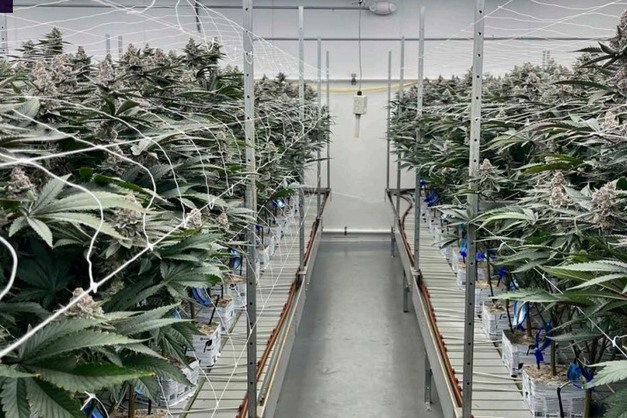
At scale, simplicity is not a preference. It is a requirement. M.I. Jane does not chase trends or stack inputs for the sake of complexity. The team believes quality shows up most clearly when unnecessary variables are removed and the system behaves the same way every run. Across two indoor cannabis cultivation facilities in Warren, Michigan, M.I. Jane manages roughly 14,000 cannabis plants. At that size, success does not come from constant adjustment. It comes from a system you can trust. That philosophy ultimately aligned M.I. Jane with partners like Grodan. Not because the operation needed fixing, but because as consistency becomes essential, every foundation has to perform as predictably as everything built on top of it.
"At this point, I'm figuring out what's not needed and cutting things out of your grow cycle," says Dustin Meckes, Head of Cultivation, M.I. Jane.
 © Grodan BV
When consistency becomes essential
As they scaled, efficiency became less about cost and more about clarity. Every unnecessary step introduced noise into a system designed to run clean. Across both facilities, the team operates at roughly one worker per 1,000 plants. That efficiency comes from simplifying the work itself, removing steps that do not directly improve plant performance. As Dustin Meckes, Head of Cultivation at M.I. Jane, puts it, "We don't need 10 to 15 part nutrient recipes. It's a plant. We've been cultivating plants for thousands of years."
That same thinking carried into irrigation decisions as plant counts increased. Variability elsewhere in the grow became harder to justify. Uneven hydration, inconsistent drybacks, and the labor burden of large pots added friction to a system built for repeatability. At that point, attention shifted naturally to the root zone. Continuing with soil and coco no longer made sense for an operation that needed an inert, repeatable stone wool growing media to support consistent execution.
Why Grodan fit
Ultimately, the decision was not about fixing a problem. It was about aligning the root zone with how the operation already functioned. After years in soil and coco, the team standardized on Grodan Starter Plugs and Improved Jumbo Blocks to support long-cycle crops and large plant counts. Within M.I. Jane's system, the stone wool substrate behaved predictably, delivering uniform saturation and consistent drybacks across rooms.
"Cleanliness is huge," Dustin notes. "You're not dealing with coco in every corner, and you're not worrying about pathogens building up over time." With fewer unknowns in the root zone, irrigation decisions became more repeatable and easier to trust.
Letting genetics lead
The team runs in-house phenohunts inside the same systems they will ultimately run in production. Cultivars are selected based on how they perform in M.I. Jane's environment, not in a tent, a different facility, or someone else's grow. "If someone hunts a pheno in a tent or outdoors, it might not work in my grow," Dustin explains. "But if you hunt for the right pheno in your system, you're going to get a better result."
That thinking drives M.I. Jane's preference for monocropping. Fewer cultivars mean fewer variables, making it easier to dial in irrigation and environmental strategies room to room. That level of consistency made execution easier to repeat, not because standards dropped, but because there was less to manage in real time.
What changed in the grow
One of the early questions around stone wool was how aggressively it could be dried back, but in practice the team quickly found the media responsive and easy to manage within their existing irrigation philosophy. "People are nervous about drying them out too much," Dustin says. "But that really hasn't been our experience." Paired with Growlink fertigation controllers, M.I. Jane shifted toward smaller, more intentional irrigation events. Multishot strategies replaced large corrective shots, supporting predictable drybacks and more consistent plant response.
Operational improvements followed quickly. Potting days were eliminated. Room resets became cleaner and faster. Instead of managing media variability, the team could spend more time executing the grow itself.
A true partnership
Throughout the transition, M.I. Jane worked closely with the Grodan team. The goal was not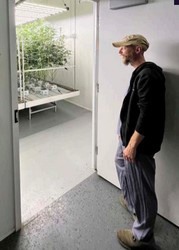 © Grodan BV reinvention. It was validation. Conversations stayed focused on how the root zone was behaving inside their environment, how irrigation strategies were landing, and whether the system would continue to perform as the operation scaled. No extra steps. No sales pitch. Just pressure testing decisions against real conditions. For Dustin, that approach mattered. With Grodan, "it feels more like a partnership, not like a sales pitch."
Refinement over noise
M.I. Jane's work going forward is not about changing the system. It is about continuing to refine it. With a consistent, inert root zone in place, the focus stays on execution — advancing in-house phenohunting, tightening irrigation strategies, and maintaining repeatability as the operation evolves. When the foundation behaves predictably, progress becomes incremental and intentional.
"Once you cut out what's not needed," Dustin says, "the system starts working for you." By removing friction from the root zone and simplifying day-to-day decisions, M.I. Jane has built a platform that supports steady improvement. Not louder. Not more complicated. Just a system that does its job, run after run, so quality can do the rest.
For more information:
Grodan
T +31 47 53 53 535
www.grodan.com