

A $1 million grant from the Campbell Foundation is funding a first-of-its-kind study aimed at helping cannabis farmers reduce costs, lower environmental impacts, and produce cleaner, more sustainable products.
Over the next two years, researchers from Cal Poly Humboldt and Chico State will partner with farmers in six California counties—Humboldt, Trinity, Mendocino, Sonoma, Nevada, and Santa Cruz—to study regenerative agricultural practices. These approaches focus on improving soil health and biodiversity through techniques such as cover cropping, increasing soil organic matter to retain water, and attracting beneficial insects for natural pest control.
The research will determine how much these practices reduce the need for water, fertilizers, and pesticides—potentially lowering costs for farmers while improving environmental outcomes, explains Dan Mar, lead researcher and faculty member in the Cannabis Studies program at Cal Poly Humboldt.
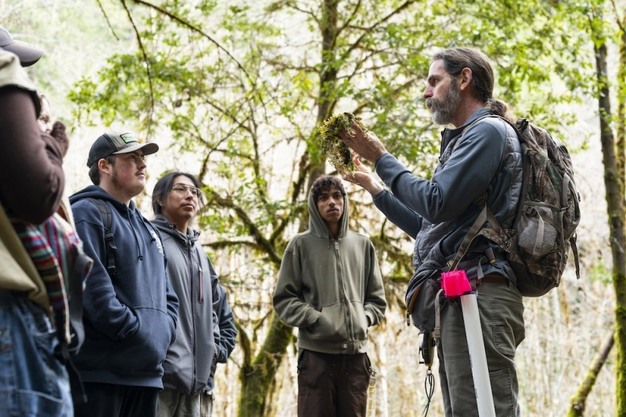 © Cal Poly HumboldtCannabis Studies Instructor Dan Mar and students visit a local watershed as part of the Cannabis Studies program's cannabis and regenerative agriculture course
"Many farming practices are described as sustainable or regenerative. But there's still limited scientific data about them in cannabis cultivation," Mar says. "This project will help us understand what works, from water and nutrient use to soil health, and what those practices mean for farmers economically."
"Ultimately, ecological practices can also be economical," Mar says. "By showing which methods are good for the land and the bottom line, this project could help build a more sustainable cannabis industry—benefiting farmers, consumers, and local ecosystems."
For consumers, the research may provide greater transparency and higher-quality products. Mar also hopes the data will inform future policies and create more equitable conditions for cannabis farmers.
One of the project's main goals is to create a Cannabis Farm Assessment Protocol—a tool developed in collaboration with farmers to evaluate their practices and help other farmers adopt more sustainable ones.
"We are excited to learn from the hard-earned experiences and knowledge these farmers have while working together to build a path forward that not only makes their operations more holistic, but also demonstrates the role of stewardship as a foundation of sustainable farms and local communities," says Soil Science Professor Garrett C. Liles, co-founder of the Center for Regenerative Agriculture & Resilient Systems at Chico State and researcher on the project.
The study will also explore the historical and cultural dimensions of cannabis farming in Northern California by documenting farmers' knowledge and experiences in a region long associated with the crop.
"This is all about collaboration," says William Nitzky, Anthropology professor at Chico State and one of the study's researchers. "What makes this project unique is that we are conducting interdisciplinary work across agriculture, the natural sciences, and the social sciences, together with farmers."
"By documenting their experience and knowledge about the region, growing strategies and systems, risks and challenges, and innovations, we're preserving an important cultural story about how this industry developed and continues to evolve," says Nitzky. "Bringing together farmer knowledge and scientific research can help shape a more equitable and sustainable future for the cannabis industry in California and beyond."
Source: News Wise