

 © DryGair
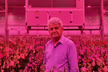
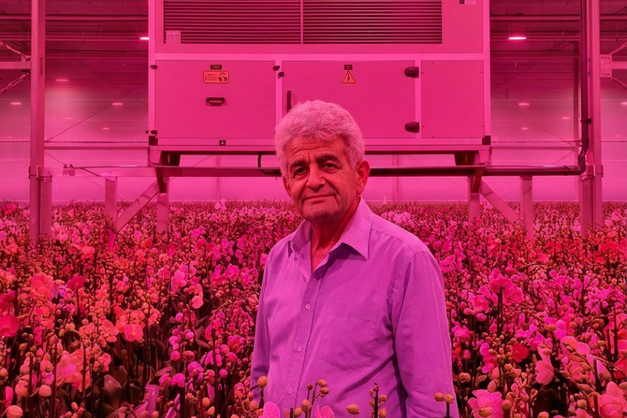
The transition to LED lighting is altering greenhouse climate dynamics, particularly in relation to humidity, plant activity, and energy use. According to Avraham Arbel, greenhouse climate engineer and developer of the DryGair closed-loop dehumidification system, growers need to adjust climate control strategies to address these changes.
"For over 40 years, I've focused on one key challenge: how to balance energy efficiency with optimal plant conditions," Avraham says. He explains that traditional greenhouse climate control relies on ventilation, which removes moisture but also leads to energy loss. During his work at the Volcani Center, he identified this dependency as a structural limitation in greenhouse systems. This led to the development of a closed-loop dehumidification method in 2010, aimed at controlling humidity without relying on ventilation.
 © DryGair
Shift to LED
The ongoing shift from high-pressure sodium (HPS) lighting to LED systems is introducing new climate-related effects. "Many growers focus on energy savings – but overlook the climate impact," Avraham says. LEDs emit less radiant heat than HPS lamps, which results in lower leaf temperatures and reduced transpiration. Plants release less moisture into the greenhouse air, altering humidity balance.
According to Avraham, this change leads to higher relative humidity levels, increased risk of condensation, and reduced plant activity. Nutrient uptake can slow down, particularly during nighttime or lights-off periods, when temperature and moisture dynamics become more pronounced.
"Humidity is not just a number—it's a chain reaction," he says. Elevated humidity levels are associated with increased disease pressure, including botrytis and powdery mildew. Biological pest control can become less effective under these conditions. Additional effects include softer plant growth, delayed harvest cycles, and changes in crop quality.
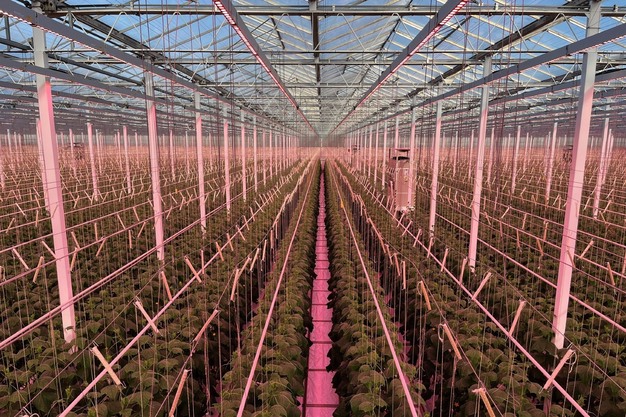
Vegetable crops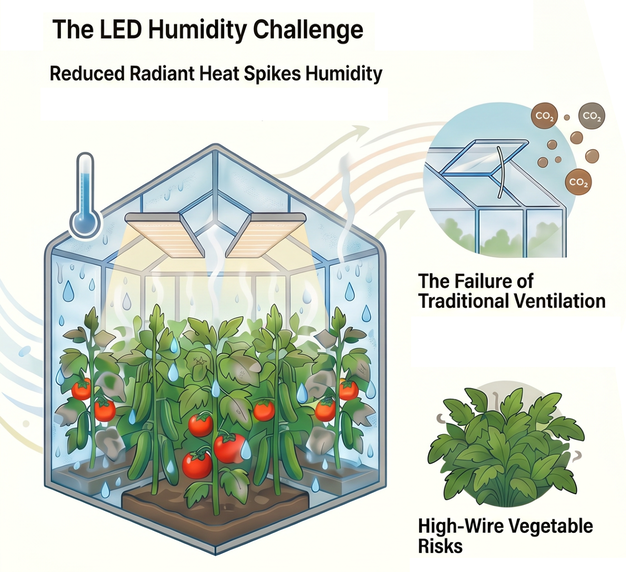 © DryGairThe impact is more pronounced in vegetable crops. "In vegetable crops, the risk is even greater due to dense canopies and high transpiration rates," Avraham explains. These factors contribute to complex humidity patterns within the crop, making uniform climate control more difficult.
Ventilation, traditionally used to manage humidity, is becoming less effective in energy-efficient greenhouse systems. "When you open vents, you don't just remove moisture – you also lose valuable heat, reduce CO₂ levels, and increase heating demand," Avraham says. This leads to less stable climate conditions and higher energy consumption. He describes ventilation in modern greenhouses as a compromise rather than a solution.
Crop type plays a role in the extent of the challenge. High-wire vegetable crops such as tomatoes and cucumbers are more affected due to their structure and growth characteristics. "Dense plant structures limit airflow, and high transpiration rates increase humidity levels," Avraham says. In closed environments, this can lead to the formation of microclimates within the canopy, increasing the likelihood of disease and variability in crop performance.
 © DryGair
Closed greenhouse environments
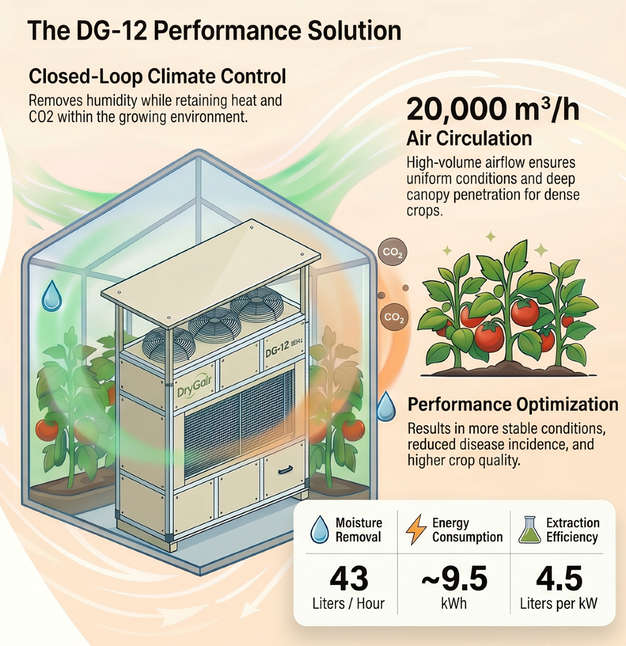
To address these conditions, new dehumidification systems are being developed for integration into closed greenhouse environments. Avraham refers to a new unit designed for high-density vegetable production, with a moisture removal capacity of up to 43 liters per hour and energy use of approximately 9.5 kWh. The system is designed to maintain airflow of around 20,000 cubic meters per hour and operate within closed greenhouse conditions to retain heat and CO₂ while removing moisture.
"The key is operating in a closed environment – removing humidity while retaining heat and CO₂," he says. This approach aims to stabilize climate conditions without relying on ventilation.
According to Avraham, growers using controlled dehumidification systems report more stable climate conditions, reduced disease incidence, and changes in plant activity. "When humidity is properly controlled, everything improves," he says, referring to yield and crop quality observations under these conditions. "The transition to LED lighting is increasing the need for alternative humidity control strategies, particularly in closed greenhouse systems where ventilation is minimized."
 © DryGair
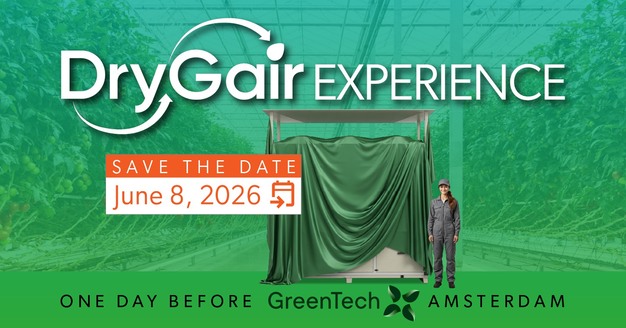
If you would like to see the new DG-12 50Hz unit in action, DryGair is inviting you to the DryGair Experience, held one day before GreenTech. This is a unique opportunity to see the dehumidifier operating within a trial greenhouse and experience its impact firsthand.
For more information:
DryGair
https://drygair.com/