

The first quarter of 2026 arrived with a federal tailwind, medical cannabis rescheduled to Schedule III under the Controlled Substances Act, but the underlying economics of state-licensed cannabis remained uneven, with the largest operators generating solid cash and the smallest still fighting for margin in compressed markets.
Green Thumb Industries: $300 million and cash to spend
Green Thumb Industries, the Chicago-based company that manufactures brands including RYTHM and Dogwalkers and operates the RISE dispensary chain, posted Q1 revenue of $300.2 million, up 7.4% from the same quarter last year. It earned a GAAP net income of $15.4 million, meaning after all costs, taxes, and interest were paid, the company made money. Cash at quarter end sat at $344.5 million.
Growth came mainly from its Minnesota stores, which began adult-use sales in September 2025, and continued strong performance in Connecticut and Florida. Prices continue to fall across the industry and competition is intensifying: Green Thumb's gross margin, the share of revenue left after production costs, dropped from 51.3% to 47.9% year-over-year.
Ben Kovler, Green Thumb Founder, Chairman, and Chief Executive Officer, said: "The recent federal action to reschedule medical cannabis from Schedule I to Schedule III is a historic step forward for our business, for investors, and for the country. Our conviction in Green Thumb remains as strong as ever, as reflected in the approximately 13.4 million shares we have repurchased so far this year."
Rescheduling removes a specific federal tax provision known as 280E that had barred cannabis companies from deducting normal business expenses. President Anthony Georgiadis said: "With medical cannabis now rescheduled, the resulting Section 280E relief for the medical portion of our business creates meaningful flexibility to reinvest in our operations, our people, and the communities we serve."
Green Thumb also disclosed DEA registration applications submitted following rescheduling and a conditional Texas Compassionate Use Program license awarded after quarter end.
Trulieve: The largest gross margin in the group
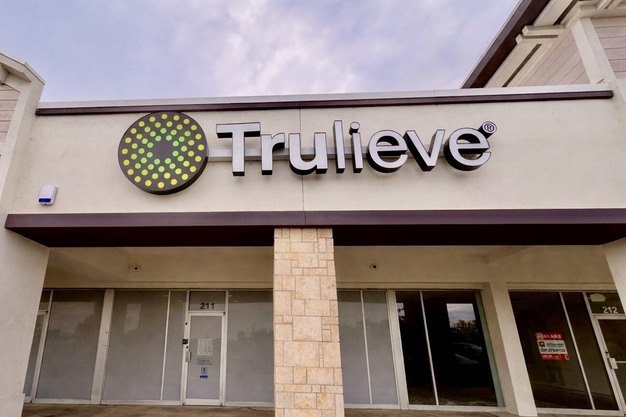
Trulieve Cannabis Corp., a Florida-anchored operator running 240 dispensaries and over four million square feet of cultivation and processing capacity, reported Q1 revenue of $287 million with a 59% gross margin, the strongest of any company in this earnings batch. It posted positive net income of $2 million and adjusted EBITDA of $100 million, generating $56 million in cash from operations. A year ago, Trulieve reported a net loss of $33 million.
 © Trulieve
Revenue was down 4% from the same quarter in 2025 and adjusted EBITDA declined 8%, reflecting continued softness across state markets.
Kim Rivers, Trulieve CEO, said: "We applaud President Trump and AG Blanche for taking bold, decisive action to reclassify medical marijuana to Schedule III. With 206 dispensaries and over 3.5 million square feet of production serving medical patients, Trulieve is well positioned to explore new opportunities enabled by rescheduling." The company filed DEA registration applications for all 206 qualifying retail locations.
TerrAscend: Positive cash flow for 15 straight quarters
TerrAscend, which operates in Pennsylvania, New Jersey, Maryland, Ohio, and California, reported Q1 net revenue of $65.5 million, up 1.9% year-over-year. Gross margin came in at 52.8%. The company posted a GAAP net loss of $6.8 million but generated $8.7 million in operating cash flow and $7.8 million in free cash flow, marking 15 consecutive quarters of positive operating cash and 11 consecutive quarters of positive free cash flow. That distinction matters: a company can report a net loss on paper while still consistently converting its operations into real cash, which is what TerrAscend has done through 2025 and into this year.
Jason Wild, Executive Chairman of TerrAscend, said: "The decision by the U.S. Department of Justice to reclassify state-licensed medical cannabis to Schedule III is a historic step forward that has resulted in the elimination of the 280E tax burden. In addition, we believe the anticipated rescheduling of adult-use cannabis in the coming months will further expand access to institutional capital and provide TerrAscend with an opportunity to up-list to the NASDAQ or NYSE."
LEEF Brands: Doubling margins in California
LEEF Brands, a California and New York extraction and manufacturing company, reported Q1 revenue of $9.4 million, flat year-over-year, but doubled its gross margin from 22% to 49% and swung from an adjusted EBITDA loss of $780,000 to a profit of $2.4 million. Unit volumes grew 60% even as per-gram prices fell, and the margin improvement came from expanding use of in-house biomass at Salisbury Canyon Ranch and scaling up higher-margin hydrocarbon extraction lines.
Kevin Wilson, Chief Financial Officer of LEEF Brands, said: "Per-gram pricing in California continues to compress, yet we grew unit volumes by 60% on our core extraction lines and expanded gross margin to 49%. The cost structure we've built, anchored by in-house biomass from Salisbury Canyon Ranch, would produce significantly stronger economics in any other state. The fact that it's working in California is what gives us confidence in the platform we're building and ensures we're ready for federal reform."
Micah Anderson, Chief Executive Officer of LEEF Brands, said: "As we scale Salisbury Canyon Ranch toward its full 180-acre permitted capacity by year-end and continue integrating our platform, we see a significant opportunity to expand into higher-value channels, including interstate and global export. We have engaged Shane Pennington, a leading expert on DEA licensing, and have submitted applications for multiple DEA licenses." On April 28, LEEF announced the acquisition of Himalaya, a California concentrates brand, to add retail margin alongside its wholesale business.
NewLake Capital: The landlord's view
NewLake Capital Partners, a real estate investment trust that owns 34 cannabis properties leased to operators under long-term agreements, reported Q1 revenue of $12.3 million, down 6.8% from a year ago. Three properties in Pennsylvania, Nevada, and Massachusetts remained vacant following tenant departures in 2025. Net income for the quarter was $5.8 million. The company collected 100% of contractual rent across its occupied portfolio.
One tenant, The Cannabist Company, entered restructuring proceedings in March 2026. NewLake owns four properties leased to Cannabist in Illinois and Massachusetts and confirmed it collected full rent from all four during the quarter.
Anthony Coniglio, NewLake's President and Chief Executive Officer, said: "The rescheduling of medical cannabis represents a historic shift in the federal government's approach and is a pivotal moment for the industry. While implementation will take time and further guidance is needed from federal authorities, we believe increased regulatory clarity marks an important step forward and has the potential to strengthen the operating environment for our tenants."
The throughline across all five companies is that rescheduling has already changed the tax calculus, with 280E relief on medical operations real and immediate, while broader structural questions around pricing, competition, and access to institutional capital remain unresolved.