

Most of the decisions that determine whether a cannabis cultivation facility performs well or poorly are made during design and planning, long before operations begin. That was the central argument of a recent webinar by Pipp Horticulture, where three experienced operators walked through the design and operational errors they see most frequently, and what they cost.
The panel featured Michael Williamson, co-founder of Greenhouse Industries, which was acquired by Pipp in 2017, with over 40,000 hours of hands-on cultivation experience and involvement in the design and commissioning of more than seven million square feet of facilities globally; Mike Lent of Klutch Cannabis, one of Ohio's leading operators; and Brent Barnes of Clayborn Co., a vertically integrated California operator with a background in plant breeding and post-harvest.
 © Klutch Cannabis
HVAC and airflow
HVAC obviously was one of the main topics. The core problem the panelists described is a mismatch between the static assumptions engineers use when sizing systems and the dynamic biological reality of a flowering cannabis room. Transpiration is not constant, Michael noted, for instance. A high-performing cultivar under high light intensity can transpire two to three times more than a conservative model assumes, and as canopy fills in over the growth cycle, the ability to remove moisture from the air decreases. Systems that look adequate on paper are sized for average conditions, not peak latent load, which arrives mid to late flower when transpiration is at its highest and humidity starts to drift. By that point, Michael said, operators are no longer controlling their environment, and are just left reacting to what's thrown at them.
Mike added that the misalignment often traces back to the early design phase, when cultivation strategy has not been clearly defined with the engineers making the key inputs. A new grower coming in and increasing plant count, for example, puts more substrate in the room, more water-holding capacity, and more moisture that needs to be removed, none of which may have been accounted for in the original system design. The timing of irrigation compounds it further: if watering happens across a 12-hour window, the system needs to be designed to pull that moisture out within the same period, not over 24 hours.
Brent pointed to airflow as the variable most commonly underestimated in relation to HVAC performance. Adequate tonnage means nothing if air distribution is uneven. Without intentional airflow across and through a dense canopy, microclimates develop, temperature and humidity can swing by 10 degrees or 10 percentage points within the same room, and the HVAC equipment cannot do its job regardless of its capacity. Laminar airflow through long bench runs, he argued, is one of the most important and most overlooked factors in achieving environmental uniformity. Mike further elaborated on this point with a practical example. When airflow is right, it creates a swamp cooling effect through the canopy that actually increases transpiration rates and nutrient absorption, improving plant performance while also helping the mechanical system run more efficiently.
On the question of whether operational discipline can compensate for undersized HVAC, the answer from all three was qualified at best. There are levers to pull, running a drier irrigation strategy, slowing blower speed to increase moisture contact across coils, adjusting planting density, but each comes at a cost to yield or consistency, and all of them are defensive moves rather than performance strategies. Michael explains that if the infrastructure is not aligned with the actual biological demand of the plants, the team is managing constraints, not optimizing a system.
 © Klutch Cannabis
Energy
Power was the second major topic, and one of the areas where Michael has seen the most serious and avoidable damage done to projects. The problem is almost always the same. That is, power is assumed rather than validated. When someone tells him a building has plenty of power, he said, his immediate response is to ask for the actual numbers, because a vague assurance is already a warning sign. The real demand only becomes clear when HVAC, dehumidification, lighting, irrigation controls, and ancillary loads are all layered in together, at which point the numbers are almost always higher than anticipated. In multi-phase buildouts, future expansion is frequently not accounted for at all. The consequences arrive during design, construction, or commissioning, when the project is already committed and options are limited. A best-case scenario means value engineering and compromised equipment. A more common scenario involves utility upgrades, new transformers, and new switchgear that can add months or years to a timeline that was never budgeted to accommodate them. Lent added that equipment draws more power in summer, when compressors run harder under heat load, and that demand can increase by as much as 30% seasonally, a variable that load studies need to account for.
Floors and drainage generated equal conviction. Michael's non-negotiables were flat, level floors for multi-tier mobile systems, a six-inch taper toward trench drains on each side to prevent pooling from irrigation runoff, and urethane cement sealing over standard epoxy, which handles moisture vapor and temperature swings without peeling or cracking over time. Mike emphasized sanitation drains as a requirement that operators only fully appreciate the first time they have to move 100 gallons of water by hand. The placement of trench drains relative to racking layouts was flagged as a detail that causes persistent problems when it is not caught early. To put it bluntly, standing water creates ideal conditions for pythium, fusarium, and biofilm growth, and poorly placed drains that are hard to access simply do not get cleaned. Michael described pulling up drain trenches during facility audits to find rooms that looked spotless, with drains full of plant material, algae, and fungus gnats.
Space optimization and verticality
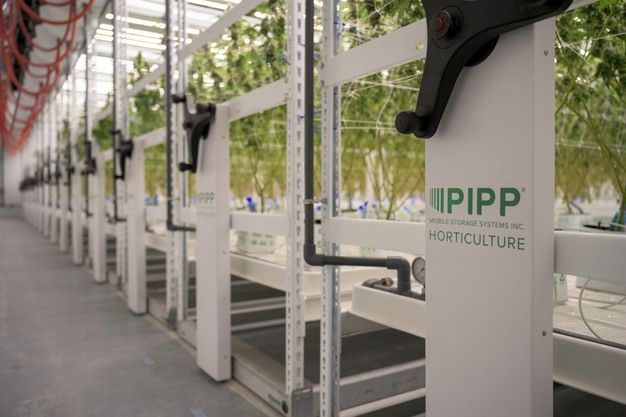
Space planning and vertical are obviously the bread and butter of Pipp Horticulture. In multi-tier systems, the overhead space gets consumed quickly by ducting, fire suppression, structural elements, and electrical pathways, and the losses add up faster than most designs anticipate. Barnes described the compounding effect: a duct here, a strut there, an electrical bus, and suddenly you are losing feet, not inches, from the usable height of a racking system. Fire code also varies by state, and sprinkler head clearance requirements that work in one market may eat into rack heights in another. The solution, both Brent and Mike agreed, is to go through every detail of overhead infrastructure before committing to rack heights, and to involve fire protection engineers and mechanical engineers early in the process rather than after the structural decisions have been made.
Aisle width was treated as a direct proxy for operational efficiency. Brent and Michael both cited 30 to 36 inches as the practical minimum for a single working aisle in a flower room, the point below which labor workflow starts to break down. Larger rooms benefit from planning for 60 to 72 inches of total mobile aisle to allow two independent working aisles, and 90 to 108 for three. The defoliation process was cited as the task most sensitive to aisle access, particularly when operating on a 12-and-12 light schedule that limits the available window for room entry. Lent noted that loading a room with 2,000 plants and completing the associated canopy work in a single shift across multiple tiers requires more aisle space than most designs provide.
 © Klutch Cannabis
The post-harvest section surfaced a structural misalignment that the panelists described as one of the most consistently underplanned areas in cannabis facility design. Cultivation gets the attention and the capital; drying, trimming, packaging, and work-in-progress space get what is left over. Michael described the downstream consequence: a facility that can grow more than it can process, with harvest bottlenecks, delayed sellable output, and limited consistency. The fix, he argued, is to treat the cultivation-to-post-harvest transition as a controlled system rather than a handoff, with pre-harvest walkthroughs between the cultivation and post-harvest teams, aligned KPIs, and enough dedicated whip space and cure room capacity to absorb variability in harvest timing and batch size without disrupting flow. Barnes added that SOPs are the most important operational document a cultivation facility can have, and that every member of the team should have a hand in writing and revising them.
Expansion planning closed the webinar, and the failure mode the panelists described was a familiar one: facilities designed for day one with no structural provision for what comes next. Conduit runs, roof load capacity for additional HVAC units, corridor width for pallet movement at scale, and post-harvest space all need to be sized for the future state of the business, not just its current one. The cost to retrofit an operating facility, Brent noted, is almost always higher than the cost of building it right the first time, and the options available once cultivation is running are limited to shutting down space or building out.
For more information:
Pipp Horticulture
[email protected]
www.pipphorticulture.com